
If your rooftop space is narrow or contains columns, equipment, and service paths that prevent the installation of a standard ready-made tank, the solution is not simply to buy the smallest tank available. A custom GRP water tank in Kuwait can be designed around the available space and required storage capacity, provided that the installation location, supporting base, maintenance access, and water connections are all suitable. Arabic Orchid currently offers custom GRP tanks designed according to rooftop dimensions, with published capacities ranging from 600 to 10,000 gallons. For that reason, the correct choice begins with measuring the location and understanding actual water consumption before deciding on the final tank shape and dimensions.
GRP Water Tank Kuwait

People searching for a GRP water tank in Kuwait often start looking after discovering that a standard tank does not fit the intended installation area. The available space may be short and wide, long and narrow, or divided by a stairwell, air-conditioning units, water heaters, pumps, or existing water pipes.
GRP is a glass-fiber-reinforced composite material used to manufacture water tanks in configurations that can offer greater flexibility in dimensions than some ready-made tanks with fixed sizes.
The main advantage here is not simply the material itself, but the ability to adapt the tank design to the available space.
When Is a GRP Tank a Practical Option?
A GRP tank is worth considering when:
-
The rooftop does not have enough space for a large circular or standard tank.
-
You need a specific storage capacity but do not have a suitable area for a conventional tank.
-
Several obstacles surround the proposed installation location.
-
You want to make better use of a rectangular space or a particular corner.
-
You need a tank for a house, villa, apartment building, or commercial property.
-
You want to plan the tank location together with pumps, heaters, and the rest of the water system.
According to Arabic Orchid’s current service description, custom GRP tanks are available in capacities from 600 to 10,000 gallons depending on the available space, while its tank services can also include connections to float valves, water networks, and water-heating systems according to the needs of the installation.
Is the Largest Tank Always the Best?
Not necessarily.
Tank capacity should be selected according to actual water consumption, available space, and the load that the installation location can safely support.
Every gallon of water adds weight, so choosing a tank larger than necessary should not be based only on whether there is enough physical space for it.
This is particularly important on rooftops. The tank location and supporting base must be suitable for the intended capacity, and a qualified structural professional should be consulted whenever the structural load requires assessment.
A good tank is one that provides the required storage capacity without creating problems with access, maintenance, or load distribution.
Custom-Made Water Tank to Order
The idea of a custom-made water tank to order does not mean that the customer chooses a random length and width and the tank is immediately manufactured to those measurements.
Correct customization starts with the actual requirement.
The first step is to determine how much water needs to be stored. The available space is then assessed to identify dimensions that can provide the required capacity in a practical way.
What Information Is Needed for a Custom Tank?
Before approving the dimensions, it is useful to know:
-
Available length
-
Available width
-
Maximum permitted height
-
Locations of columns and walls
-
Existing pipe locations
-
Air-conditioning units, heaters, or pumps in the area
-
Rooftop service paths
-
Water inlet and outlet locations
-
Drainage or cleaning access
-
Whether the tank can still be reached after installation
One common mistake is designing the tank to occupy every available centimeter and leaving technicians without enough room for future inspection or maintenance.
Which Is More Important: Capacity or Dimensions?
Both are connected.
A customer may say, “I want the largest tank that can fit here,” but it is usually better to determine the required storage capacity first.
If household consumption can be served by a particular capacity, significantly increasing tank size may use rooftop space that is needed for other equipment.
On the other hand, reducing storage capacity simply to fit a standard tank may result in inadequate water reserves during periods of heavy consumption.
A custom tank therefore makes it possible to balance dimensions, capacity, and actual use.
Uses of a Custom GRP Tank
Common uses for custom GRP tanks include:
-
Villas
-
Multi-story houses
-
Apartment buildings
-
Offices
-
Commercial facilities
-
Buildings requiring more than one tank
-
Rooftops with irregular layouts
-
Locations where bringing in a large pre-manufactured tank is difficult
The important point is that the tank type and components should be appropriate for the intended water use.
GRP Water Tank for Rooftops

Choosing a GRP water tank for rooftops requires more than confirming that the tank physically fits in the available space.
Once filled, the tank becomes a significant load, so its location and the way that load is transferred to the supporting base are important considerations.
Any rooftop design should take the structural condition of the location into account from the beginning, particularly when larger capacities are involved.
Check Four Things Before Installation
First: Tank Base
The surface supporting the tank should be suitable for its design and should provide level, stable support according to the installation requirements.
Using an unsuitable base may affect the stability or structure of the tank.
Second: Access
Ask how the tank components or sections will be brought to the installation location.
One practical advantage of some custom GRP tanks is that they can be used in locations where bringing in one large ready-made tank would be difficult. However, the access route should still be checked before work begins.
Third: Connections
The locations of the water inlet, outlet, float valve, and pump connection should be established before assembly.
Changing outlet positions after installation because they were not planned properly can make the project more complicated.
Fourth: Maintenance
Do not trap the tank between walls and surrounding equipment.
Leave appropriate service access according to the design so that parts requiring inspection, cleaning, or maintenance can still be reached.
Rooftop Sun and Heat
Rooftops in Kuwait are exposed to intense summer heat.
For that reason, capacity should not be the only consideration. Tank location in relation to sunlight, insulation condition, and the route of external pipes should also be reviewed.
Even when the tank itself is suitable, exposed pipework can increase water temperature while the water travels through the system.
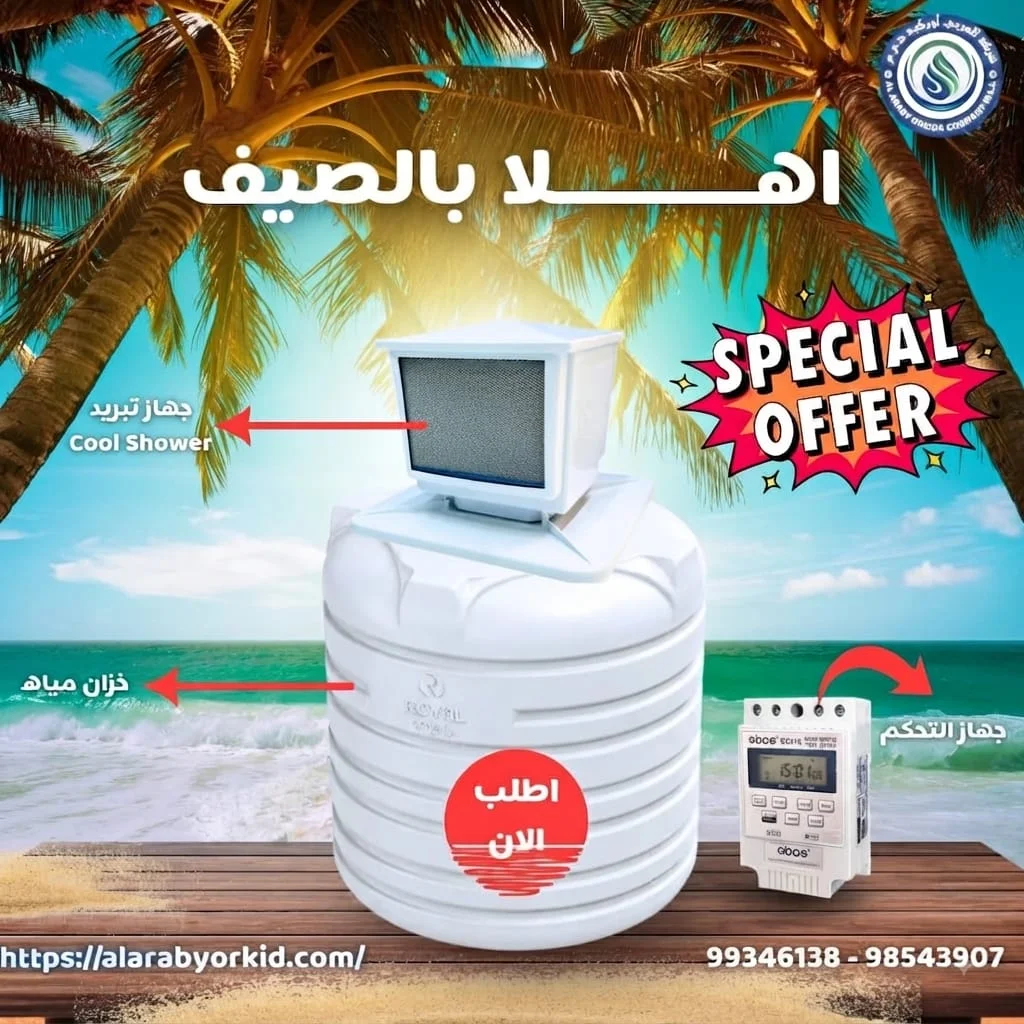
If the property also has a tank-cooling system, it is better to plan the tank, cooling equipment, circulation system, and pump as one complete water system rather than installing each component separately without coordination.
Water Tank for Nonstandard Dimensions
The need for a water tank for nonstandard dimensions usually appears when the shape of the available space is the problem, not simply its total area.
You may have enough square meters overall, but the layout may not suit a standard manufactured tank.
For example:
A long and narrow rooftop area.
A corner between two walls.
Space beside a stairwell.
An area between air-conditioning units.
Or a rooftop with several different levels.
This is where a custom design can become useful.
How Can the Space Be Used More Efficiently?
Instead of choosing a ready-made tank first and then trying to find somewhere to place it, reverse the process:
-
Measure the available space.
-
Identify all obstacles.
-
Determine the required storage capacity.
-
Identify areas that must remain open.
-
Select suitable tank dimensions.
-
Review all water connections.
-
Confirm that installation and future maintenance are practical.
This approach reduces the risk of discovering a major problem only after the tank has arrived at the property.
Do Not Turn Every Empty Area Into Tank Space
The fact that a rooftop area is empty does not automatically mean it is the correct location for a water tank.
You should consider:
-
Structural load
-
Access
-
Proximity to the water network
-
Whether the tank blocks other equipment
-
Whether service paths remain open
-
Whether leaks or future maintenance can be handled easily
For an apartment building or commercial facility, the tank becomes part of the overall water-system design rather than simply a way to fill unused rooftop space.
Can One Custom Tank Be Better Than Several Smaller Tanks?
Sometimes yes, and sometimes no.
One custom tank may use the available area more efficiently than several small ready-made tanks, but in other projects dividing storage between more than one tank may provide better operational or maintenance flexibility.
There is no universal rule.
The correct choice depends on required capacity, location, water network design, and how the property uses water.
Custom Water Tank Fabrication in Kuwait

A custom water tank fabrication service in Kuwait should begin with inspection and measurement rather than presenting the customer with a standard size.
The main reason for requesting a custom tank is that the location itself has special limitations.
What Happens From the Start of the Request?
A logical process includes:
1. Determine the Intended Use
Is the tank for a house, villa, apartment building, or commercial facility?
2. Determine Required Capacity
This should be based on the number of users and actual water-consumption patterns.
3. Measure the Location
Length, width, height, and obstacles are identified.
4. Review the Tank Position
Access, connections, maintenance space, and supporting base should all be considered.
5. Define the Tank Shape and Dimensions
The goal is to achieve the required capacity within the available space.
6. Review Inlets and Outlets
They should be compatible with the water network, pump, and float valve.
7. Manufacture and Install the Tank
Work is carried out according to the approved design.
8. Test the Connections
The installation is checked for proper operation and visible connection problems.
Why Arabic Orchid?
If you are searching for the best company for a custom GRP tank, do not rely only on the word “best” as an advertising statement.
Compare providers using clear criteria:
|
Comparison Criterion |
Why It Matters |
|
Site measurement |
Helps prevent choosing unsuitable dimensions |
|
Capacity selection |
Avoids buying a tank that is too small or unnecessarily large |
|
Clear specifications |
Helps you understand exactly what will be supplied |
|
Connection planning |
Reduces modifications after installation |
|
Water-network integration |
Important for pumps, heaters, and float valves |
|
Warranty terms |
Clarify post-installation responsibilities |
|
Maintenance access |
Keeps the tank serviceable in the future |
Arabic Orchid currently lists fiberglass, porcelain, and GRP tanks among its tank services, with custom GRP tanks available up to 10,000 gallons depending on rooftop space. The company also publishes a 10-year warranty on tanks according to the terms of the service offered.
GRP Water Tank for Villas
A GRP water tank for villas can be particularly useful when several different building services already occupy the rooftop.
You may have a central water heater, pump, filter, air-conditioning units, a water-cooling system, and a water tank all sharing the same area.
The remaining space therefore needs careful planning.
Instead of positioning every piece of equipment independently and then trying to find somewhere for the tank afterward, it is better to look at the rooftop as one complete service area.
What Tank Capacity Is Suitable for a Villa?
There is no single capacity that suits every villa.
The correct capacity depends on:
-
Number of household members
-
Number of bathrooms
-
Water-consumption habits
-
Domestic staff or annex accommodation
-
Number of floors
-
Reliability of the incoming water supply
-
Presence of a ground tank or additional tank
-
Available rooftop space
A large villa does not automatically need the largest possible tank, and a smaller property does not always have low consumption.
The real criteria are water demand and the required reserve.
One Tank or More Than One?
One tank can create a simpler arrangement, while multiple tanks can sometimes provide additional flexibility depending on the water-network design and available space.
If several tanks are selected, their filling, outlet connections, float valves, and hydraulic balance should be considered.
A custom tank may instead make it possible to obtain the required storage capacity in one specific area rather than dividing it among several standard tanks.
Connect the Tank Decision to the Rest of the System
If the villa uses a pressure pump, central water heater, or tank-cooling system, the tank outlets and location should be suitable for those components.
Treating the project as one coordinated water system reduces the need for improvised pipe modifications later.
Custom Water Tank for Available Space

A custom water tank for available space is a practical solution when the main priority is using a specific area efficiently without sacrificing the required storage capacity.
However, the word “custom” should involve more than the external shape.
True customization may include:
-
Tank dimensions
-
Capacity
-
Connection locations
-
Float-valve position
-
Pump requirements
-
Inspection access
-
Service-opening position according to the tank design
-
Clearance from surrounding equipment
Practical Example
Suppose you have enough width but limited length because of a rooftop stairwell. Tank dimensions can potentially be adjusted within the limits of the design instead of immediately moving to a tank with significantly lower capacity.
If height is limited because of a roof structure or equipment above the installation area, a different volume distribution can be considered.
However, all dimensional adjustments have to remain within a practical and structurally suitable tank design. Customization does not mean that every dimension can be changed without limits.
The Main Advantage of a Custom Tank
The main advantage is designing the tank around the available space instead of forcing the available space to accept the dimensions of a standard product.
This is particularly useful in Kuwait because the rooftop layouts of older and newer houses and villas can differ significantly.
What Information Should You Send Before the Site Visit?
To make the initial assessment easier, prepare:
-
A clear photo of the proposed location
-
Approximate dimensions
-
Capacity of the existing tank
-
Capacity you are considering
-
Number of users
-
Photos of the nearby pipework
-
Location of the pump, if present
-
Any visible obstacles
Photos and customer measurements, however, do not always replace an actual site inspection before approving a large tank or a nonstandard design.
Residential GRP Water Tank Installation
Successful residential GRP water tank installation depends as much on correct installation as it does on choosing the tank itself.
A high-quality tank installed in a location that was not planned properly can still create operating and maintenance problems.
Organized Installation Steps
Step One: Inspect the Location
Measurements, access, and the proposed supporting base are checked.
Step Two: Review the Design
Dimensions, capacity, and connection positions are confirmed against the actual location.
Step Three: Prepare the Installation Area
The base and surrounding area should be ready according to the requirements of the tank and project.
Step Four: Install or Assemble the Tank
Installation is carried out according to the tank design and system requirements.
Step Five: Connect the Water Network
This can include filling lines, outlets, float valves, and other connections required by the design.
Step Six: Connect the Pump or Water System
If the tank forms part of a pressure system or central water-heating installation, the connections should be coordinated accordingly.
Step Seven: Test the Installation
Connections are checked and the tank is monitored after filling.
Mistakes to Avoid
-
Ordering the tank before measuring the site
-
Ignoring the supporting base
-
Positioning the tank in front of a door or service path
-
Failing to leave maintenance access
-
Selecting capacity based only on available space
-
Changing outlet positions after installation because they were not planned
-
Installing pipework that places unnecessary stress on tank connections
-
Ignoring the weight of stored water when selecting the location
Arabic Orchid’s published tank services also include float-valve installation and tank connections to water networks and water-heating systems as part of the solutions offered.
Water Tank for Tight Spaces
Searching for a water tank for tight spaces does not necessarily mean that you need a small tank.
Sometimes the available area is restricted in only one direction, while additional length or height may allow a larger volume to be accommodated through a different design.
This is where a custom tank differs from a ready-made tank.
Tight Spaces Require Accurate Measurement
A small difference in dimensions can change the entire design.
Do not measure only the exact area where the tank will stand.
Also measure:
-
Access opening
-
Path leading to the installation area
-
Distance between walls
-
Height of surrounding obstacles
-
Clearance from air-conditioning units
-
Door-opening areas
-
Space required for future maintenance
If the tank fits physically but blocks access to the pump, the design has not succeeded.
Can a Custom Tank Solve Every Space Problem?
No.
In some situations, the available area is simply unsuitable for the required storage capacity.
The correct solution is not to force a large tank into an excessively small location. It may be necessary to rearrange surrounding equipment, select another location, or divide the storage capacity between more than one tank.
This is an important point when discussing reliability: customization provides flexibility, but it does not eliminate physical, structural, or maintenance limitations.
Uses in Tight Spaces
This type of tank is worth considering for:
-
Rooftops of smaller villas
-
Houses where new equipment has been added to the roof over time
-
Spaces between service rooms
-
Areas with restricted access paths
-
Commercial facilities that need to use available space efficiently
-
Replacing an old tank with a different size while preserving as much of the existing water network as practical
Water Tank Design to Match Rooftop Dimensions
Water tank design to match rooftop dimensions is the stage where all previous decisions come together: available space, storage capacity, supporting base, connections, maintenance access, and final price.
The best design is not the tank that occupies the largest possible area. It is the tank that provides the required storage capacity while keeping the complete system practical to operate and maintain.
How Do You Choose the Final Dimensions?
Use this order:
-
Determine actual water requirements.
-
Identify the required storage capacity.
-
Measure the rooftop area.
-
Mark columns, obstacles, and equipment.
-
Keep suitable service-access paths open.
-
Review the locations of pumps, heaters, and filters.
-
Determine water inlet and outlet positions.
-
Review the supporting base and load requirements.
-
Approve the tank dimensions.
-
Review the price and installation scope before work begins.
Custom GRP Water Tank Prices in Kuwait
There is no single fixed price for a custom tank because project costs vary according to the specific design and installation conditions.
Important factors affecting the price include:
-
Tank capacity
-
Tank dimensions
-
Tank design
-
Installation location
-
Ease of access
-
Assembly requirements
-
Number of outlets and connections
-
Float valves
-
Water-network connection work
-
Pumps or additional modifications, if required
-
Site preparation requirements
Two tanks with the same storage capacity can therefore have different installation costs if one is installed in an easily accessible location while the other requires a more complicated design and installation process.
For that reason, the quotation should clearly state whether it covers the tank only or includes supply, installation, connections, and additional work.
What Should You Ask Before Ordering?
Ask:
-
What is the actual storage capacity?
-
What are the final dimensions?
-
Will the tank fit the installation area properly?
-
What is required to prepare the supporting base?
-
What is included in the price?
-
Are the connections and float valve included?
-
Will the tank be connected to the pump or water heater?
-
What are the warranty terms?
-
How will technicians access the tank for future maintenance?
Arabic Orchid currently lists custom GRP tanks for nonstandard spaces in capacities from 600 to 10,000 gallons, together with published tank warranty terms and installation and connection services for water systems.
If your rooftop has nonstandard dimensions and you do not want to choose a tank that is smaller than your actual needs simply because standard dimensions do not fit, you can contact Arabic Orchid on 99346138 and provide the available space and required storage capacity before selecting the final design.
Conclusion
Choosing a custom GRP water tank in Kuwait for nonstandard rooftop spaces can be a practical solution when a ready-made tank cannot use the available area efficiently or cannot provide the storage capacity required by the house, villa, or building.
The main advantage of a custom tank is the ability to design its dimensions around the available space, but the correct decision cannot be based on measurements alone.
You need to combine required capacity + rooftop dimensions + supporting base + access + water connections + pump requirements + maintenance access + final cost.
If the available space is tight, do not begin by asking for the smallest tank that can fit there. Start by determining how much water you actually need to store, then evaluate how that capacity can be distributed within the available area in a practical way.
Arabic Orchid offers custom GRP tanks as part of its water-tank solutions in Kuwait. You can contact Arabic Orchid on 99346138 or through its website to discuss your rooftop dimensions and water-storage requirements before approving the tank design.
Frequently Asked Questions
What Is the Difference Between a Custom GRP Tank and a Ready-Made Tank?
A ready-made tank comes in predetermined dimensions, while a custom tank allows the dimensions to be selected according to the available space within the limits of the design. This is particularly useful on nonstandard rooftops or in areas containing columns and other equipment.
Can a GRP Tank Be Custom-Made for Any Space?
Not necessarily. The location still needs to be suitable for installation, water connections, and maintenance access, and the supporting base and tank position must be appropriate for the required load.
How Do I Know the Right Tank Capacity for a Villa?
Capacity depends on the number of users, water-consumption patterns, water-supply reliability, and whether another tank is already available. Choosing the largest possible tank is not always the best option.
How Much Does a Custom GRP Water Tank Cost in Kuwait?
There is no fixed price for every custom tank. The cost varies according to capacity, dimensions, installation location, water connections, float valves, network work, access requirements, and assembly conditions. The most accurate quotation can therefore be prepared after the site details are known.
What Custom GRP Tank Capacities Are Available From Arabic Orchid?
According to the currently published service information, Arabic Orchid provides custom GRP tanks designed according to available space in capacities ranging from 600 to 10,000 gallons, together with installation and water-system connection services according to project requirements.