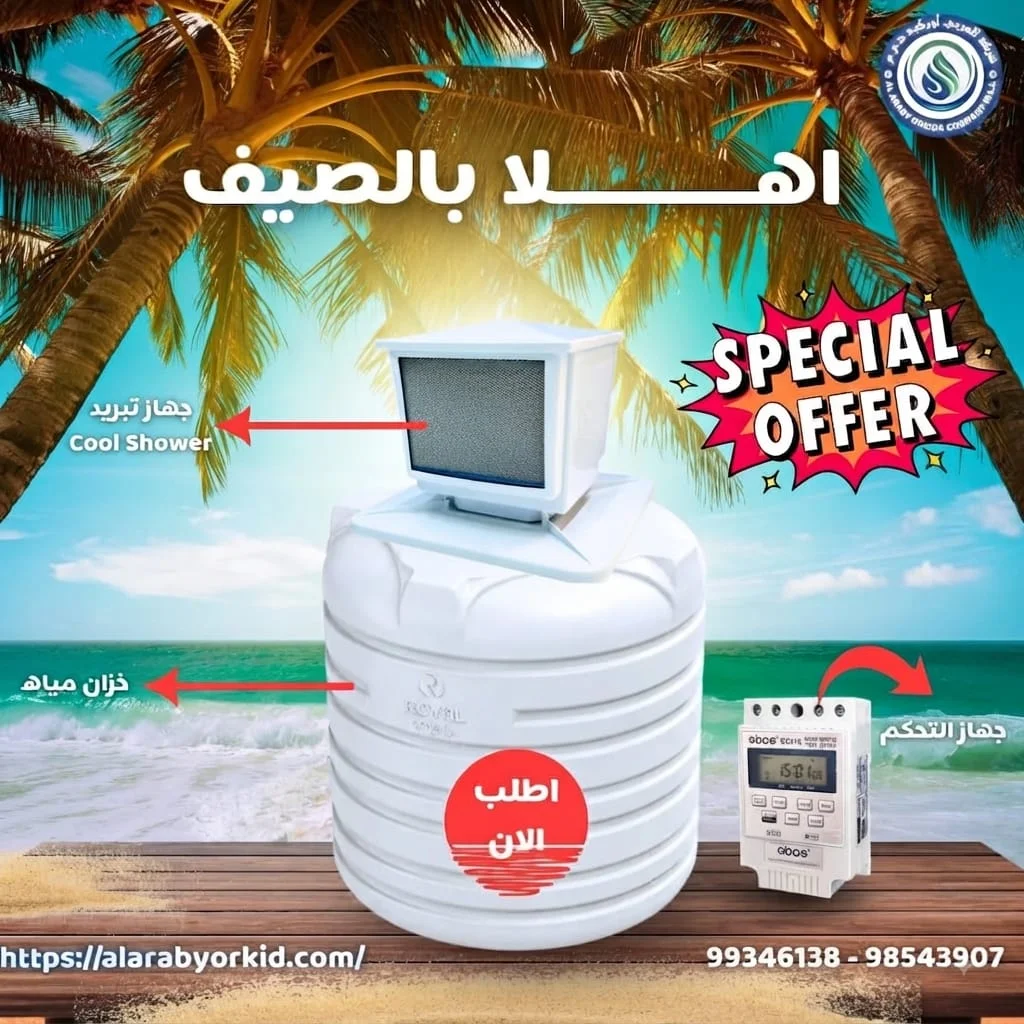
The problem of excessively hot water inside a home tank during Kuwait’s summer is not just an inconvenience during showering. A tank installed on the roof may remain exposed to high outdoor temperatures and direct sunlight for many hours, and as heat continues to build up, the water inside the home plumbing system can become much hotter than a comfortable usable temperature. Solving the problem starts by understanding the tank size, its location, daily water consumption, and the level of cooling required, then selecting a cooling system that matches those conditions. Al Arabi Orchid currently provides direct fan-based tank cooling solutions as well as compressor systems with circulation such as Falcon, LG, and Wansa. The difference between these solutions is not only the device itself but also how they reduce water temperature and how consistently that temperature is maintained inside the tank.
Cooling Home Water Tank Water

Cooling home water tank water starts by understanding why the water becomes hot in the first place. Most household water tanks in Kuwait are installed on rooftops or in areas exposed to very high daytime temperatures. The tank itself absorbs heat from the surrounding air and from direct sunlight, and that heat is then transferred to the water stored inside it. If the water remains inside the tank for several hours without significant consumption, its temperature can rise noticeably before it reaches bathrooms and kitchens.
One of the first mistakes customers make is seeing hot water and immediately asking for the most powerful cooling system available without first understanding the scale of the problem. The tank may be relatively small with high water turnover, meaning fresh water enters frequently. Another tank may be much larger, with water staying inside for longer periods and continuously absorbing heat. In another home, the main issue may simply be that the tank is fully exposed to direct sunlight for most of the day. Every situation creates a different thermal load, so one solution cannot be applied to every home.
Al Arabi Orchid currently advertises two main approaches to water-tank cooling. The first uses fan-based systems such as Cool Shower, Cool King, and Gold Star, which are installed directly above the tank. The second uses compressor systems with circulation such as Falcon, LG, and Wansa. The company states that fan systems target approximately 27°C, while compressor systems with circulation target around 19–20°C depending on the specific system and operating conditions.
This difference is extremely important because not every home needs the same level of cooling. A household that simply wants comfortable water instead of extremely hot water may be well served by a simpler solution. A household that wants noticeably colder water during the main usage periods may need a stronger cooling circuit.
It is also important to understand that cooling the tank does not necessarily mean every liter of water inside the tank instantly reaches exactly the same temperature. Water movement inside the tank, the location where fresh water enters, and the way water circulates all affect temperature distribution. This is one of the reasons circulation is used in stronger compressor-based systems.
In practical use, it is helpful to monitor water behavior for one or two days before choosing the system. Note when the water reaches its highest temperature, when household consumption is highest, and whether the problem occurs all day or mainly during the afternoon. This information gives the technician a much clearer picture than simply saying, “the water is hot.”
-
If water temperature rises strongly in the afternoon and falls after a large amount of water is used this suggests that heat stored in the tank is a major factor
-
If the problem continues even when the tank is shaded the tank size and water turnover rate should be checked before selecting a cooling system
-
The device should be chosen according to the desired comfort temperature rather than according to brand name or compressor size
-
Knowing the number of tanks and how they are connected to the plumbing network helps determine whether direct cooling is enough or a circulation loop is needed
-
Al Arabi Orchid can help identify a suitable system after receiving the tank size and location details on 99346138
Water Tank Cooling Device
A water tank cooling device is not one single product with one fixed shape and operating method. There are simple systems that depend on airflow and heat removal around the tank, and there are more complete cooling systems that use a compressor and circulating water loop.
With simpler systems such as the Saudi Cool Shower, the fan is installed above the tank. Al Arabi Orchid describes this type as a simple and electricity-saving solution and states that Cool Shower can reduce water temperature to around 27°C. This type is more suitable for customers who do not want a complicated cooling circuit and whose primary goal is to reduce excessive tank-water temperature to a more comfortable level.
A compressor-based device works differently. Al Arabi Orchid offers Falcon, LG, and Wansa and states that these compressor units operate with a circulation system to cool water inside the tank. Falcon is described on the website as being able to reduce water temperature to approximately 19–20°C and includes a timer for controlling operating periods. The company also states that LG and Wansa units are available in capacities from 1 to 3 tons.
This leads to an important point: device capacity must match the actual cooling load. Installing a 3-ton unit on a tank that does not require that level of capacity is not automatically an advantage. On the other hand, installing an undersized unit on a large tank with heavy daily water consumption can make the equipment run for long periods while still failing to reach the target temperature.
The cooling device also needs an appropriate installation environment. An outdoor compressor unit should have sufficient ventilation according to its design. Electrical supply must match the equipment capacity. If the system uses circulation, the water route between the tank and cooling unit needs to be properly planned. The tank itself should also be in good condition without leaks or problems at the inlet and outlet connections.
If the property has more than one water tank, you should not assume that one cooling device will automatically cool all of them equally. The way the tanks are connected determines whether water actually moves between them or whether each tank requires a different cooling arrangement.
-
A simple cooling device is more suitable when the goal is to reduce water temperature to a comfortable level without building a larger cooling circuit
-
Compressor capacity should be selected according to tank size and usage hours rather than buying the largest unit as a precaution
-
A timer is useful for controlling operation but it should be programmed according to the actual periods when tank temperature rises
-
The cooling system should be installed on a tank and plumbing network in good condition because leakage or poor water flow can reduce system performance
-
If the property has several tanks the connection arrangement should be identified before deciding the number of units or total cooling capacity
Home Water Tank Cooling System

A home water tank cooling system is more than a device placed beside the tank. A good system consists of several elements working together: a suitable cooling source, proper water movement, appropriate electrical and plumbing connections, operating-time control, and a tank that is structurally sound.
If a compressor system such as Falcon, LG, or Wansa is selected, circulation becomes important because the goal is to move water through the cooling unit and return it to the tank instead of leaving one part of the tank cooler and another part significantly warmer. Al Arabi Orchid describes these systems as circulation-based and states that Falcon includes a timer.
In practical terms, circulation means the system does not rely on cooling one small area only. Water is drawn from the tank, passed through the cooling unit, and returned to the system so the temperature of the total water volume gradually decreases. The time required to reach the target temperature depends on tank size, starting temperature, cooling-unit capacity, and how much new warm water enters the tank during use.
A 500-gallon tank is not the same as a 3,000-gallon tank. A home that consumes large amounts of water in the morning and evening continuously adds new water to the tank, which changes the cooling load. This is why correct cooling capacity cannot be calculated from tank size alone.
A fan-based system is simpler. It does not require the same complete compressor circulation loop, but it still depends on correct installation above the tank and on local weather and exposure conditions. If the tank is heavily exposed to direct sunlight, safely shading the tank or improving its thermal environment may help reduce the load on the cooling device instead of forcing the equipment to handle all the heat by itself.
Control is also part of the system. Running a compressor 24 hours a day is not automatically the best approach. If the highest temperature occurs from midday through the evening and the main household use occurs before or during that period, operation can potentially be scheduled so the tank reaches a more comfortable temperature before peak demand. The timer helps manage this, but it does not make the decision on its own. Proper settings depend on actual monitoring and household usage.
Most importantly, this cooling system should not be confused with other water systems in the house. A pressure pump improves network pressure. A hot-water recirculation pump reduces the time needed for hot water to reach distant fixtures. A tank cooling system lowers the temperature of the stored water. Each system performs a completely different job.
-
A complete cooling system manages both stored water and its movement rather than depending on the cooling unit alone
-
The location of the supply and return points in a circulation system affects how evenly cooled water is distributed inside the tank
-
New water entering during household use adds extra cooling load so daily turnover matters in addition to tank capacity
-
A timer works best when it is programmed according to actual tank temperature and household use instead of using one fixed random schedule
-
A tank cooler should never be used as a solution for low water pressure because pressure and cooling are different functions
Cooling Tank Water in Summer
Cooling tank water in summer requires a seasonal approach. The problem in Kuwait becomes much more severe when outdoor temperatures rise and sunlight exposure lasts for many hours, so the way the system is operated in summer can differ greatly from winter or milder periods.
If the water tank is installed on the roof and exposed to sunlight from morning until afternoon, its temperature rises gradually throughout the day. Some customers notice that the water is acceptable in the morning but becomes extremely hot by the afternoon. In that situation, the cooling strategy should focus on dealing with the thermal load that accumulates during daylight hours.
A timer can be useful with a compressor system because the unit can start cooling before the main household usage period instead of waiting until the entire tank has already become extremely hot. Al Arabi Orchid lists a timer as part of the Falcon system, which provides greater control over daily operating times.
Fan systems operate in a simpler way and are more appropriate when the goal is reducing excessive heat rather than maintaining significantly lower temperatures. Al Arabi Orchid lists Cool Shower, Cool King, and Gold Star among its direct tank-cooling solutions and states that this category targets approximately 27°C.
Cooling equipment should not be considered separately from the tank environment. A dark tank fully exposed to direct sunlight for most of the day can absorb considerably more heat than a protected or shaded tank. If sun exposure can be reduced safely without preventing ventilation or maintenance access, that can help reduce the load on the cooling system.
Household water consumption also matters. If the tank empties and refills significantly during the day, the cooling system is constantly dealing with incoming water at a different temperature. If consumption is low and the same water stays inside the tank for many hours, the system is dealing more with heat absorbed from the surrounding environment.
From the customer-comfort perspective, there is usually no reason to cool the water below what the household actually needs. The objective is not to achieve the lowest possible number but to maintain a comfortable and stable temperature with sensible operating time.
-
Monitoring water temperature in the morning afternoon and evening helps identify when the cooling system needs the greatest output
-
Cooling before the peak-use period may be more effective than starting the system only after the entire tank becomes extremely hot
-
Correctly shading the tank can reduce some of the thermal load but it is not a guaranteed substitute for active cooling in every situation
-
Frequent entry of new water during summer changes how quickly the tank reaches and maintains a stable temperature
-
Setting the system for comfortable household use is more practical than chasing the lowest possible temperature without a real need
Home Water Tank Cooler in Kuwait

Choosing a home water tank cooler in Kuwait should reflect the type of property rather than outdoor temperature alone. A small house with one tank and moderate usage is different from a villa with several tanks, a larger plumbing network, and simultaneous water demand. The same cooling unit will not be the ideal choice for both situations.
Al Arabi Orchid currently provides several options including Falcon, LG, and Wansa compressor systems and Cool Shower, Cool King, and Gold Star fan systems. Having more than one technology allows the cooling solution to be selected according to household requirements instead of selling the same unit to every customer.
If the household has normal water consumption and the main problem is simply that the tank becomes too hot during summer, a fan-based solution may be worth considering. If the household requires significantly cooler water and more control, compressor systems become a stronger option.
The correct cooler should also take noise, installation position, and maintenance access into account. A compressor unit installed close to a bedroom or outdoor sitting area should be positioned carefully. Pipes should also be routed in a way that does not obstruct movement on the roof or make access to the tank difficult.
The building location and roof exposure also change the cooling load. A high, fully exposed roof can behave differently from a tank installed under good shading.
One factor that separates a specialized installation service from simply selling equipment is whether the technician actually evaluates the tank and plumbing network. Al Arabi Orchid states that it covers all six governorates of Kuwait for its tank and cooling services, allowing installations to be arranged across its service areas.
-
The correct tank cooler should be selected according to the property size plumbing system and number of tanks rather than Kuwait’s climate alone
-
Offering both fan and compressor systems allows the customer to choose the cooling level closest to actual household requirements
-
The compressor location should provide suitable ventilation easy maintenance access and reasonable distance from occupied areas
-
Buildings with heavily sun-exposed roofs need a different thermal-load assessment from tanks in protected locations
-
Requesting an inspection or sending clear site photos to 99346138 provides a better basis for selection than choosing equipment over the phone without enough information
Solutions for Hot Water in the Tank
Solutions for hot water in the tank do not always begin with buying a cooling device. The best diagnostic process starts by identifying why the water temperature is increasing and then arranging possible solutions from the simplest to the strongest.
The first solution is to review the tank location. If the tank receives direct sunlight throughout most of the day, appropriate shading or better thermal protection can help reduce the amount of heat entering the stored water. However, this needs to be done without trapping heat or blocking maintenance access.
The second solution is to make sure the tank size is appropriate for household use. A tank that is dramatically oversized for the property may hold water for longer periods, giving it more time to absorb heat from the environment. This does not automatically mean the tank should be replaced simply because it is large, but tank size should be considered when understanding the problem.
The third solution is a direct fan system when the goal is to reduce excessive heat. Al Arabi Orchid lists Cool Shower, Cool King, and Gold Star in this category and states that approximately 27°C is the target level associated with this type of cooling.
The fourth solution is a compressor system with circulation when stronger cooling is required. Falcon, LG, and Wansa are among the company’s current options.
The fifth solution is proper operating control. Even an excellent device can consume more energy than necessary if it operates at the wrong times. Matching operation to the hours when heat and household use are highest can make the system more practical.
The sixth solution is system maintenance. If circulation is weak, piping is restricted, or the cooling unit is not operating efficiently, the system will not provide the expected result even when its original capacity was correctly selected.
The seventh solution is separating different water-system problems. If pressure is low, address water pressure. If hot water takes too long to reach distant fixtures, review hot-water recirculation. If the water itself inside the storage tank becomes excessively hot, then tank cooling is the correct category of solution.
-
Reducing direct sun exposure can help the cooling system instead of forcing the equipment to handle the full thermal load by itself
-
Tank size and how long water remains stored inside it are relevant to understanding heat buildup even when they are not the only causes
-
Fans and compressors represent two different levels of cooling so the choice should follow the required temperature
-
Maintaining circulation flow is important because poor flow reduces the amount of water passing through the cooling unit
-
Separating heat problems from pressure problems and delayed hot-water delivery prevents buying equipment that does not address the real cause
Cooling a Home Rooftop Water Tank

Cooling a home rooftop water tank requires greater attention to location because the roof is normally the area most exposed to direct sunlight and hot outdoor air during summer.
The first thing to assess is the direction and duration of sunlight on the tank. The second is whether there is sufficient space for installing a cooling unit or fan. The third is whether electrical wiring and water pipes can be routed safely without leaving unsuitable exposed connections.
A rooftop tank should also remain accessible for maintenance. Installing a compressor in a narrow corner or behind other equipment can make future servicing difficult. The same applies to a fan installed above the tank; it should not prevent opening or inspecting the tank.
If a circulation system is used, the supply and return paths need to be planned so water moves properly through the cooling circuit without creating undesirable short loops. The objective is to pass water through the cooling unit and return it to the tank in an organized way.
The roof may also contain more than one tank. Some homes have a main tank and an additional tank. Before installation, it is important to identify which tank feeds the plumbing network and how water moves between them.
Al Arabi Orchid also provides fiberglass, porcelain, and GRP water tanks in sizes beginning around 500 gallons and extending into several thousand gallons depending on the tank type. This is relevant because the company works with different tank sizes in addition to its cooling services.
-
A fully exposed rooftop needs sun-load evaluation before selecting cooler capacity because thermal conditions differ from one location to another
-
Electrical wiring and water piping on the roof should be organized serviceable and protected from unsafe exposure
-
Multiple tanks require identifying the primary tank and how water moves between them before installing circulation
-
Leave service space around the tank and cooling equipment instead of crowding everything into an area that cannot be reached later
-
Inspecting tank condition before adding cooling prevents installing a new system on a tank that already has leakage or structural problems
Installing Home Water Tank Cooling
Installing home water tank cooling should be carried out as a complete system rather than simply mounting one device. The first step is inspecting the tank and confirming its size, location, and condition. The second step is selecting the cooling type. The third is identifying the electrical supply and water route. Only after that should installation and commissioning begin.
If a fan-based system is selected, installation is generally more direct, but the mounting still needs to suit the tank design. If a compressor system is selected, the work includes circulation, supply and return lines, and operating controls.
For the Falcon system, Al Arabi Orchid states that circulation and a timer are included in the system description and that cooling targets approximately 19–20°C. For LG and Wansa, the company lists units in capacities from 1 to 3 tons. These details are important when planning the installation requirements.
After the work is completed, a proper operating test should be carried out. The technician should verify that water is actually circulating, check for leaks, confirm that the unit starts and stops correctly, and make sure the timer is properly programmed. After a reasonable operating period, the actual change in water temperature should be measured rather than simply listening to the unit and assuming it is working.
Electrical connections should be completed by a qualified person according to the equipment capacity. If plumbing modifications are required, materials suitable for the water network and rooftop conditions should be used.
The customer should also understand how to start and stop the system, when maintenance is required, and which warning signs justify contacting a technician, such as failure to reduce temperature, unusual noise, or poor circulation.
-
The inspection before installation determines whether the site is ready or needs additional electrical or plumbing work before the cooling unit arrives
-
Testing actual water circulation is more important than simply confirming that the compressor turns on because cooling depends on water moving through the system
-
Measuring water temperature before and after operation provides practical evidence that the installation is achieving the intended result
-
Explaining the timer and operating method to the customer is part of proper handover so the unit does not run on an unsuitable schedule
-
Correct electrical and plumbing installation protects the equipment from problems that can appear even when the cooling unit itself is brand new
Circulation System for Cooling the Water Tank

A circulation system for cooling the water tank is one of the main features that separates compressor cooling from simpler direct cooling methods. The idea is that water does not remain stationary in the tank while only a limited area is cooled. The system draws water from the tank, passes it through a cooling path, and returns it so continuous heat exchange takes place.
Al Arabi Orchid describes Falcon, LG, and Wansa as circulation-based cooling solutions and states that Falcon targets approximately 19–20°C with timer control.
Circulation performance depends on suitable flow. If flow is too low, only a limited amount of water passes through the cooling unit. If the piping design is poor, water may circulate only through a short section of the tank without adequately mixing the remaining water.
The supply and return points should therefore be positioned in a way that supports good water movement. This is where a technician who understands tank plumbing becomes important instead of simply installing two pipes wherever there is space.
It is also important to understand that circulation does not “create new water.” It repeatedly moves the same tank water through the cooling unit. Whenever fresh water enters the tank because of household consumption, the cooling load changes and the system requires time to reduce the temperature again.
The timer helps manage the circulation cycle. The system can potentially begin cooling before periods of heavy use so the stored water is already close to the desired temperature when peak demand begins.
Circulation-system maintenance includes checking water movement, looking for leakage or restrictions, and reviewing pump or flow components according to the design of the system.
-
Circulation moves water through the cooling unit so lower temperatures can be distributed more evenly throughout the tank
-
The position of the supply and return lines affects mixing efficiency so piping layout matters as much as the cooling unit itself
-
Poor flow reduces the amount of water passing through the cooling unit even when the compressor itself is operating normally
-
Fresh water entering during household use adds a new thermal load so the water temperature should not be expected to remain permanently fixed
-
Checking water movement and leakage is a basic part of circulation-system maintenance rather than focusing on the compressor alone
Best Way to Cool a Water Tank
The best way to cool a water tank does not have one answer for every home. The best method is the smallest system capable of maintaining the level of comfort you need without placing unnecessary load on the electrical system or making you pay for equipment much larger than required.
If the main problem is uncomfortable hot water and the goal is simply to reduce it to a more usable temperature, fan systems such as Cool Shower may be suitable after evaluating the tank. Al Arabi Orchid states that this category targets approximately 27°C.
If the home requires noticeably colder water, has a larger tank, or carries a higher cooling load, compressor systems with circulation become a stronger option. Falcon, LG, and Wansa are among the options currently listed by the company, with Falcon described as targeting approximately 19–20°C.
The best approach also includes improving the tank environment itself. Reducing excessive heat exposure safely, leaving suitable maintenance space, and selecting the right operating schedule can all improve the effectiveness of the cooling equipment.
Common mistakes include buying a cooling unit before knowing tank size. Another mistake is running a compressor all day without a clear need. A third mistake is expecting a simple fan system to perform like a compressor. A fourth is confusing excessively hot water with low plumbing pressure.
The best decision usually comes after giving the technician four pieces of information: the tank size, its location, the number of tanks, and the water temperature you consider comfortable. From there, the technician can decide between fan and compressor cooling, identify the required capacity, and design the circulation arrangement where necessary.
Al Arabi Orchid states that it serves all six governorates of Kuwait and offers multiple tank-cooling solutions rather than one fixed system. The published contact number is 99346138.
-
The best solution is not the most powerful device but the one that covers the required cooling load without unnecessary oversizing
-
Fan systems are better suited to moderate heat reduction while compressor circulation systems are better suited to stronger cooling requirements
-
Improving the tank location and operating the system at the right times can increase the benefit obtained from the cooling equipment
-
Defining a target temperature before purchase prevents a mismatch between customer expectations and actual system performance
-
Contact 99346138 and send a photo of the tank and its capacity so the recommendation is based on the real installation
Conclusion
Home water tank cooling from Al Arabi Orchid works best when the problem is treated as a complete thermal system rather than as a random equipment purchase. Excessive water temperature begins with exposure to outdoor heat and sunlight and is affected by tank size, stored-water volume, incoming water during the day, and the household’s usage pattern.
Al Arabi Orchid’s current solutions can practically be divided into two cooling levels. The first uses fan-based options such as Cool Shower, Cool King, and Gold Star, while the stronger level uses Falcon, LG, and Wansa with circulation systems. The company states that fan systems target approximately 27°C and compressor systems target approximately 19–20°C depending on the specific solution and conditions.
Choosing a fan system is logical when the goal is to reduce excessive heat and reach a comfortable water temperature without needing stronger cooling. Choosing a compressor becomes more appropriate when the home needs colder water, more control, and continuous circulation.
Circulation itself is an important part of compressor performance because it repeatedly moves water through the cooling unit instead of relying on cooling only one small area inside the tank. A timer also helps connect system operation with periods of high temperature and household demand.
Before installation, inspect the tank, its location, electrical supply, and plumbing. After installation, test water flow, leakage, timer operation, and the actual water temperature.
Do not confuse different plumbing problems. If the issue is weak water pressure, the solution is related to a booster pump. If hot water takes too long to reach a distant bathroom, hot-water recirculation may be the solution. If the stored water itself becomes excessively hot during summer, then water-tank cooling is the correct category.
To get a system that matches your home, contact Al Arabi Orchid on 99346138 and provide the tank capacity, number of tanks, a photo of the location, and the desired cooling temperature so the recommendation is based on your actual usage.
Frequently Asked Questions
Why does home water tank water become hot during summer?
Because the tank absorbs heat from the outdoor air and direct sunlight during the day and transfers that heat into the stored water. The final temperature depends on tank location, size, how long the water remains stored, and the amount of direct sun exposure.
What is the best device for cooling water tank water?
There is no single device that is best for every home. Fan systems are more suitable for moderate cooling, while compressor systems with circulation are more suitable when lower water temperatures and greater control are required.
What is the difference between Cool Shower and a compressor system?
Cool Shower is a direct fan-based solution that Al Arabi Orchid states targets approximately 27°C, while compressor systems such as Falcon use circulation and target approximately 19–20°C depending on conditions.
Does tank cooling always require a circulation system?
No. Fan-based systems do not use the same circulation loop as compressor systems. Circulation is much more important with Falcon, LG, and Wansa systems because they repeatedly pass water through the cooling unit.
Does tank size affect the cooling-system choice?
Yes. Tank size, water consumption, incoming-water temperature, and household usage all affect the cooling load, so cooling capacity should not be selected without knowing the tank size.
Can I run the water tank cooler all day?
It may be possible depending on the system design, but continuous operation is not automatically the best or most economical approach. A timer can help organize operating periods according to tank temperature and household usage.
Can shading the tank replace a cooling system?
Not always. Proper shading can reduce thermal load, but it does not guarantee a specific water temperature during extreme summer conditions. It should be treated as a supportive measure rather than a universal replacement for active cooling.
Does Al Arabi Orchid provide LG and Wansa tank cooling systems?
Yes. The current Al Arabi Orchid website lists LG and Wansa among its water-tank cooling systems and states that they are available in capacities from 1 to 3 tons.
Does a water tank cooling system solve low water pressure?
No. Tank cooling reduces water temperature, while network pressure is a separate issue related to booster pumps and plumbing design. The problem should be identified before purchasing equipment.
How do I order home water tank cooling from Al Arabi Orchid?
Call 99346138 and send a photo of the tank, its capacity, the number of tanks, and their location, and explain approximately what water temperature you want. The company can then determine whether a fan or compressor system is more suitable and identify the required capacity and circulation arrangement.