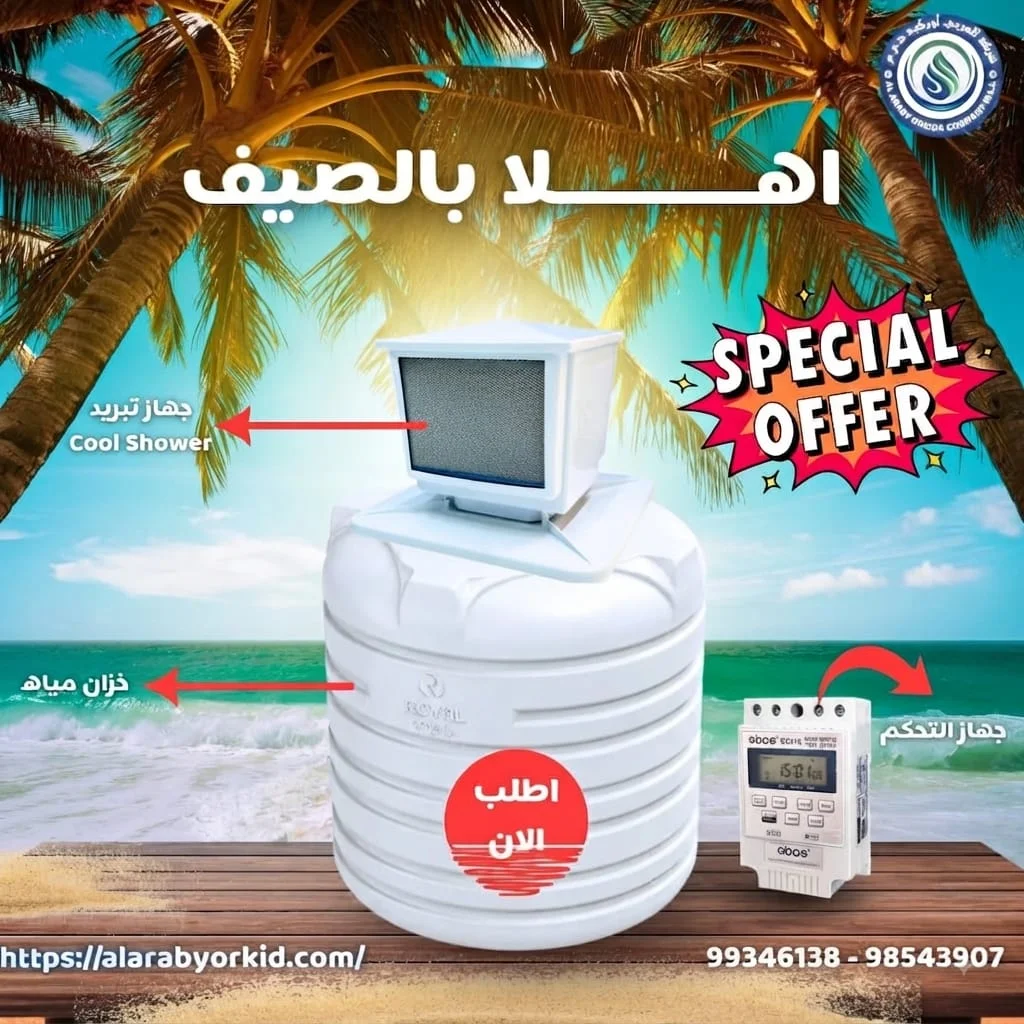
Water tank cooler installation is not simply a matter of placing a device on the roof and connecting electricity. A successful result begins by inspecting the water tank, identifying its capacity and location, evaluating how much direct sunlight it receives, understanding household water demand, and then deciding whether the property needs a compressor-based system with water circulation or an air-driven cooling solution mounted directly on the tank. Al Arabi Orchid currently offers Falcon, LG, and Wansa compressor systems in capacities from 1 to 3 tons, as well as Cool Shower, Cool King, and Gold Star air-cooling solutions, with 99346138 available for installation and service. This article focuses entirely on the practical installation process: how the site is prepared, how the equipment and connections are installed, and how the entire system is tested before handover, because even an excellent cooler can lose much of its value when installed incorrectly.
Water Tank Cooler Installation

Water tank cooler installation begins before the cooling unit reaches the roof. The first practical step is inspecting the tank itself: its actual capacity, material, cover condition, whether there are cracks or leaks, where water enters and leaves, and how directly the tank is exposed to sunlight. This matters because the cooler is dealing with a complete thermal load rather than only the number of gallons printed on the tank. A tank exposed to intense sunlight for most of the day and serving a high-demand household requires a very different approach from a shaded tank used by only a few people.
The next step is choosing the cooling technology. Al Arabi Orchid currently offers compressor systems from Falcon, LG, and Wansa in capacities from 1 to 3 tons with water circulation, together with air-driven systems such as Cool Shower, Cool King, and Gold Star that are mounted on the tank. The company currently advertises approximately 19–20°C as a target for compressor systems and around 27°C for air-cooling solutions, but these figures depend on site and operating conditions and should not be treated as identical guaranteed temperatures for every tank.
Once the technology is selected, the equipment location and connections are prepared. With compressor systems, the outdoor unit needs a suitable place where it can reject heat effectively and remain accessible for maintenance. The technician also reviews the water circulation pipe route, electrical supply, and control arrangement. With air-driven systems, attention shifts toward the tank opening, mounting method, filter, airflow path, and ensuring that no unprotected openings allow dust to enter the tank.
The final stage is testing. The system is operated while water movement or airflow is monitored. Connections are checked for leakage, vibration is observed, and temperature reduction is measured gradually. Installation should not be considered complete simply because the machine starts. The important question is whether the water inside the tank is actually responding to the cooling system as intended.
-
Proper installation begins with evaluating the tank and thermal load rather than buying equipment first and forcing the property to adapt afterward
-
Compressor cooling or air-driven cooling should be selected according to target temperature water demand and tank conditions rather than purchase price alone
-
Equipment location and connection routing directly affect performance because a powerful cooler installed in the wrong location can work harder and become more difficult to maintain
-
Post-installation testing should include leakage water circulation or airflow and actual tank-temperature response
-
Al Arabi Orchid provides installation for both water tank cooling categories in Kuwait through 99346138
Water Tank Cooler Installation Technician in Kuwait
A water tank cooler installation technician in Kuwait should not begin the job with tools and drilling. The first stage should be asking questions. What is the tank capacity? How many people use the water? At what time of day does the water become most uncomfortable? Is the tank shaded or fully exposed? Is there one tank or more than one? These questions help determine whether the selected cooler is appropriate before installation begins.
The technician should then review the cooling system type and how it will be connected. In circulation-based systems, effective cooling depends on moving water correctly between the tank and the cooling equipment. If the suction and return points are arranged poorly, water can circulate through only a small section of the tank, creating uneven cooling even when the compressor itself is operating normally.
Some Falcon systems available in Gulf markets, for example, use an external cooling unit combined with a coil installed in the tank, along with temperature sensing and control. This demonstrates why installation must follow the exact design of the selected model rather than assuming that every Falcon system is installed in the same way.
Electrical requirements also need to be checked carefully. The cooler’s electrical input should come from the actual model data plate, not from a memorized rule such as “every water cooler uses this breaker size.” Different capacities and models can require different supply arrangements and protection.
With fan-based systems, the technician focuses more heavily on cover integrity, equipment stability, filtration, electrical connection, and timer control. Cool Shower systems commonly use an air motor, multi-layer filtration, and timer-based operation, so each of these components becomes part of the installation rather than an optional extra.
-
A professional technician evaluates the tank requirement before selecting or installing the equipment instead of beginning with a randomly purchased model
-
In circulation systems suction and return points should be arranged so water moves through the tank effectively instead of creating a short circulation loop
-
Electrical work should follow the actual model data plate because capacity and design determine supply and protection requirements
-
Fan installation requires attention to filtration tank-cover integrity and airflow in the same way compressor installation requires attention to piping and circulation
-
After installation the technician should explain timer operation filter maintenance and basic system care instead of leaving the customer with equipment but no operating guidance
Water Tank Cooler Installation Company

Choosing a water tank cooler installation company becomes especially important when the project involves more than one component: the tank, cooler, plumbing connections, circulation system, electrical supply, and controls. When every part is handled independently, there is a greater chance that one technician will blame another system when a problem appears. A better approach is using a team that understands the water and cooling system as one connected installation.
Al Arabi Orchid currently provides installation and maintenance services in Kuwait for water heaters, filters, pumps, tanks, and tank cooling systems. Its cooling options include Falcon, LG, and Wansa compressor systems together with Cool Shower, Cool King, and Gold Star air-cooling solutions. This broader service scope can be useful in properties where the tank, pump, filtration, or water network also needs inspection during the cooling project.
However, the word “company” by itself is not a guarantee of quality. Before agreeing to the work, ask which model is being recommended, what its capacity is, what the price includes, where the unit will be installed, how the piping will be routed, what electrical work is required, and what will be tested before handover. If the answer is simply “we install it,” the information is incomplete.
Documentation also matters. Keep a photo of the equipment data plate, the model number, written warranty information, and installation date. These details can save significant time if service is required after one or two summer seasons.
A good company should not automatically push every customer toward a compressor system when an air cooler is sufficient, and it should not recommend an air cooler only because it is cheaper when the tank load clearly requires stronger cooling. The real value comes from selecting the correct technology for the site and then installing it properly.
-
The right company treats the tank cooler piping electrical supply and controls as one integrated system rather than isolated components
-
Before approving the project ask for the brand model capacity installation scope and whether plumbing and electrical work are included
-
Keep equipment information installation records and written warranty details because they make future maintenance much easier
-
Having access to more than one cooling technology allows the provider to match the system to the customer instead of selling the same solution to every property
-
Al Arabi Orchid currently provides tank cooling installation and maintenance services through 99346138
Installing a Water Tank Cooling Device
Installing a water tank cooling device changes completely according to the equipment design, which means there is no single mechanical installation procedure that applies to every model. A system that circulates water through an external cooler requires different connections from one that uses a cooling coil inside the tank, and both are very different from an air-driven unit installed in place of or through the tank cover.
In an external compressor circulation system, the technician identifies suitable points for drawing water from the tank and returning it after cooling while avoiding a short-circuiting water path where the same small volume circulates repeatedly without mixing with the rest of the tank. The pipes should be supported correctly and insulated where they are exposed to sunlight so cooled water does not regain unnecessary heat before returning to the tank.
Some Falcon coil-based systems use an internal tank coil, temperature sensor, control panel, and water-level sensing arrangement, while the outdoor cooling unit is installed beside the tank. Those features apply to specific designs and should not be assumed to exist on every Falcon model without checking the actual equipment.
An air-driven system such as Cool Shower is installed on the tank opening or cover according to its design. The equipment must be secured properly, electrical power connected correctly, timer settings configured, and filtration installed. Some versions use multi-layer aluminum filters designed to reduce the entry of dust and insects with the incoming airflow.
Regardless of system type, final testing should never stop at “the unit is running.” The installer needs to check connection stability, leakage, and actual water-temperature change after a suitable operating period.
-
Installation procedures are determined by the actual model design and should never be copied from another product simply because both cool water tanks
-
Water-circulation piping should follow a route that limits heat gain and vibration while maintaining effective movement through the tank
-
Internal-coil systems should be installed according to their specific sensor and coil arrangement rather than assuming all products from the same brand are identical
-
Air-driven units require proper sealing mounting and filtration so cooling does not create uncontrolled openings into the tank
-
Final commissioning should evaluate the tank-water response instead of simply confirming that the compressor or fan motor has started
Installing a Water Tank Cooler

Installing a water tank cooler works best when the tank itself is evaluated before the cooler. An older tank with a broken cover, cracks, severe contamination, or a faulty float valve should have those problems corrected first. There is little value in installing new cooling equipment on a tank that is already losing water or cannot be sealed correctly.
Tank location is equally important. A tank surrounded closely by walls or other rooftop equipment may not provide enough space for a compressor unit that needs ventilation and service access. The technician should select a location that allows airflow around the unit and makes future maintenance practical instead of forcing the equipment into the tightest corner simply to shorten the pipe route.
Direct solar heat should also be considered. Kuwait’s summer conditions cannot be eliminated, but the cooling load can often be reduced by shading the tank appropriately and improving insulation where practical. Every amount of heat prevented from entering the tank is heat the cooling equipment does not need to remove later.
When the tank supplies the entire property, household usage timing should also be reviewed. A timer can be programmed so the system operates before high-demand periods, allowing the household to begin using water after the tank has already reached a suitable temperature rather than trying to cool it only after heavy demand begins.
Al Arabi Orchid currently offers both circulation-based compressor systems with timer controls and air-cooling systems mounted directly on tanks, so the tank preparation process changes according to the selected category.
-
Inspect the tank body cover and float valve before installing the cooler so a new cooling system is not added to an existing water-loss or sealing problem
-
Provide sufficient service space around the cooling unit because future access reduces maintenance time and cost
-
Shading and insulation reduce the thermal load instead of forcing the cooler to remove all solar heat after it enters the water
-
Schedule cooling before high-demand periods so the system prepares the tank instead of attempting to catch up during peak use
-
Tank location and rooftop layout influence installation design more than the equipment brand name alone
Water Tank Cooler Connections
Water tank cooler connections are one of the biggest differences between a professional installation and a system that develops problems after a short period. In a water-circulation system, there can be a suction line, return line, isolation valves, and possibly a circulation pump depending on the design. The objective is to create a controlled path for water movement while allowing the cooling equipment to be isolated for future maintenance without dismantling the entire network.
Piping should be suitable for the application and supported independently so that its weight or movement does not place unnecessary stress on the unit connections. If lines run across an exposed roof, insulation becomes especially important because cooled water can quickly regain heat under direct sunlight and force the system to repeat the same cooling work.
Isolation valves are also valuable. Correctly placed valves allow the technician to service or clean the cooling equipment without draining or dismantling more of the system than necessary. A network without proper isolation turns a small maintenance job into a much larger operation.
Electrical supply should be dedicated according to the actual model’s requirements. There should never be one breaker or cable-size rule copied across all compressor cooling units. Different models and capacities require different electrical arrangements.
Air-driven systems generally have lighter electrical requirements, but the same principle still applies. The exact electrical specifications should always come from the device being installed, not from assumptions based on another model.
-
Suction and return lines should support effective circulation while also allowing the cooling equipment to be isolated for service
-
Pipes exposed to direct sunlight should be insulated to reduce reheating of the cooled water before it reaches the tank or the property
-
Pipework should be independently supported so its weight and movement do not pull on cooler connections
-
Electrical supply should follow the actual equipment data plate rather than copying cable or breaker sizes from another installation
-
All connections should be tested while the system is operating so minor leakage or abnormal performance is identified before handover
Preparing a Water Tank for Cooler Installation

Preparing a water tank for cooler installation can prevent many expensive modifications after the equipment has already been purchased. Preparation begins by cleaning the area around the tank and inspecting the external condition, cover, plumbing connections, and float valve. If the tank itself is leaking, that problem should be corrected before cooling is installed because continuous water loss means new warmer water is constantly entering and creating additional cooling load.
The available installation space should then be measured. Where will the compressor unit be located? How far is it from the tank? Is there enough room for a technician to access the equipment? Can a suitable electrical supply be prepared correctly? Can the pipes follow a short and organized route instead of running unnecessarily around the roof?
For fan-based systems, preparation focuses more heavily on the tank opening and cover. The device needs to be mounted securely in a way that matches its design, and filtration must remain part of the airflow path. Cool Shower-type products rely on filtration during air entry, so the system should not be operated without the filtration components intended for the product.
Tank insulation and shading should also be reviewed. A tank that absorbs large amounts of heat from the roof or direct sunlight can often be improved before increasing cooling capacity. In some cases, a relatively simple site improvement can reduce equipment runtime more effectively than automatically purchasing a larger system.
It is also important to identify which tank actually supplies the property. In homes with a main tank and secondary tanks, the cooler should be installed where it can influence the actual water distribution system rather than on a tank that does not serve the required flow.
-
Repair tank leakage or structural problems before installing cooling equipment so continuous water replacement does not create unnecessary cooling demand
-
Prepare enough space for ventilation and maintenance instead of choosing the equipment location only according to the shortest pipe route
-
With air-cooling systems inspect the tank opening mounting arrangement and filtration because airflow quality is part of successful operation
-
Review shading and insulation before installation because reducing thermal load can lower the cooling capacity required
-
Confirm that the cooling system is serving the correct tank within properties that use a main storage tank together with secondary tanks
Installing a Water Tank Cooling Compressor
Installing a water tank cooling compressor should be treated more like installing a complete refrigeration system than connecting a simple electrical appliance. The outdoor unit needs sufficient space around it to reject heat effectively and remain accessible for service. Placing it in a confined corner or covering it in a way that restricts airflow can reduce efficiency and increase operating stress.
After positioning the unit, the heat-transfer arrangement is installed according to the specific design. Al Arabi Orchid currently offers Falcon, LG, and Wansa cooling systems in capacities from 1 to 3 tons for water tank cooling and uses circulation and timer control within its current compressor-based solutions.
However, even Falcon systems can appear in different configurations. Some Gulf-market systems use an internal tank coil together with an outdoor unit, temperature sensor, and digital control arrangement. This is why the installer needs to read the exact model specifications instead of assuming that every Falcon product uses the same installation method.
Electrical preparation comes next. Breaker size, cable capacity, and isolation arrangement should be selected from the equipment data and local installation requirements. They should not be estimated simply from cooling tonnage.
After the system is connected, commissioning should be carried out gradually. Compressor sound, water movement, temperature response, and leakage should all be monitored.
The most important measurement is how the temperature of the full tank responds over time. The goal is not simply to make one outlet pipe feel cold. The objective is to reduce the temperature of the stored water mass to the required range and maintain that result during actual household use.
-
Leave sufficient ventilation and maintenance clearance around the compressor because installation location directly affects efficiency and service life
-
Follow the actual model design whether it uses water circulation or an internal cooling coil rather than relying only on the brand name
-
Electrical preparation should follow the unit specifications because different capacities and models have different supply requirements
-
Measure tank-water response after startup rather than judging success only from the temperature of one pipe leaving the cooler
-
Al Arabi Orchid currently offers Falcon LG and Wansa compressor cooling installation through 99346138
Installing a Water Tank Cooling Fan
Installing a water tank cooling fan is mechanically simpler than installing a compressor system, but it requires a different kind of accuracy. Air-driven cooling depends on filtered airflow associated with the tank, so the three most important installation points are mounting location, filtration, and tank-cover integrity.
Cool Shower products commonly mount on or through the water tank cover and use an air motor together with multi-layer filtration and timer-based operation. Some published versions use electrical ratings around 360 watts at 220 volts, but equipment specifications can vary, so the installer should always verify the actual product before preparing the electrical connection.
During installation, the unit should be secured firmly so excessive vibration does not develop. The filter should be installed in the correct direction, and the tank cover should remain properly sealed except for the designed airflow path. There is little benefit in filtering incoming air through the cooling unit while leaving a damaged cover that allows unfiltered dust to enter freely from somewhere else.
Timer programming is another important part of the installation. The system should operate during the periods that provide the greatest benefit according to outdoor temperature and household usage. Some Cool Shower systems allow several daily operating periods, which can make it possible to cool the tank before showering hours instead of running the fan continuously without a plan.
Fan systems also require simple but important maintenance. The filter should be checked because accumulated dust can reduce airflow even when the motor itself continues operating normally.
-
Equipment stability and correct tank sealing are more important than simply placing the fan over the opening and turning it on
-
Never operate an air-driven system without the filtration designed for it because the filter is part of protecting the tank during air intake
-
Program the timer according to household demand instead of operating the equipment during periods when nobody needs cooler water
-
Check the filter periodically because dust accumulation can reduce airflow and cooling performance while the motor still appears to run normally
-
A fan-based system is appropriate when the required cooling level falls within its realistic capability rather than using it as a forced substitute for a compressor system needed for a larger load
Water Tank Cooling Installation Service
A high-quality water tank cooling installation service should end with a clear handover to the customer rather than with the technician leaving as soon as the equipment starts. At the end of the job, the customer should know what was installed, the system capacity, how to operate it, the maintenance requirements, when the filter needs attention, and when to call for service if the tank temperature does not respond as expected.
The first handover item is temperature testing. The water temperature should be recorded before operation and measured again after an appropriate period. A large tank will not change temperature in a few minutes like a small pipe. With a compressor system, gradual tank response and circulation should be monitored. With an air system, airflow and the effect of operation on tank temperature should be observed under the actual weather conditions.
The second handover item is leakage testing. Every connection added or modified during installation should be inspected while the system is operating, particularly suction and return lines.
The third item is explaining the timer and controls. The customer should understand how to adjust the schedule when household usage changes and when it is better not to change technical settings without service guidance.
The fourth item is maintaining a service record. Al Arabi Orchid currently provides water tank cooling installation and maintenance across Kuwait and works with Falcon, LG, Wansa, Cool Shower, Cool King, and Gold Star systems.
Most importantly, if the tank location or site conditions make the advertised target temperature unrealistic under the actual application, that should be explained before installation instead of promising a result that cannot be guaranteed.
-
A complete installation service gives the customer clear operating and temperature information instead of simply saying that the device has been installed
-
All newly installed connections should be tested under operating conditions because a leak appearing two days later means the commissioning process was incomplete
-
Timer operation should be explained so the customer can match cooling to household demand and avoid unnecessary runtime
-
Record the equipment brand model and installation date because these details make future service much faster
-
For assessment and installation in Kuwait contact Al Arabi Orchid on 99346138 and request a tank inspection before selecting the cooling system
Conclusion
Water tank cooler installation with Al Arabi Orchid 99346138 begins with inspection and ends with complete testing, and the stages between those two points are much more important than simply mounting the equipment. Tank capacity, number of users, location, and target water temperature should first be identified, followed by selecting either a compressor system with water circulation or an air-driven system mounted directly on the tank.
Al Arabi Orchid currently offers Falcon, LG, and Wansa compressor solutions in capacities from 1 to 3 tons, together with Cool Shower, Cool King, and Gold Star air-cooling systems. The company currently advertises approximately 19–20°C for the compressor category and around 27°C for the air-cooling category under the stated operating conditions, so the two technologies should be chosen according to different performance goals rather than treated as identical alternatives.
After equipment selection comes tank preparation, equipment location, water circulation, pipe insulation, electrical work, timer control, leakage testing, and temperature verification. This is where specialist installation makes a real difference. A powerful compressor cannot compensate for poor water circulation, and an excellent air cooler cannot compensate for a damaged tank cover or neglected filter.
If you need a new installation, contact Al Arabi Orchid on 99346138 and provide the tank capacity, number of tanks, tank location, number of residents, and target water temperature. Ask from the beginning for the brand, capacity, connection scope, electrical requirements, control method, and commissioning procedure so you receive a cooling system that genuinely works with the tank rather than simply a device mounted on the roof.
Frequently Asked Questions
What is the first thing checked before installing a water tank cooler?
The technician should inspect the tank capacity, condition, location, sunlight exposure, household demand, and required water temperature. These details determine the correct system type and capacity before any piping or electrical work begins.
Does every water tank cooler need a compressor?
No. Al Arabi Orchid currently offers Falcon, LG, and Wansa compressor systems together with Cool Shower, Cool King, and Gold Star air-driven cooling solutions. The correct choice depends on thermal load and the water temperature required.
Where is the water tank cooling compressor installed?
It should be installed close enough to the tank for practical connections while maintaining enough ventilation and service clearance. Some Falcon coil-based systems place the outdoor unit beside the tank while the cooling coil is installed inside the storage tank.
Does compressor installation require water circulation?
Many tank cooling systems use water circulation or another dedicated heat-transfer arrangement. Al Arabi Orchid currently uses circulation within its compressor solutions, but the exact installation method depends on the selected model.
Is a Cool Shower fan installed on the tank cover?
Many Cool Shower designs are intended to be installed on or through the tank cover and use an air motor, filter, and timer. Installation should always follow the exact design of the model supplied.
Should water tank cooler pipes be insulated?
Yes, particularly when the piping is exposed to direct sunlight. Insulation reduces heat gain after the water has been cooled and can reduce unnecessary cooling-system runtime.
Does a water tank cooler need a dedicated electrical supply?
It depends on the equipment type and capacity. Some compressor units require circuits sized specifically for their electrical demand, while fan systems generally have lighter requirements. The actual equipment data plate and installation instructions should always determine the electrical setup.
How do I know whether the cooler installation was successful?
Do not judge only by hearing the machine operate. The technician should confirm that there is no leakage, verify water circulation or airflow, measure tank temperature before and after a suitable operating period, and observe whether the system can maintain acceptable performance during normal use.
Does the cooling fan filter need cleaning?
Yes. In air-driven systems, the filter is part of the airflow path. Dust buildup reduces airflow and can lower cooling performance even while the fan motor continues to operate normally.
How do I request water tank cooler installation from Al Arabi Orchid?
Contact 99346138 and provide the tank capacity, number of tanks, number of users, tank location, solar exposure, and desired water temperature. Request an inspection that identifies the cooling technology, required capacity, installation method, piping, electrical requirements, controls, and final commissioning tests before the work begins.


