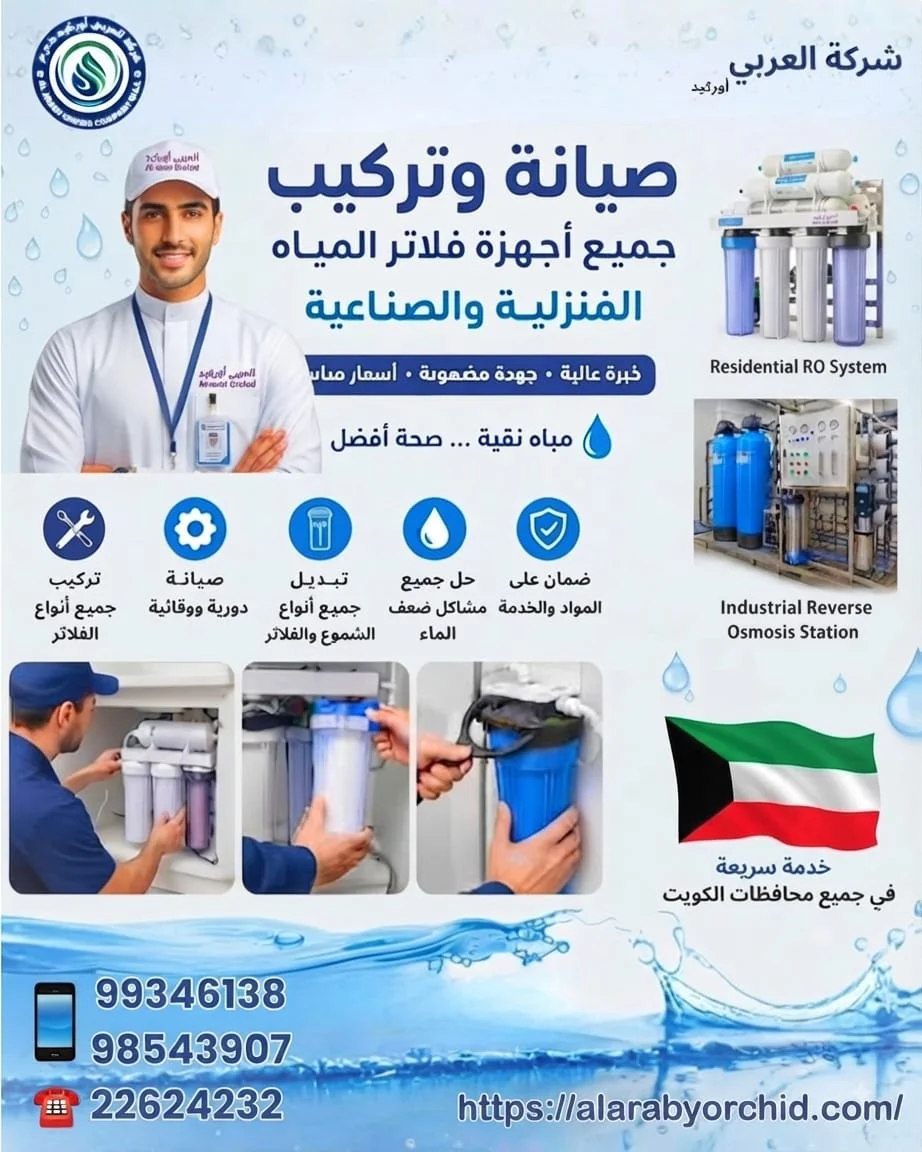
When you start thinking about installing a filter at home, do not begin by asking, “How many stages does it have?” because the number of stages alone does not tell you whether the filter is actually suitable for your problem. Choosing the right water filter starts by identifying exactly what you want to treat: sediment coming from the tank, particles that may affect the heater and pump, unpleasant taste or odor at the kitchen tap, or a need for more advanced drinking-water treatment. In Kuwait, drinking water supplied through the public system is treated, disinfected, and monitored by the Ministry of Electricity, Water and Renewable Energy. This means installing a household filter does not automatically mean that public water is unsafe. The filter’s role should instead be defined according to storage conditions, the building’s internal plumbing, and the intended use. Al Arabi Orchid 99346138 provides solutions ranging from main-line filters, sand filters, jumbo systems, and stainless-steel filters to multi-stage kitchen drinking-water filters according to each home’s actual requirements.
Choosing the Right Water Filter
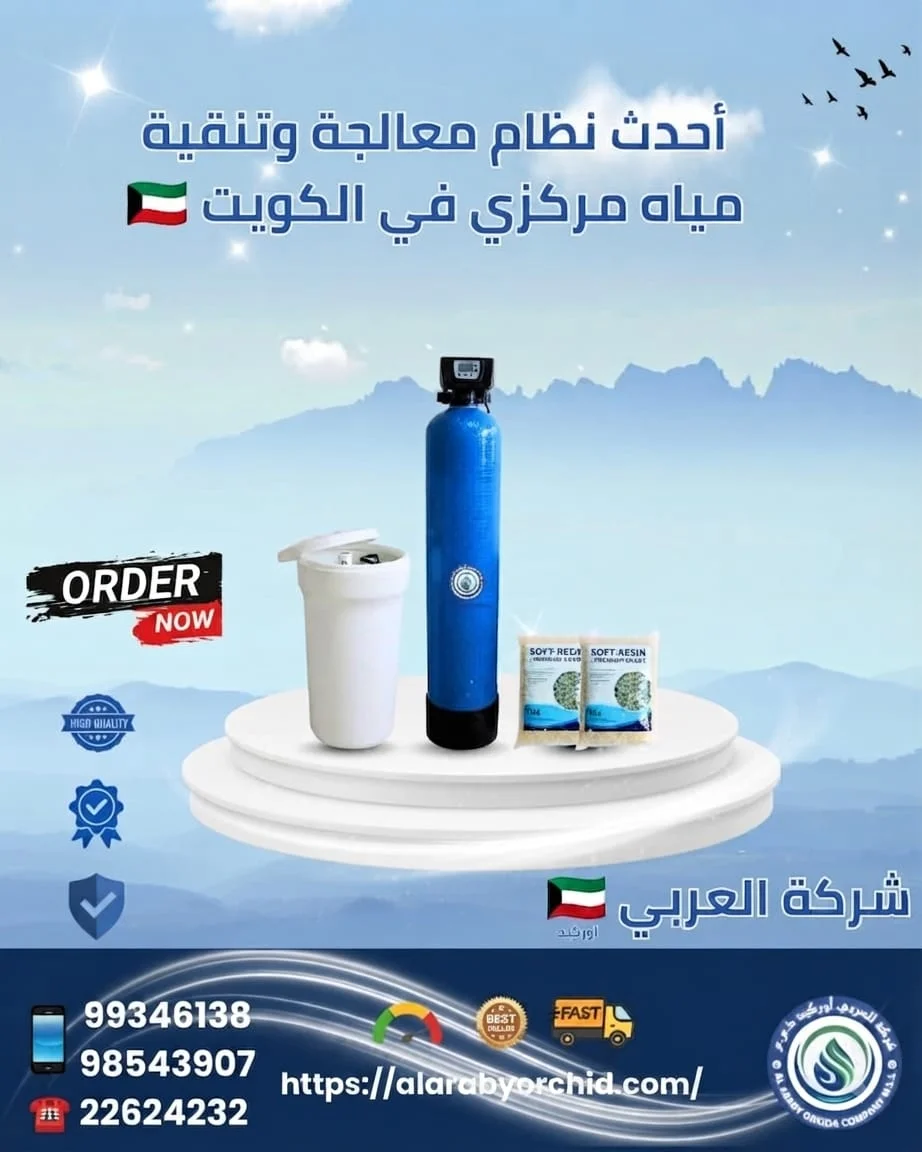
Choosing the right water filter begins by identifying where the problem exists before choosing the device itself. The first important distinction is between a filter installed at the main water entry point for the whole property and a filter intended only for drinking water at the kitchen. A Point-of-Entry system treats a much larger volume before water is distributed to bathrooms, the heater, pump, and the rest of the plumbing network. A Point-of-Use system treats a smaller quantity at a specific outlet such as the kitchen tap. Choosing one when you really need the other may cause you to spend more than necessary or produce a result different from what you expected.
If the main problem is visible dirt, rust, or sediment coming from the storage tank, the first priority is usually mechanical filtration before those particles reach the water heater, faucets, valves, and pump. If the water looks clear but you want to improve taste or reduce chlorine odor at the drinking point, activated carbon becomes a completely different treatment option. If you are concerned about a specific contaminant or want to reduce dissolved salts, you should not assume that an ordinary sediment or carbon cartridge will solve the problem because every filtration technology has a different treatment range.
A filter capable of reducing certain microorganisms does not automatically remove chemical substances, and the opposite is also true. This is why the product label and specific tested performance claims matter. The phrase “purifies water” is far too broad. A professional water-treatment product should clearly state what it is designed to reduce rather than relying on vague claims about everything it might supposedly remove.
After identifying the treatment goal, flow rate must be considered. A main-line filter serving a villa with several bathrooms has to pass much more water than a compact kitchen filter. If an extremely fine cartridge is installed on the main line without considering household demand, the water may become better filtered in one sense while pressure throughout the house drops noticeably. Correct selection therefore balances filtration level with the amount of water the property actually needs.
Maintenance is another part of the decision. A filter that uses cartridges that are difficult to find or requires the entire unit to be dismantled every time maintenance is needed may look impressive on paper but become inconvenient in real use. This is why selecting a household filter should include the unit, cartridge type, maintenance schedule, and ease of servicing rather than focusing only on the filter housing.
-
Start by deciding whether the objective is protecting the entire household plumbing network or treating drinking water because this decision changes the filter location size and technology from the beginning
-
Sediment taste dissolved salts and more specific contaminants are different problems and one filter stage should never be assumed to treat all of them with the same effectiveness
-
The filter flow rate must match the number of fixtures being supplied so improving water quality does not create frustrating pressure loss throughout the bathrooms
-
Any claim that a filter reduces a specific substance should be supported by a specification or certification related to that exact claim because the phrase certified filter alone is not enough
-
Ease of cartridge replacement spare-part availability and annual maintenance cost should influence the selection just as much as the purchase price of the unit
Best Home Water Filter in Kuwait
When searching for the best home water filter in Kuwait, there is no single model that can be installed in every property and honestly described as the best for everyone. Kuwait has an important residential water-use pattern that should be considered. Public drinking water is treated and officially monitored, but many homes then store that water in private tanks and distribute it through the building’s own plumbing system. The purpose of a household filter may therefore be to protect the internal network from storage-related sediment or improve specific characteristics at the point of use rather than assuming every property has one identical water problem.
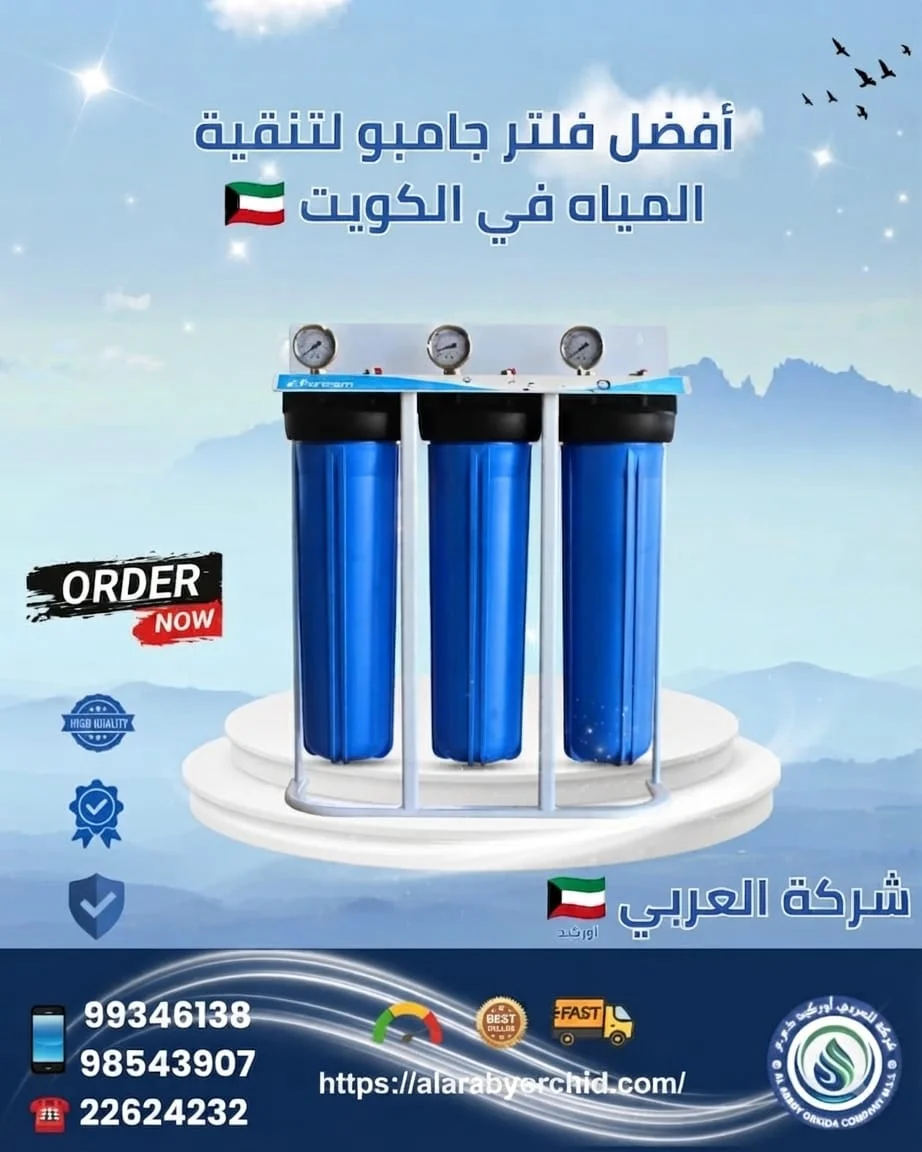
In a house with an older tank where small particles or temporary cloudiness appear after cleaning or maintenance, a main sediment filter or jumbo housing may be a practical starting point. Al Arabi Orchid currently provides options such as Jumbo Filters for removing larger particles and protecting the plumbing network as well as sand filters in different sizes and stainless-steel multi-cartridge systems for homes and larger buildings.
A second property may have no visible sediment problem at all, but the family wants dedicated drinking water in the kitchen. In that situation, there is usually little reason to pass shower, laundry, and toilet water through an under-sink RO system. Treating only the drinking-water point can reduce maintenance cost and make the system more practical.
Water hardness and white mineral deposits also need to be understood correctly. A standard sediment filter is not a water softener. Activated carbon does not remove calcium and magnesium in the same way as a softening system. If hardness is the real issue, a technology designed for hardness reduction, such as ion exchange in suitable applications, may be required. RO may also reduce certain dissolved salts at the drinking-water point depending on the goal. This distinction matters because some homeowners install a three-stage filter and then wonder why white mineral marks are still appearing on faucets.
The best filter in Kuwait is therefore the system that treats the identified problem without restricting pressure and without adding unnecessary stages that do not have a clear purpose in that particular home.
-
If sediment is the real problem begin by protecting the main supply line instead of purchasing a complicated drinking-water system that will not stop sand from entering the heater and pump
-
If only drinking water needs additional treatment a kitchen Point-of-Use system is often more economical and easier to maintain than treating the entire household supply to the same level
-
Mineral scale requires a different diagnosis from visible sediment because sediment and carbon filters are not automatic substitutes for softening or dissolved-salt treatment
-
High-flow villas require larger housings and more filtration surface than small apartments so pressure can remain acceptable when several outlets are used at once
-
The best home water filter in Kuwait is the one that matches the property’s water tank plumbing system and intended use rather than the one with the largest number of stages printed on the box
Types of Home Water Filters

Understanding the types of home water filters makes the selection process much easier because each technology performs a different job. The first category is the sediment filter. Its main function is to capture suspended particles such as sand, rust, and dirt according to the micron rating of the cartridge. This type is excellent as a protective first stage, but it should not be marketed as a solution for every dissolved substance or chemical odor.
The second type is activated carbon. Carbon filtration is commonly used to improve taste and odor and to reduce certain substances depending on the exact product and certification. NSF/ANSI 42, for example, is associated with aesthetic effects such as chlorine, taste, and odor, while NSF/ANSI 53 covers specific contaminant-reduction claims related to health effects. The numbers are not a ranking where 53 is automatically “better” than 42. Each standard serves a different purpose.
Then there is Reverse Osmosis, or RO, which provides more advanced treatment for drinking water through a semi-permeable membrane. RO can reduce various dissolved substances, salts, and other contaminants depending on the specific system. NSF/ANSI 58 is the standard associated with residential reverse-osmosis systems and includes requirements related to TDS reduction, water efficiency and recovery, and certain contaminant-reduction claims.
Ultrafiltration and Nanofiltration are additional technologies with different membrane pore sizes and treatment ranges. UF can be effective against many bacteria and parasites but should not be considered a general treatment for every dissolved chemical. NF provides a finer level of separation and has a different performance range. Terms such as “Nano” or “Ultra” should therefore describe real membrane technology rather than functioning only as marketing language.
On the main water line, Sand Filters can be used for initial sediment treatment in suitable applications. Jumbo cartridge systems and stainless-steel multi-cartridge filters can provide larger filtration area and higher flow capability. Al Arabi Orchid currently provides sand filters from approximately 10 to 16 inches, multi-stage main filters, jumbo systems, and stainless-steel Nano, Aqua, and Panther filter systems using multiple cartridges, in addition to 3-stage, 5-stage, 6-stage, and 7-stage kitchen filters.
-
A sediment filter is mainly designed to capture solid particles which makes it an excellent protective stage but not a complete treatment for dissolved substances
-
Activated carbon is useful for objectives such as taste odor and chlorine reduction according to the product specifications but it is not an RO membrane or a water softener
-
An RO system is generally more relevant at the drinking-water point when the goal includes reducing TDS or other specific substances covered by the system’s tested performance
-
UF and NF are technologies with different characteristics and the words Nano or Ultra should not be used as marketing terms without understanding the actual membrane and performance claims
-
Sand filters jumbo housings and stainless-steel multi-cartridge systems serve different flows and loads so the housing size and number of cartridges should be selected according to the property network
Water Filter Suitable for Drinking
Choosing a water filter suitable for drinking requires more precision because the objective is no longer simply protecting a heater from sediment. This is the water the family drinks and uses for cooking. The first rule is that no single filter removes “everything.” Certification to one standard does not mean that the product reduces every possible contaminant. The specific reduction claim listed for the exact model should always be checked.
If the objective is mainly improving taste and odor, an appropriately certified carbon filter may be sufficient. If there is a demonstrated need to reduce TDS or certain substances within the treatment capability of an RO system, then reverse osmosis becomes a more logical option. Choosing RO only because it has “more stages” is not automatically the best use of the budget.
Production capacity also matters. A drinking-water filter should be evaluated not only by what it reduces but also by how much treated water it can provide and how often cartridges or membranes need replacement. A technically excellent system with a very small storage tank may still feel inconvenient for a large family if the available drinking-water volume cannot keep up with daily use.
Maintenance becomes especially important in drinking-water systems. Cartridges should not be left unchanged for years simply because the water still tastes acceptable. Filter media collects material over time and performance can change. Replacement intervals, cartridge cost, and maintenance requirements should therefore be considered from the day the system is purchased.
-
Drinking-water filters should be selected according to the specific substances you want to reduce rather than the total number of stages because a stage with no connection to your actual requirement adds little value
-
Look for certification tied to a defined reduction claim instead of relying only on a general Certified statement without details
-
RO can be useful for certain requirements but is not automatically necessary for every household when the goal is only taste improvement or simple sediment removal
-
Drinking-water tank capacity and production rate matter for larger families because treatment quality alone is not enough if the system cannot provide the required daily volume
-
Replacing cartridges and membranes according to the intended maintenance schedule is part of maintaining system performance and should never be treated as an optional task after installation
Best Home Water Purification System
The best home water purification system is often not one single device. In many properties, the better arrangement is two different treatment points serving two different purposes. The first is installed at the main entry point to protect the plumbing network from larger sediment. The second is installed in the kitchen to provide more detailed drinking-water treatment. This approach gives each part of the home the level of treatment that matches its use instead of applying an expensive technology to shower and laundry water without a clear reason.
Imagine a villa with a storage tank, booster pump, and central water heater. If sediment is coming from the tank, it makes sense to stop those particles before they reach the pump, heater, mixers, and faucets. After that, a separate kitchen system can treat drinking water. This arrangement can also reduce the particle load reaching the kitchen filter, allowing it to operate under more stable conditions while the main network remains protected from larger debris.
However, placing many filters in series without calculating their hydraulic effect can create pressure loss. Every housing and every cartridge introduces resistance, especially as the media becomes loaded with particles. A complete system should therefore be designed around the required household flow before installing several restrictive filter bodies on the main line of a large villa.
In some homes, a simpler central system is actually better. If there is no drinking-water concern and the only goal is preventing sand from entering the heater, there is little reason to turn the property into a small treatment plant. The complexity of the system should follow the actual problem.
-
Combining a main sediment filter with a separate drinking-water filter provides targeted treatment instead of forcing all household water through stages that are unnecessary for most uses
-
Installing a protective stage before household equipment reduces particle entry into heaters pumps and fixtures and makes maintenance more logically distributed
-
Adding many filter housings to the main line without calculating flow can lower water pressure and create a new problem while trying to improve water quality
-
The best system is not necessarily the most complicated one but the one where every stage has a defined purpose and can be maintained and evaluated
-
When designing a complete household system the locations of the tank pump heater and direction of flow should all be understood so filter stages can be arranged without interfering with network performance
Buying a Home Water Filter
Before buying a home water filter, do not compare only the purchase price. Ask how much replacement cartridges cost, how easy they are to find, how often they should be changed, who services the unit, what the rated flow is, what pressure it can handle, and whether the housing is suitable for the planned installation location. A cheap filter can become expensive after one year if its replacement media is rare or costly.
Annual ownership cost should be considered as well. Replacement filters are part of the water-treatment budget and should be calculated alongside the initial purchase price.
Ask whether the system uses standard cartridge sizes or model-specific replacement parts. Some housings accept widely available cartridges while other systems require proprietary replacements. Neither approach is automatically wrong, but the buyer should know what future maintenance will involve before making the purchase.
Al Arabi Orchid currently publishes examples starting from around KWD 50 for certain Jumbo Filters and some 3-stage and 5-stage kitchen filters, while selected Sand Filter systems begin from around KWD 165 according to the current service listings. These should be treated as starting reference prices rather than guaranteed final installation costs because housing size, cartridge configuration, plumbing modifications, and site conditions can change the total price.
-
Compare cartridge replacement cost over one or two years because an inexpensive filter with costly consumables may become more expensive than a higher-priced unit
-
Confirm that the rated flow is suitable for the property especially when the filter will serve the complete household network rather than one kitchen outlet
-
Ask about connection size and operating pressure before purchase so unexpected plumbing modifications are not discovered during installation
-
The advertised unit price does not automatically represent the complete installed-system cost because piping valves installation and the initial cartridge set may be separate items
-
The best purchase is one where future maintenance cost and parts availability are clear from the beginning rather than being discovered several months later
Choosing Water Filter Stages
Choosing water filter stages should be based on the function of every individual stage rather than following the idea that seven stages must automatically be better than five and five must always be better than three. A higher number may simply mean that additional post-carbon, mineral, alkaline, or other stages have been added. It does not automatically prove that the core filtration performance is superior.
A simple three-stage system might contain a sediment cartridge followed by carbon and then a carbon block depending on the manufacturer’s design. In an RO system, a membrane becomes part of the treatment sequence and the pre-filters are important because they help protect that membrane. In a six-stage or seven-stage system, extra stages may be installed after the RO membrane to adjust taste or other water characteristics.
The important thing is to know the name and purpose of every cartridge. If a seller says “seven-stage purification,” ask exactly what the fourth, fifth, sixth, and seventh stages do and how their performance is supported. Stage count is not itself an NSF performance standard or an official safety rating.
Al Arabi Orchid currently provides 3-stage, 5-stage, 6-stage, and 7-stage kitchen filters as well as alkaline kitchen-filter options. Selection between them should be based on the treatment goal and the actual components in each system rather than the number alone.
-
The number of stages is not a quality score because a properly designed three-stage filter can be more suitable than a seven-stage system containing stages the household does not need
-
You should know the purpose and replacement interval of every cartridge because it is difficult to judge or maintain a stage when you do not know what it is supposed to do
-
In RO systems the pre-treatment stages help protect the membrane so neglecting them can reduce the service life of one of the most important components
-
An alkaline or mineral stage has a different purpose from sediment removal and all stages should not be described with the single vague word purification
-
Choose the number of stages after identifying the actual problem maintenance budget and available under-sink space rather than deciding from the number printed on the product
Water Filter Suitable for Household Water
Choosing a water filter suitable for household water becomes easier when each visible symptom is linked to a different treatment path. If you see particles or cloudiness, inspect the storage tank and sediment treatment. If the issue is taste or odor, investigate the source and then choose an appropriate carbon stage. If white mineral deposits appear on faucets, understand that this is related to dissolved minerals and hardness and should not be treated as if it were ordinary sand.
If the problem appears mainly after the storage tank, tank cleaning and maintenance are part of the solution. A filter should not be used as a substitute for a neglected tank. If water changes after passing through older internal pipes, the source of that change should be identified before installing a larger treatment system.
The sound approach is to identify what is present in the water or what exactly you want reduced and then select a treatment system designed and certified for that purpose. This prevents buying filtration equipment based on fear rather than useful information.
-
Visible cloudiness points first toward sediment while taste and odor require a different assessment and different filter media
-
Mineral scale is not the same as sand which means a sediment cartridge should not be judged by whether white deposits disappear from faucets
-
A dirty storage tank needs cleaning and maintenance because installing a filter downstream without treating the source can cause cartridges to clog much faster than normal
-
A change in water quality in only one part of the property may come from a local plumbing branch so the complete household system should not be replaced before locating the problem
-
Selecting filtration based on a water test or a clearly identified symptom is more accurate than installing as many stages as possible in anticipation of every imaginable problem
Specifications of a Good Water Filter
The specifications of a good water filter begin with clear performance information. What does the filter reduce? At what flow rate? What is the expected cartridge life? What operating pressure is allowed? A strong-looking housing alone does not define a good filtration system.
Certification should also be understood correctly. NSF/ANSI 42 is associated with claims such as taste, odor, and chlorine reduction. NSF/ANSI 53 deals with specific contaminant-reduction claims related to health effects. NSF/ANSI 58 applies to Reverse Osmosis systems. The useful certification is the one related to the function you actually need.
The housing itself is particularly important on a main water line. Connections must be suitable for the network pressure and the materials should be appropriate for drinking-water use when the application requires it. In larger systems, pressure gauges before and after filtration can help identify increasing pressure drop and show when the filter is becoming restricted instead of relying only on a fixed calendar interval.
Ease of maintenance is another practical specification. The housing should have enough clearance to be opened safely and there should be a suitable method to release pressure before servicing it. A technically good filter installed so close to a wall that its cartridge cannot be replaced easily becomes a maintenance problem every time service is required.
-
Published performance should identify the targeted substances and flow rate instead of relying on general phrases such as complete purification or removes all impurities
-
Useful certification is certification related to the required function because a standard number by itself does not mean the filter removes every contaminant
-
Pressure rating housing quality and connection strength are especially important in a main-line filter because any failure can affect the complete household plumbing network
-
Easy housing removal and safe cartridge replacement are practical specifications because a filter requires repeated service rather than being installed only once
-
Pressure gauges in suitable larger systems can help monitor increasing restriction from actual performance instead of replacing cartridges only because a certain number of months has passed
Water Filter Buying Guide in Kuwait
A practical water filter buying guide in Kuwait can be reduced to a clear sequence instead of moving randomly between dozens of products. First decide whether you need a whole-house filter or a drinking-water filter. Second, identify the problem. Third, determine the required flow. Fourth, select the appropriate treatment technology. Fifth, review maintenance requirements and total cost.
If the property mainly needs protection from larger particles, options may include a Jumbo filter, a multi-stage main-line filter, or a Sand Filter depending on sediment load and required flow. If you have a villa or another property with higher demand, stainless-steel multi-cartridge filters may be more appropriate depending on the design. If the goal is kitchen drinking water, Al Arabi Orchid currently provides 3-stage, 5-stage, 6-stage, and 7-stage systems as well as alkaline-filter options.
Do not purchase until you know exactly what the quoted price includes. Does it include the cartridges? Installation? Valves? Will piping modifications be required? Is scheduled maintenance available? Current published prices should also not be treated as permanent because service offers and product prices can change.
If you are concerned about a specific substance in the water, testing is the better starting point, followed by selection of a product with documented performance for that specific substance. Independent performance claims provide a more reliable basis than assuming that every household filter removes everything.
Al Arabi Orchid 99346138 currently provides sand filters, jumbo systems, multi-stage main filters, stainless-steel systems, kitchen filters, cartridge replacement, and maintenance services in Kuwait. When contacting them, it is useful to explain the property size, number of bathrooms, tank location, and the exact water problem you have noticed so the recommendation begins with your real requirements.
-
Decide from the beginning whether the filter is intended for the whole house or drinking water because this is the most important step in avoiding a system with the wrong size or function
-
Photos of sediment or a clear description of taste odor and where the problem appears can help narrow down the required treatment before the site visit
-
Ask about rated flow and expected pressure drop before selecting a whole-house filter so water pressure remains acceptable after installation
-
Request a clear cartridge replacement schedule and replacement-part cost because maintenance budget matters more over time than a small difference in the initial purchase price
-
You can contact Al Arabi Orchid on 99346138 to select a suitable filter after defining the intended use instead of simply buying more filtration stages than the property actually needs
Conclusion
Choosing the right water filter does not begin with the brand or the number of stages. It begins with one question: what exactly do I want to change about the water? If the objective is sediment removal and plumbing protection, focus on a main-line filter that can handle the required flow. If the objective is drinking water, choose a Point-of-Use system and a treatment technology that matches the substances you want to reduce. If the issue is hardness or dissolved salts, do not expect a standard sediment or carbon cartridge to perform the job of a system designed specifically for dissolved minerals.
It is also important to remember that drinking water supplied in Kuwait is treated, disinfected, and officially monitored. The role of household filtration should therefore be determined by the individual property’s tank, internal plumbing, storage conditions, and intended use rather than by assuming that every home has the same water-quality problem.
Al Arabi Orchid provides solutions ranging from Sand Filters, Jumbo Filters, 3-Stage systems, and Stainless Steel Filters to 3-stage, 5-stage, 6-stage, and 7-stage kitchen filters. You can contact 99346138 to select a system according to the property’s needs. The right filter is not the one with the greatest number of stages. It is the one where every stage has a clear reason, flow remains suitable, and maintenance stays practical after a year just as it was on the first day.
Frequently Asked Questions
How do I know which water filter is suitable for my home?
Start by identifying whether the issue is sediment, taste and odor, or a specific drinking-water requirement. Then decide whether treatment is needed for the complete household supply or only at the point of use.
Does every home in Kuwait need a seven-stage filter?
No. Stage count is not an automatic measure of quality. Some homes may only need a main sediment filter, while drinking-water applications may require a completely different system depending on the goal.
What is the difference between a whole-house filter and a kitchen filter?
A whole-house filter treats the water entering the property’s plumbing network, while a kitchen filter treats a smaller amount at the drinking-water point and can use more specialized treatment without applying it to the entire household supply.
Does a carbon filter remove dissolved salts?
Activated carbon is mainly used for purposes such as taste, odor, and reduction of specific substances depending on the product. It is not a water softener and does not function like RO for broad dissolved-salt reduction.
When do I need an RO system?
RO is appropriate when the goal includes reducing TDS or specific substances within the tested capability of the system rather than simply because it has more treatment stages. NSF/ANSI 58 is the standard associated with residential reverse-osmosis drinking-water systems.
Is a sand filter suitable as a kitchen drinking-water filter?
A sand filter is generally used as an initial filtration stage for sediment within a larger system and should not automatically be treated as a substitute for a Point-of-Use drinking-water filter designed for more specific treatment objectives.
Can a water filter reduce household water pressure?
Yes. If the filter is undersized for the required flow, the cartridge becomes clogged, or the micron rating is too restrictive for the application, pressure drop can increase. This is why flow capacity matters when selecting a main-line filter.
How do I know when to replace the filter cartridge?
Follow the manufacturer’s recommendations while also monitoring flow, cartridge condition, and pressure difference where gauges are installed. Time alone is not always the only factor because sediment load can vary significantly between properties.
How much do water filters cost in Kuwait?
The price depends on filter type, size, number of stages, and installation requirements. Al Arabi Orchid currently publishes examples starting from around KWD 50 for certain Jumbo and 3-stage or 5-stage kitchen filters, while selected Sand Filter systems begin from around KWD 165. Final prices can vary according to the system and installation site.
Who can help me choose and install a water filter in Kuwait?
Al Arabi Orchid provides installation and maintenance for household water-filter systems including sand filters, jumbo filters, stainless-steel systems, multi-stage filters, and kitchen drinking-water filters. You can contact 99346138 to determine the most suitable system according to the property’s water network and intended use.