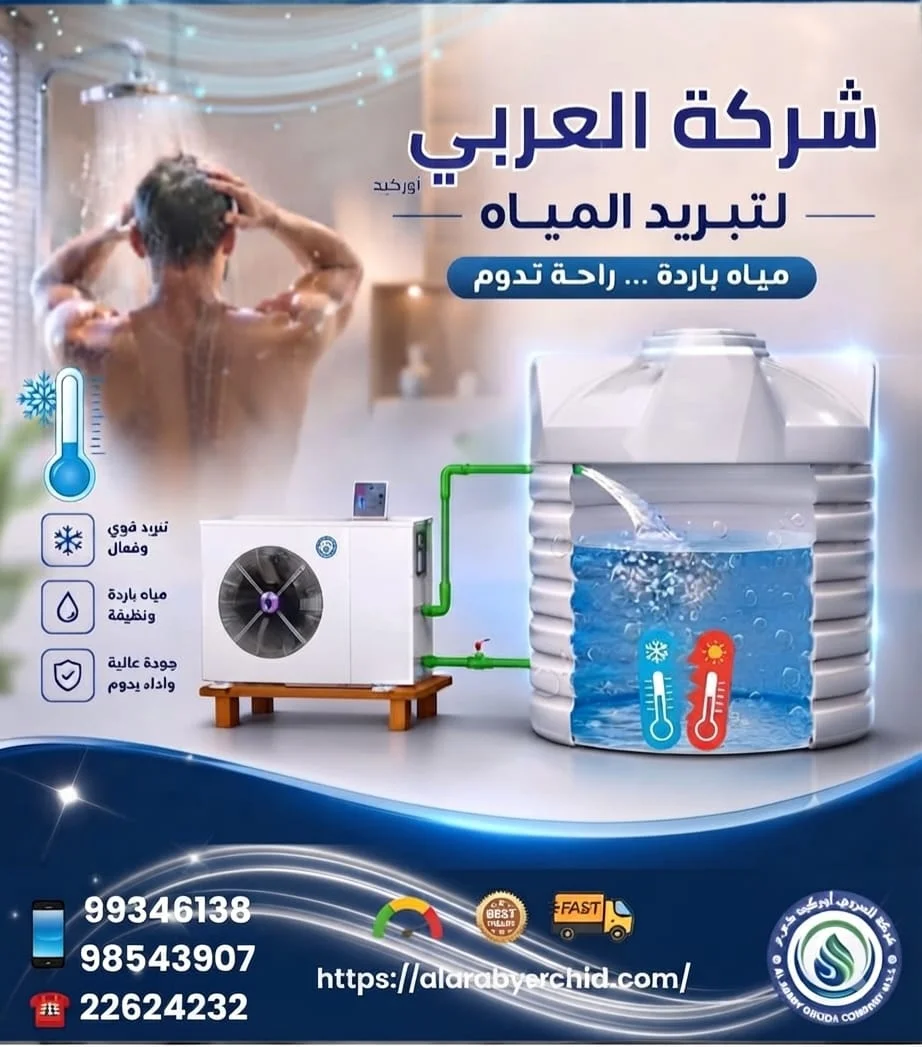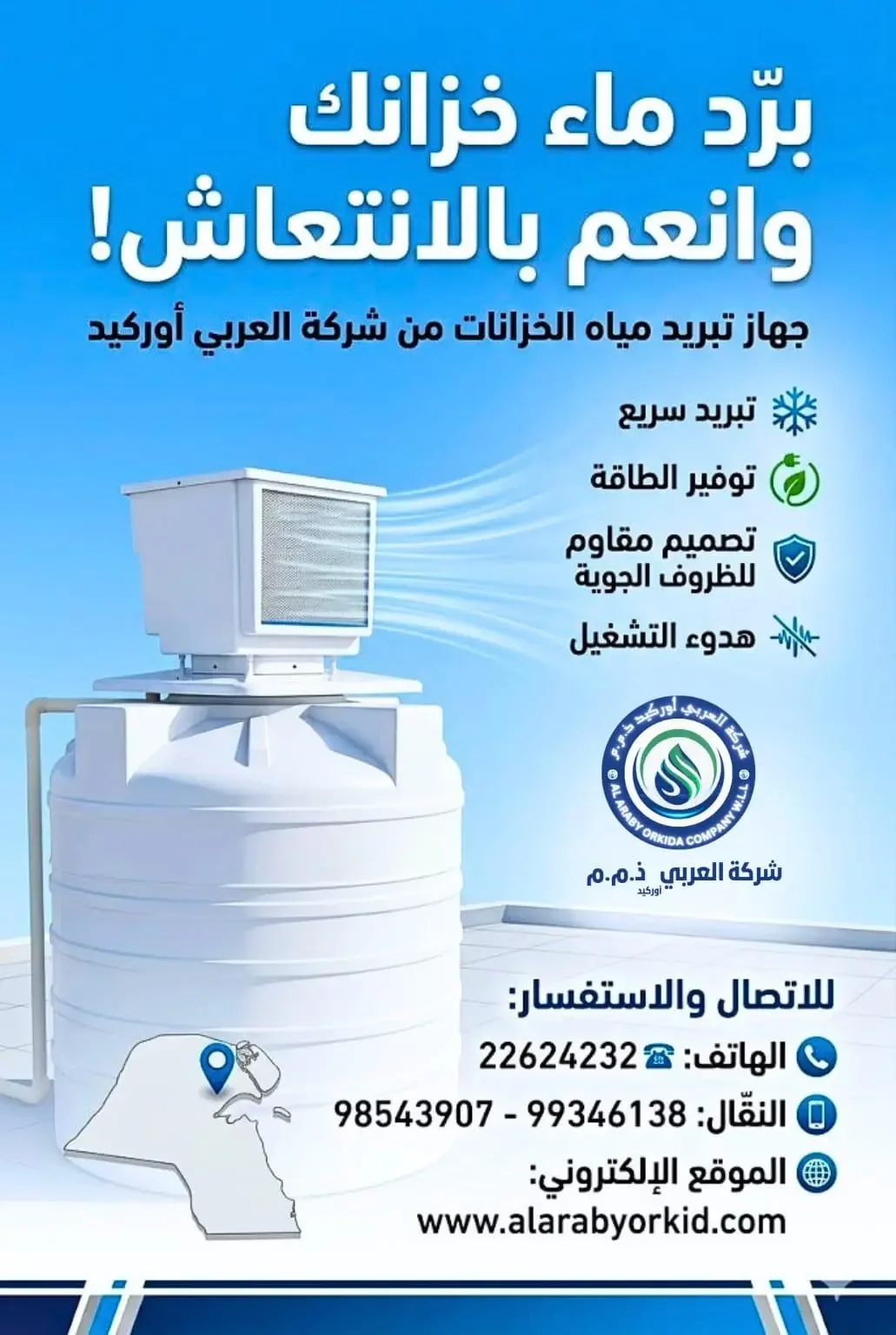
When the water tank cooler becomes weaker or suddenly stops during summer, the first mistake is assuming immediately that the compressor has failed or that the system “needs gas.” Proper water tank cooler repair starts by identifying the symptom accurately. Does the unit fail to start at all? Does it operate while the water stays warm? Has cooling become slower than before? Is the problem affecting the entire tank, or is it related to the circulation loop? Al Arabi Orchid currently works with Falcon, LG, and Wansa compressor systems and with Cool Shower, Cool King, and Gold Star fan systems, so the diagnostic process changes according to the cooling technology involved. The goal of proper maintenance is to prove the cause before replacing any component and restore the cooler to normal performance with the least unnecessary intervention.
Water Tank Cooler Repair in Kuwait

Water tank cooler repair in Kuwait requires an organized diagnostic process because the statement “the cooler is not cooling” can describe several completely different faults. The first step is to separate a unit that does not start at all from a unit that runs but fails to lower water temperature and from another unit that still cools but does so much more slowly than before. These three situations should not be approached with the same repair method.
If the unit does not operate at all, the inspection starts with electrical supply and controls. Is power reaching the unit? Has the breaker tripped? Is the timer sending a start command? Is a contactor, starting component, or thermal protection device preventing operation? Manufacturer diagnostic guidance for condensing units commonly includes loss of power, loose electrical connections, breaker or fuse problems, and faulty starting or control components among the items that should be checked before concluding that the compressor itself has failed. These electrical inspections should be carried out by a qualified technician because compressor circuits are not suitable for household experimentation.
If the compressor operates but the water does not cool, the diagnostic scope becomes wider. Possible causes of weak cooling can include low refrigerant charge, a dirty condenser, poor ventilation around the unit, reduced compressor efficiency, incorrect operating settings, or restrictions inside the refrigeration circuit. In a water tank cooling system, one more factor becomes extremely important: water flow through the circulation loop. The cooling circuit may be producing refrigeration, but if enough water is not actually moving through the system, that cooling effect will not transfer efficiently to the tank.
Water-cooled and water-circulation systems also depend on adequate water flow and proper heat rejection, which supports the idea that a technician should not focus only on refrigerant or the compressor.
Consider a practical example. The customer says, “the unit has been running for two hours but the tank water is still hot.” A qualified technician should not start by adding refrigerant. The technician first measures the water temperature, checks whether circulation is moving, inspects condenser airflow and fan operation, verifies the controls, and only then moves to refrigeration-system measurements when necessary.
-
If the unit is completely off diagnosis should begin with electrical supply and control before opening the refrigeration circuit or blaming the compressor
-
If the unit runs but the water does not cool circulation condenser airflow and the refrigeration circuit should be evaluated as one complete system
-
Low refrigerant is one possible technical cause but it is not an automatic diagnosis whenever tank water feels warmer than usual
-
Measuring water temperature before inspection and after repair provides clearer proof of success than relying only on touch
-
Al Arabi Orchid currently advertises installation and maintenance for tank cooling systems across all six governorates and can be contacted on 99346138
Water Tank Cooler Repair Technician
A water tank cooler repair technician is not simply someone who arrives with tools and starts taking the unit apart. The real value of a specialist appears in the order of diagnosis and in reaching the actual cause while replacing as few unnecessary parts as possible.
The first thing the technician needs to identify is the type of system. Is it a Falcon, LG, or Wansa system using a compressor and circulation? Or is it a Cool Shower, Cool King, or Gold Star fan-based cooler? Al Arabi Orchid currently works with these categories, and because the technologies are different, the faults expected in each system are also different.
With a compressor-based system, the technician records operating behavior. Does the unit start normally? Does it shut down quickly? Does it keep running continuously? Is the outdoor fan operating? Is hot air leaving the condenser normally? Is there visible or measurable water movement through the circulation loop? The technician then checks controls, timer operation, and sensors depending on the specific design.
If the compressor starts and stops repeatedly in short cycles, it is not correct to immediately say “the compressor is weak.” Repeated short cycling may be related to electrical supply problems, safety protection, refrigerant conditions, high discharge pressure, excessive load, or insufficient compressor cooling. Repeated starting itself can also increase thermal and electrical stress.
With a fan system mounted above the tank, the diagnostic path is different. The technician checks whether the motor starts, whether the fan rotates normally, whether there is rubbing, vibration, reduced speed, or blocked airflow. There is no compressor pressure or refrigerant charge to inspect in this type of system, so applying compressor-based diagnosis to a fan cooler would be technically incorrect.
A skilled technician should also avoid relying on the question “does it feel cold or not?” It is better to measure the water temperature before operation and after a known period and observe water movement and equipment behavior. If weak cooling is caused by increased system load, such as the addition of another tank or a large increase in household consumption, replacing a component will not solve the problem because the unit may still be mechanically healthy while facing a higher load than before.
Electrical testing should be handled carefully. Measuring unit voltage, compressor windings, capacitors, or protective devices should be performed by a qualified technician, especially because cooling equipment may use higher-power electrical circuits.
-
A good technician begins by identifying whether the problem is electrical control flow-related or refrigeration-related instead of replacing parts by guesswork
-
The history of the fault matters because a system that cooled properly for years and suddenly became weak is different from one that never achieved the required temperature from the first day
-
Repeated shutdowns require identifying why protection is operating before repeatedly restarting the unit
-
Fan-based systems should be diagnosed through motor rotation airflow and mechanical condition rather than refrigerant-related checks
-
A short written service report explaining what was checked and what was actually proven faulty helps protect the customer from unnecessary part replacement
Repairing Water Cooler Faults

Repairing water cooler faults becomes much easier when the faults are classified according to the symptom rather than placing every complaint under “not cooling.” In practice, several different operating scenarios can appear, and each one requires its own inspection path.
Fault 1: The unit does not operate at all.
The technician checks power supply, breaker, controls, timer, wiring connections, starting components, and protective devices. Diagnostic guidance for condensing units commonly begins with these items before moving toward major component failure.
Fault 2: The unit operates but cooling is weak.
Possible causes include low refrigerant charge, condenser fouling, poor ventilation, weak compressor pumping, unsuitable system settings, or restrictions within the refrigeration circuit.
Fault 3: Cooling appears to occur at the unit but the tank remains hot.
In this case, attention shifts strongly toward circulation. Water flow may be weak, the return line may distribute water poorly, a valve may be partly closed, or the loop may contain a restriction. Water-cooling systems depend on actual flow through the circuit, so inadequate water movement can directly reduce performance.
Fault 4: The unit cools for a period and then shuts down.
Possible causes include thermal protection, high operating pressure, poor ventilation, or a condenser fan problem. High condensing pressure can be associated with a dirty condenser or fan failure, while excessive compressor temperature can be related to high discharge pressure, excessive load, or frequent starts.
Fault 5: Cooling has gradually become slower.
This situation often justifies checking cleanliness, airflow, circulation, and maintenance history before assuming a major failure.
Fault 6: A new noise or vibration appears.
The technician identifies whether the sound comes from the fan, compressor, mounting points, or piping. Noise should be treated as a separate diagnostic symptom because the causes of “compressor noise” are not the same as the causes of “compressor does not start.”
Fault 7: The unit runs continuously.
Here, system capacity is compared with the cooling load while the technician checks condenser condition, ventilation, water flow, refrigeration performance, and control settings. Long operating time alone does not prove that the unit is either strong or weak.
-
Classifying the fault according to how the problem appears reduces the number of possibilities before any component is dismantled
-
A running unit with no reduction in water temperature directs attention toward circulation and heat transfer rather than the compressor alone
-
Repeated safety shutdowns should be diagnosed instead of resetting the breaker and restarting the unit every time
-
Gradually slower cooling often deserves airflow cleanliness and circulation checks before assuming a major failure
-
Keeping a record of water temperatures and operating times helps the technician compare current performance with normal operation
Water Tank Cooler Is Not Cooling
If the water tank cooler is not cooling even though you can hear the unit running, do not assume that this proves “the gas has run out.” That assumption often sends the diagnosis in the wrong direction.
The first question is: is the water circulating at all? In a compressor system with circulation, there must be actual water movement between the tank and the cooling unit. If flow has stopped or become significantly weaker, the compressor can continue operating while the tank receives very little benefit. Water flow is therefore not a secondary detail in water-based cooling systems.
The second question is: can the condenser reject heat properly? If condenser fins are dirty, airflow is blocked, or the condenser fan has stopped, refrigeration performance can drop significantly and operating pressure may rise. Poor ventilation and dirty condenser surfaces are common causes of insufficient cooling and high condensing pressure.
The third question is: are the operating settings correct? The timer may have been changed, or the operating schedule may not give the unit enough time to cool the water before peak household usage.
The fourth question is: has the tank load changed? Installing a larger tank, adding more users, or introducing much more fresh water can cause a system that used to be adequate to run longer and deliver weaker results.
The fifth question is: is there a fault inside the refrigeration circuit itself? At this stage, a qualified technician checks pressures, pipe temperatures, refrigerant charge, restrictions, and compressor pumping performance according to the unit specifications. Low refrigerant, internal restrictions, or poor compressor efficiency are among the technical possibilities for weak cooling.
Most importantly, adding refrigerant without finding the reason is not proper maintenance if the system genuinely has lost charge. If refrigerant loss is caused by a leak, the source should be identified and repaired before the system is recharged according to manufacturer procedures.
-
Hearing the compressor run does not prove that cooling is actually reaching the tank water
-
One of the first practical checks should be circulation flow followed by condenser heat rejection before jumping to refrigerant charge
-
If the problem started after changing tank size or household usage the cooling load should be compared again with unit capacity
-
Low refrigerant should be diagnosed through technical measurements rather than water temperature alone
-
Repairing a leak when one exists is more important than simply recharging the unit and waiting for the same problem to return
Water Tank Cooling Compressor Maintenance

Water tank cooling compressor maintenance does not mean opening the compressor during every service visit. Proper maintenance focuses on all the surrounding conditions that allow the compressor to operate correctly because many compressor failures begin with a problem around the compressor rather than inside it.
The first area is condensing and ventilation. The compressor moves heat from the colder side to the hotter side, and the condenser must be able to reject that heat. High condensing pressure can be related to a dirty condenser or a condenser fan problem, so condenser cleaning and fan inspection are important parts of maintenance.
The second area is the number of starts and stops. Frequent short cycling increases stress on starting components and the compressor. Repeated starting can also contribute to excessive compressor-body temperature.
The third area is electrical supply. Voltage, electrical connections, contactors, and starting components all play a role in units that fail to start or shut down unexpectedly. Direct testing of voltage, capacitors, and compressor windings should be carried out by a qualified technician.
The fourth area is refrigerant charge and the refrigeration circuit. Refrigerant charging should not be treated as a routine annual service that automatically needs to be done every year. A properly sealed refrigeration system should not require refrigerant simply because time has passed. If measurements indicate low charge, the technician should investigate the cause and compare readings with manufacturer specifications.
The fifth area is water circulation. Even when the compressor operates perfectly, weak water flow can force the unit to run for longer periods to achieve the same result and can create poor system performance.
The sixth area is monitoring sound, temperature, and behavior. Changes from normal operation are more useful than arbitrary numbers. New noise, repeated thermal shutdown, or suddenly longer cooling time should trigger inspection.
If testing confirms that the compressor operates but cannot produce adequate pumping performance after outside causes have been excluded, replacement can become justified. The important point is that compressor replacement should follow evidence rather than being the first decision during the service visit.
-
Keeping the condenser clean and providing enough ventilation allows the compressor to reject heat under better operating conditions
-
Frequent starting and stopping should be investigated because repeatedly restarting the unit can increase stress instead of solving the fault
-
Refrigerant charging is not a fixed periodic maintenance item and should be linked to measurements and leak diagnosis when necessary
-
Weak circulation can extend compressor operating time even when the compressor itself is healthy
-
Compressor replacement becomes reasonable only after testing proves poor pumping performance or actual compressor failure
Water Tank Cooler Fan Repair
Water tank cooler fan repair is completely different from servicing a Falcon, LG, or Wansa compressor system. Al Arabi Orchid currently lists Cool Shower, Cool King, and Gold Star among fan-based systems mounted directly above the tank, and these units do not use the same refrigerant circuit found in compressor-based systems.
One common symptom is that the fan does not rotate at all. The technician checks the electrical supply, switch or control device, wiring, and motor components according to the model. If there is a humming sound without rotation, there may be a mechanical obstruction or a starting problem depending on the motor design, but no component should be replaced before proper testing.
The second symptom is slow rotation. The cause may be electrical, mechanical, or related to wear in moving components or dirt buildup that interferes with blade movement.
The third symptom is vibration or loud noise. The technician checks fan mounting, blade condition, shaft alignment, foreign objects, and imbalance. Continued vibration is not only annoying; over time it can also put additional stress on the mounting points above the tank.
The fourth symptom is that the fan rotates normally but cooling effectiveness becomes weaker. In this situation, airflow, tank condition, and surrounding environmental conditions should be checked. The fan may be mechanically healthy while direct sunlight has increased or a cover or obstruction has reduced airflow around the system.
The fifth point is mounting safety. Because Cool Shower, Cool King, and Gold Star are installed above the tank, maintenance should not focus only on the motor. Mounting condition, tank opening, electrical wiring, and future service access are also part of the inspection.
Cool Shower is currently described by Al Arabi Orchid as a simple fan-based cooling solution, while Cool King and Gold Star are also listed in the same general category.
-
A fan that does not rotate should have its power supply motor and starting components checked before deciding to replace the entire unit
-
New noise or vibration should trigger inspection of the blade mounting and shaft before it becomes a larger problem
-
Weak airflow can reduce cooling performance even when the motor continues to rotate
-
Fan maintenance includes mounting wiring and rooftop installation condition rather than the motor alone
-
Diagnosing Cool Shower Cool King and Gold Star differs from compressor diagnosis because the technology is fundamentally different
Inspecting a Water Tank Cooling Device

Inspecting a water tank cooling device is best performed using a consistent checklist so important steps are not skipped and diagnosis does not become guesswork.
The inspection begins with the water itself. The technician measures tank-water temperature before operation or at the beginning of the visit and records the time. The technician also asks what temperature the system normally achieved previously if that information is known.
Next come commands and controls. The timer, sensor, or thermostat is checked depending on system design to confirm that the unit is actually receiving the correct operating command.
After that comes water movement in circulation systems. Is there actual flow? Are the supply and return lines open? Is there any leak or obstruction? Water-flow problems can directly reduce performance and can also trigger protective operation in water-cooling systems.
The next stage is heat rejection. The technician checks the outdoor fan, condenser condition, and available ventilation space. Poor ventilation and dirty condenser surfaces are among the common causes of insufficient cooling.
Only then does the technician move to the refrigeration circuit in compressor systems. Required measurements are taken according to refrigerant type and manufacturer specifications to evaluate pressures, temperatures, refrigerant condition, restrictions, and compressor efficiency. This work belongs to a qualified refrigeration technician because it involves refrigerant pressure and electrical equipment.
Then comes electrical inspection. Voltage, current, protective devices, and operating components are reviewed by a qualified person.
Finally, the unit is restarted and the post-repair result is measured. A strong service report should not say only “repair completed.” It should explain, for example, that circulation returned to normal, the unit operated without unexpected shutdown, and tank-water temperature began dropping in line with expected system performance.
-
Begin inspection with a measurable symptom such as water temperature rather than a vague description such as “it feels like it is not cooling”
-
Separate circulation testing from refrigeration testing because either one can independently reduce system performance
-
The condenser and outdoor fan should be checked before assuming a major internal fault
-
Pressure refrigerant and electrical measurements should be performed by a qualified technician according to unit data
-
Repeating measurements after repair is what proves the problem was corrected rather than simply replacing a component and turning the unit on
Repairing a Water Tank Cooler
Repairing a water tank cooler should consider the relationship between the cooling unit and the tank itself. Sometimes the unit is repaired correctly, but the customer still says, “the result is not like before,” because the tank conditions have changed.
Example one: the home originally had one tank, and later a second tank was added to the same network. The old cooling unit now handles a larger total water volume. If the load has increased beyond system capacity, there may be no failed component to repair. The correct action is to reassess capacity.
Example two: the cooling unit was moved into a tighter corner or new rooftop equipment was installed directly in front of the condenser. Poor condenser ventilation can reduce cooling performance and increase operating pressure even when the refrigeration circuit itself remains healthy.
Example three: the tank piping was modified and circulation became weaker. The compressor may still operate with the same efficiency, but less water now passes through the cooling path.
Example four: the timer that used to start the system before peak demand changed after a power interruption or manual adjustment. The unit now begins cooling too late, so the customer experiences hot water during normal use.
These examples show that “repairing the cooler” does not always mean opening the cooling unit itself.
After inspection, the technician should generally reach one of four conclusions:
The device is healthy and the issue is operational
The device is healthy and the problem is circulation or site conditions
A specific component needs repair or replacement
The compressor or fan motor itself has been proven faulty and requires replacement
This order reduces unnecessary cost and gives the customer a decision based on evidence.
Al Arabi Orchid currently advertises installation and maintenance for cooling systems, tanks, pumps, and related water services, which can be useful when diagnosis needs to include more than one part of the plumbing network.
-
Changing the number or size of tanks can make a healthy cooling system appear weak because the load itself has changed
-
Moving the unit or blocking condenser airflow can reduce cooling without any internal compressor failure
-
Any plumbing modification carried out before the cooling problem appeared should be reviewed during diagnosis
-
Timer settings should be checked especially when the problem starts after a power interruption or operating change
-
The best repair determines whether the cause is inside or outside the cooling unit before judging major components
Water Tank Cooler Maintenance Technician

A water tank cooler maintenance technician needs to understand both refrigeration and water movement because tank-cooling systems combine the two. This makes them different from repairing a household refrigerator or an ordinary fan.
With a Falcon, LG, or Wansa system, the technician needs to understand the refrigeration circuit while also reviewing the water circuit. If refrigerant pressures are normal but circulation has stopped, the customer will still receive poor cooling. If water flow is excellent but the condenser is dirty or the outdoor fan has failed, cooling capacity will still drop.
Professional troubleshooting guidance lists multiple possible causes for weak cooling rather than one single explanation, including refrigerant condition, ventilation, condenser performance, compressor efficiency, control settings, and internal restrictions. This is exactly the type of diagnostic thinking a technician should use instead of making a decision from the first symptom.
The technician should also know when not to replace the compressor. If testing proves that the problem is a condenser fan, contactor, or water-flow issue, compressor replacement would be wasteful. On the other hand, if the compressor operates but testing proves that it cannot pump effectively, replacement becomes justified.
With Cool Shower, Cool King, and Gold Star systems, the technician needs a different diagnostic approach focusing on the fan motor, blade, mounting, electrical supply, and airflow.
Al Arabi Orchid currently advertises installation and maintenance for cooling systems and tanks across all six governorates with 24/7 service and the contact number 99346138.
It is also helpful for the customer to provide any previous information during the visit: when the problem began, whether a tank or water line was changed, whether repeated power interruptions occurred, and whether refrigerant was previously added. Every useful detail reduces unnecessary diagnostic guessing.
-
A water tank cooler technician needs to see the water circuit and refrigeration circuit as one complete system
-
Replacing the compressor without proving poor compressor performance can turn a simple fault into an unnecessarily expensive repair
-
Knowing what changed in the plumbing system before the problem appeared can shorten diagnosis significantly
-
The technician should change the inspection method between compressor coolers and fan coolers because their components are different
-
Al Arabi Orchid maintenance service can be requested on 99346138 across all six governorates according to the company’s current service coverage
Water Tank Cooling Repair Service
A strong water tank cooling repair service begins from the first phone call. Instead of saying only “the cooler is broken,” try to explain whether it is Falcon, LG, Wansa, Cool Shower, or another type, whether the unit runs, whether you hear the compressor or fan, and whether the problem is complete failure, weak cooling, repeated shutdown, or unusual noise.
This information allows the technician to arrive with a clearer idea of the system likely to be inspected.
At the property, the service starts with visual diagnosis: tank condition, cooling unit, piping, leaks, condenser condition, and fans. Then the unit is operated and observed. After that, technical measurements are performed according to the type of system.
If the cause is simple, such as an incorrect timer setting, weak flow caused by a cleanable obstruction, or a loose connection, the actual cause should be corrected. If a refrigeration fault appears, it should be proven through measurements. If a major component is found defective, the customer should be shown why that conclusion was reached.
Professional service should also separate repair from preventive maintenance. Repair corrects an existing fault. Preventive maintenance tries to reduce the chance of future failures by addressing issues such as condenser dirt, poor ventilation, weak connections, or unsuitable operating settings before they cause complete shutdown.
There should not be one fixed statement such as “service every three months for every home” without considering conditions. A tank cooler on a dusty, heavily exposed rooftop operating for long periods needs a different maintenance pattern from a seasonal unit operating in a cleaner location.
Al Arabi Orchid currently advertises service across Capital, Hawalli, Farwaniya, Jahra, Ahmadi, and Mubarak Al-Kabeer with 24-hour installation and maintenance coverage.
After repair, ask the technician to explain:
What the fault was
What was replaced or cleaned
Whether circulation was tested
Whether water temperature was measured
Whether there is anything that should be monitored later
These five questions give you a much clearer understanding than simply receiving the unit back because it has started running.
-
When requesting service describe the cooler type and the exact symptom so diagnosis begins closer to the real cause
-
Repair addresses the current fault while preventive maintenance checks the conditions that could cause the fault to return
-
There is no single maintenance interval suitable for every system because dust operating hours and heat exposure vary by location
-
After repair ask what component or cause was proven faulty and what test confirmed that performance returned
-
For water tank cooler repair from Al Arabi Orchid contact 99346138
Conclusion
Water Tank Cooler Repair | Al Arabi Orchid Technician 99346138 should not begin with replacing the compressor or automatically adding refrigerant. The best repair process starts by identifying the symptom and then narrowing the possibilities step by step.
If the unit does not operate, the technician begins with power supply, controls, starting components, and protection. If the unit operates but the water does not cool, circulation, condenser condition, fan operation, ventilation, and then the refrigeration circuit should be checked. Professional compressor and refrigeration diagnostic guidance shows that weak cooling can result from several factors such as electrical supply, ventilation, condenser condition, refrigerant charge, restrictions, and compressor efficiency, so assuming one cause without measurement is not professional diagnosis.
Water tank systems also have one additional factor that is especially important: water flow. If circulation is weak, the compressor may be completely healthy while the transfer of cooling into the tank remains poor. Correct flow is essential for stable performance in water-cooling systems.
If the problem involves Cool Shower, Cool King, or Gold Star, diagnosis focuses more on the fan, motor, electrical supply, mounting, and airflow because these systems are technically different from Falcon, LG, and Wansa compressor units.
During compressor maintenance, remember that refrigerant charging is not an automatic routine service. If the system has lost charge, the reason should be identified. If compressor efficiency is suspected, the decision should be based on appropriate testing.
Al Arabi Orchid currently works with Falcon, LG, Wansa, Cool Shower, Cool King, and Gold Star and advertises tank-cooling installation and maintenance throughout all six governorates with 24/7 service.
If your tank cooler has stopped, cools more slowly, or shuts down repeatedly, contact 99346138 and describe the unit type and the exact symptom. The more accurate the description is, the faster the technician can move toward the real cause instead of replacing parts by assumption.
Frequently Asked Questions
Why does my water tank cooler run but not cool?
Possible causes include weak circulation, a dirty condenser, poor ventilation, a stopped condenser fan, unsuitable operating settings, a fault in the refrigeration circuit, or reduced compressor efficiency. A running unit therefore does not automatically mean the system is healthy.
Does weak tank cooling mean the refrigerant is low?
No. Low refrigerant is only one of several possibilities. Other possible causes include dirty condenser surfaces, poor ventilation, restrictions, compressor performance problems, and control settings. Refrigerant charge should be judged through technical measurements rather than water temperature alone.
When does a water tank cooling compressor need replacement?
Replacement becomes reasonable when testing proves that the compressor itself has an electrical or mechanical failure or when it runs but cannot achieve the required pumping performance after outside causes have been excluded.
Why does the water tank cooler keep switching off and restarting?
Possible causes include electrical supply problems, protective shutdown, high operating pressure, poor ventilation, excessive load, or unsuitable refrigerant conditions depending on the unit. Repeated cycling should be diagnosed instead of repeatedly resetting and restarting the system.
Can weak circulation cause poor tank cooling?
Yes. In compressor systems that depend on circulating water, insufficient flow can prevent cooling from being transferred properly to the tank even when the cooling unit itself is operating.
How do I know whether the tank cooler fan needs repair?
Possible signs include failure to start, slow rotation, new noise or vibration, or noticeably weaker airflow. The electrical supply, motor, fan blade, and mounting should be checked before deciding to replace the entire fan.
Is cleaning the tank cooler condenser important?
Yes, in air-cooled compressor systems. A dirty condenser or restricted airflow can reduce heat rejection, raise condensing pressure, and weaken overall performance. Condenser cleaning and fan inspection are important parts of troubleshooting these conditions.
Can I test the compressor electricity myself?
It is better not to. Voltage, current, capacitor, winding, and protective-device testing should be performed by a qualified technician because mistakes can create serious risk to both the person and the equipment.
Does Al Arabi Orchid repair Falcon, LG, Wansa, and Cool Shower systems?
Al Arabi Orchid currently advertises installation and maintenance for water tank cooling systems and lists Falcon, LG, Wansa, Cool Shower, Cool King, and Gold Star among the cooling products it works with.
How do I request a water tank cooler repair technician?
Call 99346138 and provide the cooler type, whether the unit runs or does not run, and whether the problem is complete shutdown, weak cooling, repeated cycling, or unusual noise. Al Arabi Orchid currently advertises 24/7 installation and maintenance service across all six governorates of Kuwait.