Choosing between an 80-gallon or 120-gallon central water heater is different from choosing a capacity for an average-sized home because here we are usually talking about a villa or a large house with several bathrooms and multiple hot-water fixtures that may operate at the same time. Eighty US gallons is approximately 303 liters, while 120 gallons is about 454 liters by direct conversion, although the actual nominal capacity of some models may be 118 or 119 gallons. The correct decision does not depend on the size of the building alone. It depends on Peak-Hour Demand, First-Hour Rating, recovery rate, heating-element capacity, and the number of hot-water fixtures operating simultaneously. Al Arabi Orchid currently offers 80 and 120-gallon categories among the American central water heaters it installs in Kuwait.
80 or 120 Gallon Central Water Heater
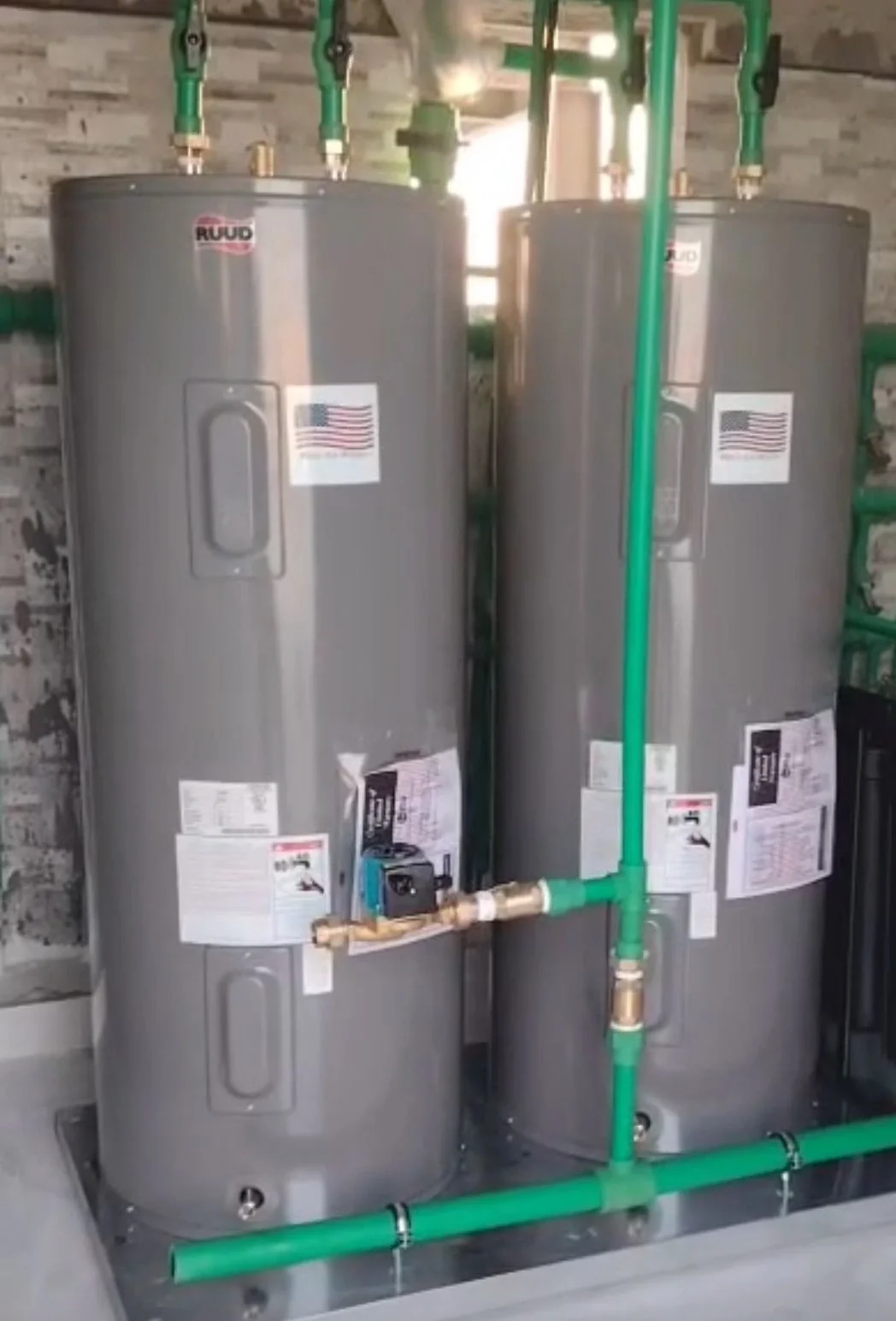
When the question is 80 or 120 gallon central water heater, one of the biggest mistakes is saying, “The villa is large, so choose 120 gallons.” The size of the villa does not consume hot water. What consumes hot water is the number of showers, sinks, bathtubs, and other fixtures operating during the same period. A large villa with only two or three occupants who use hot water at different times may be served comfortably by an 80-gallon heater, while a smaller house with a large family using three bathrooms during the morning hour may create much greater demand and require serious consideration of a 120-gallon system.
Eighty US gallons is approximately 303 liters, while 120 gallons converts to roughly 454 liters. However, commercial and large residential models are not always exactly equal to those mathematical capacities. One useful example comes from Bradford White: the RE380T6 model is nominally rated at 79 gallons, while the RE3120T6 model is nominally rated at 118 gallons, with Rated Storage Volumes of 73 and 108 gallons respectively. This is why when people say 80 or 120 gallons, they are often referring to a capacity category, and the final reference should always be the specification sheet for the exact model.
More important than nominal storage is the First-Hour Rating. The U.S. Department of Energy defines FHR as an estimate of the maximum amount of hot water a storage heater can provide during an hour that begins with the tank fully heated. In the same Bradford White example, the 80-gallon category has an FHR of 76 gallons, while the 120-gallon category has an FHR of 110 gallons. This is a meaningful difference in the amount of hot water available during the busiest hour, but it does not necessarily come from faster recovery. The published recovery rate for both models in this example is 21 gallons per hour at a 90°F temperature rise. The primary performance difference here therefore comes from the larger stored reserve.
This is where the purchasing decision becomes clearer. If the villa’s peak demand falls comfortably within the capacity of an 80-gallon model with a reasonable margin, installing 120 gallons may simply be unnecessary oversizing. If several bathrooms are used within the same hour and household demand approaches the limit of the 80-gallon model, the additional reserve of the 120-gallon model begins to provide real value.
-
An 80-gallon model makes sense when the property has many fixtures on paper but actual simultaneous usage remains comfortably within the model’s FHR
-
A 120-gallon model becomes more attractive when several bathrooms depend on the same tank during the same hour and demand approaches or exceeds the capacity of the 80-gallon category
-
Do not assume every 120-gallon model contains exactly 120 gallons because some are nominally rated at 118 or 119 gallons
-
The difference between the two sizes should be judged using FHR recovery rate and wattage rather than gallons alone
-
Before ordering from Al Arabi Orchid on 99346138 ask for the exact model numbers and full specifications for both the 80 and 120-gallon options
Difference Between 80 and 120 Gallons
The difference between 80 and 120 gallons is not simply an extra 40 gallons. The difference also appears in stored thermal reserve, First-Hour Rating, physical dimensions, filled weight, installation requirements, initial cost, and standby heat loss.
In basic storage terms, moving from 80 to 120 gallons represents roughly a 50% increase in nominal capacity. However, in the Bradford White large-volume example, the nominal 80-gallon category is actually 79 gallons while the nominal 120-gallon category is 118 gallons. Rated Storage Volume is 73 versus 108 gallons, while FHR is 76 versus 110 gallons. The practical difference for the homeowner is therefore not merely the number written on the product label but how much additional hot water the system can actually provide during a heavy-use hour.
The second difference is physical size. In the example above, the 80-gallon category is approximately 26 inches in diameter and around 60⅛ inches high, while the 120-gallon category is approximately 30¼ inches in diameter and 63 inches high. A difference of a few inches in diameter may look minor on paper, but inside a tight mechanical room it can affect access, movement around the heater, heating-element service, and access to the safety valve.
The third difference is weight. The approximate shipping weight in the same specifications is 202 pounds for the 80-gallon category and 302 pounds for the 120-gallon category before adding water. Once filled, total weight rises dramatically because the stored water itself is heavy. Upgrading to 120 gallons therefore requires checking the support base and installation location, especially if the heater is placed on a roof, elevated service area, or older platform.
The fourth difference is recovery. This is where many buyers misunderstand the comparison. In the Bradford White example, both models have a 21 GPH recovery rate at a 90°F rise. The 120-gallon model does not automatically heat incoming cold water faster just because its tank is larger. Instead, it keeps a greater amount of already heated water available. The same principle appears in some A. O. Smith 80 and 119-gallon models that use a 4,500-watt element and have a 21-gallon-per-hour recovery rate at the same temperature rise.
-
A 120-gallon heater clearly provides a larger stored reserve but larger storage should not be confused with a faster recovery rate
-
Greater tank diameter and weight change installation requirements so site measurement should be part of the buying decision rather than an afterthought
-
If the element wattage is the same in both models the 120-gallon heater may not reheat incoming water faster than the 80-gallon heater
-
First-Hour Rating shows the practical value of the capacity increase more clearly than comparing the numbers 80 and 120 alone
-
The higher purchase cost is justified when the household genuinely uses the additional capacity rather than simply wanting the largest tank available
Comparing an 80 Gallon and 120 Gallon Water Heater

A comparison between an 80-gallon and 120-gallon water heater is fair only when the other variables are kept as similar as possible. It would not be accurate to compare an 80-gallon model from one product category with a more powerful 120-gallon commercial model and claim that the entire performance difference comes from storage size.
A useful example comes from Bradford White’s Large Volume Models. The 80-gallon category, model RE380T6, has a nominal capacity of 79 gallons, an FHR of 76 gallons, a UEF of 0.92, and a recovery rate of 21 gallons per hour at a 90°F rise. The 120-gallon category, model RE3120T6, has a nominal capacity of 118 gallons, an FHR of 110 gallons, a UEF of 0.90, and the same 21-gallon-per-hour recovery rate.
This comparison teaches an important lesson. In this example, the 120-gallon heater does not recover faster. It provides a larger reserve before the system becomes increasingly dependent on recovery during use. This is exactly what some villas need. If three showers begin within a short period, having more stored hot water reduces the chance that the last user quickly reaches colder water.
If the bathrooms are used one after another with long intervals between them, recovery has time to replace part of the consumed heat, and an 80-gallon model may cover the demand without requiring the extra capacity.
The comparison should also include UEF, which is an efficiency indicator rather than a direct monthly consumption figure. In the Bradford White example, the 80-gallon category has a UEF of 0.92 while the 120-gallon category has a UEF of 0.90. This does not mean every 80-gallon heater is always more efficient than every 120-gallon heater. It simply demonstrates why the exact model data should be reviewed rather than making assumptions from tank size.
Warranty and parts availability should also be included. Al Arabi Orchid currently states that it works with Ruud, Bradford White, A. O. Smith, Americana, Rheem, and Richmond and offers both 80 and 120-gallon categories among its published capacities.
-
A proper comparison uses two specific models and places FHR wattage recovery UEF and dimensions side by side
-
A 120-gallon model has an advantage when demand is concentrated while an 80-gallon model can remain strong when usage is distributed and there is a comfortable capacity margin
-
The same recovery rate in two heaters with different storage volumes means that much of the peak-hour performance difference comes from the amount of stored hot water
-
UEF belongs to the specific model and design so it is not correct to assume one tank size is always more efficient
-
Brand selection should also consider parts availability service support and warranty rather than storage capacity alone
120 Gallon Water Heater for a Villa
A 120 gallon water heater for a villa is justified when the villa’s actual demand pattern needs the additional reserve, not simply because the property has a large floor area or more rooms.
Imagine a villa with a main suite, two children’s bathrooms, and a guest bathroom. During the morning, the main shower and a second shower may operate together, followed immediately by a third hot-water use. In this case, consumption is concentrated into a short period. If Peak-Hour Demand is calculated and found to be close to the capability of the 80-gallon category, moving to 120 gallons provides a useful operating margin and reduces the chance of a temperature drop near the end of the busiest period.
The 120-gallon category can also make sense when the home has a large bathtub or high-flow showers that are used regularly because these fixtures can consume much more water than a short low-flow shower. The decision should not be based simply on the number of bathrooms. A bathroom that exists but is rarely used does not add meaningful demand to the heater.
A 120-gallon model may also be a sensible future-oriented choice when part of the villa is currently unused but confirmed expansion is expected soon, such as an additional family wing becoming occupied or a known increase in the number of residents. In that situation, providing a reasonable capacity margin can be more practical than installing a system already close to its limit and replacing it shortly afterward.
However, the installation space must be reviewed. In the Bradford White example, the 120-gallon category has a diameter above 30 inches and an empty shipping weight of more than 300 pounds, so the larger size has real installation consequences.
Long plumbing runs in villas may also require a hot-water recirculation pump to reduce waiting time, but a recirculation pump does not add storage capacity. Al Arabi Orchid currently advertises hot-water recirculation pumps starting from KWD 35. Their purpose is to deliver hot water to distant fixtures faster, not to turn an 80-gallon tank into the equivalent of a 120-gallon one.
-
A 120-gallon heater is suitable when actual peak demand is high rather than simply because the floor plan contains many bathrooms
-
Large bathtubs and high-flow showers should be included in the demand calculation because they can significantly increase hot-water use
-
Confirmed near-term household expansion provides a stronger reason for extra capacity than a vague possibility that may never occur
-
Before approving a 120-gallon model measure the heater-room width height support base and access path
-
If the only complaint is that hot water takes too long to reach distant bathrooms the real issue may be recirculation rather than tank capacity
80 Gallon Water Heater for a Large Home

An 80 gallon water heater for a large home is not a weak choice simply because a 120-gallon model is available. In many large homes, an 80-gallon heater is the better-balanced option when simultaneous demand remains moderate.
For example, a large home may have four bathrooms, but the family normally uses only two of them during the morning and there is a gap between most showers. The total number of bathrooms can create the impression that the largest possible tank is necessary, while actual Peak-Hour Demand may still fit comfortably within the capability of an 80-gallon model.
In the Bradford White 80-gallon example, the published FHR is 76 gallons. This means that particular model is designed to deliver a substantial amount of hot water during the first hour when it starts fully heated. However, this figure does not apply to every 80-gallon heater, so the exact model specification must always be checked.
An 80-gallon heater is also usually easier to accommodate physically than a 120-gallon model. In the same example, the 80-gallon category has a diameter of around 26 inches compared with more than 30 inches for the 120-gallon model, and its empty weight is approximately 100 pounds lower. This can make installation and future maintenance easier in homes with limited service areas.
From a cost perspective, the extra cost of the 120-gallon model should only be paid when its capacity will actually be used. Energy-efficiency guidance warns that oversizing a storage water heater can increase purchase cost and standby losses, so correctly sizing the system is generally better than choosing the largest tank simply as a precaution.
It is also important to confirm that the existing heater is functioning correctly. If an 80-gallon heater served the property for years and suddenly the hot water begins running out faster, the cause may be a lower heating element, scale buildup, dip-tube problem, or increased usage rather than proof that the home has outgrown the heater.
-
A large home can be served comfortably by an 80-gallon heater when actual simultaneous demand remains below the model’s capacity with a reasonable margin
-
The total number of bathrooms is less important than how many bathrooms actually operate during the same peak hour
-
An 80-gallon heater can be easier to install in some locations because of its smaller diameter and lower weight compared with a 120-gallon category
-
If the 80-gallon model covers current demand there is little operating benefit in storing dozens of additional gallons every day
-
Reduced performance from an existing 80-gallon heater may be a maintenance issue so inspect the heater before deciding to upgrade to 120 gallons
Choosing 80 or 120 Gallons for a Villa
Choosing 80 or 120 gallons for a villa becomes much more accurate when the decision is converted from a general question into a set of measurable numbers.
The first number is Peak-Hour Demand. Record the busiest hour in the home: how many showers were used, how long each shower lasted, whether a bathtub was filled, and whether the kitchen or another hot-water fixture operated at the same time. The goal is not to calculate the entire day. The goal is to understand the hardest hour for the heater.
The second number is the FHR for each specific model. Energy-efficiency guidance recommends choosing storage water heaters based on First-Hour Rating compared with peak-hour demand rather than nominal storage capacity alone.
The third number is Recovery Rate. If the 80 and 120-gallon models being compared use heating elements with similar output, their recovery rates may also be similar. In the Bradford White example, both are 21 GPH at a 90°F rise, which means the main advantage of the 120-gallon category is greater stored reserve rather than faster thermal recovery.
The fourth consideration is future margin. If Peak-Hour Demand is already very close to the FHR of the 80-gallon model and there is little room for additional use, the 120-gallon model can provide greater comfort. If demand is tens of gallons below the capability of the 80-gallon heater, the 120-gallon size becomes much harder to justify.
The fifth consideration is installation space. Measure the doorway, platform, ceiling height, and required service clearances before ordering.
The sixth consideration is total price rather than tank price alone. Ask Al Arabi Orchid for a comparison that includes the heater, installation, removal of the old unit, plumbing adjustments, and warranty. The company currently advertises a six-year tank warranty and two-year heating-element warranty, but a fixed individual price for the 80 and 120-gallon categories is not currently published on the main website.
-
Calculate the most demanding hour instead of selecting capacity from average daily consumption
-
Take FHR from the exact model specification because the words 80 or120 do not reveal real delivery capability
-
Check Recovery Rate so you can distinguish between greater storage and faster reheating
-
Allow a sensible margin for regular guests or confirmed expansion but do not double capacity because of unlikely future scenarios
-
Compare two complete quotations under the same installation conditions so you understand what you are actually paying for when upgrading to 120 gallons
120 Gallon Capacity for Large Families
A 120 gallon capacity for large families provides greater comfort when the number of family members translates into genuinely simultaneous hot-water demand. However, the phrase “large family” alone is not enough to determine heater size.
A family of eight that uses the bathrooms sequentially over three hours may create lower peak demand than a family of five where everyone needs a shower within a single hour. Usage timing therefore remains more important than the raw number of residents.
The main advantage of the 120-gallon category is reserve capacity. In the Bradford White example, the 120-gallon category has an FHR of 110 gallons compared with 76 gallons for the 80-gallon category. The 34-gallon difference in first-hour delivery between those two specific models can be significant in a home with concentrated demand.
However, it would still be incorrect to say that 120 gallons is guaranteed to serve eight or ten people. Shower type, flow rate, shower duration, storage temperature, incoming-water temperature, and mixing arrangements all change the result. Even a thermostatic mixing valve can influence the amount of usable mixed water delivered to fixtures.
Large families should also consider recovery after the peak period. If the model has a recovery rate of 21 gallons per hour, as in the Bradford White example, the extra storage helps during the peak hour, but after a large portion of the stored hot water has been used the heater still needs time to replace the consumed energy. A 120-gallon heater therefore does not provide unlimited hot water.
If family usage is spread throughout the day, an 80-gallon heater can sometimes be more than sufficient while taking less space and potentially costing less. The goal is to choose a heater that matches the usage pattern, not one that simply matches a family-size chart.
-
The number of family members is an initial indicator but it does not replace measuring demand during the busiest hour
-
The FHR difference between 80 and120 helps explain why additional storage benefits families with simultaneous usage
-
A 120-gallon heater does not mean unlimited hot water because recovery rate still matters after the stored reserve is consumed
-
Large families with staggered schedules may be served better by 80 gallons than a smaller family whose hot-water use is highly concentrated
-
Choosing 120 gallons becomes more justified when actual usage data repeatedly shows that the 80-gallon category is operating close to its limit
80 or 120 Gallons for Large Homes
The choice between 80 or 120 gallons for large homes depends more on the way the house operates than on the simple description “large home.” A large property may have two floors, long plumbing runs, and several bathrooms, but that creates three different questions: is storage capacity sufficient, is water pressure adequate, and does hot water reach distant fixtures quickly?
A capacity problem is addressed by selecting 80 or 120 gallons according to actual demand. Delayed hot-water arrival is usually addressed through a properly designed recirculation system. Pressure problems involve the pump and plumbing network. Mixing these three problems can lead the homeowner to purchase a larger tank when the real issue is not the amount of stored hot water.
Al Arabi Orchid currently provides American central water heaters, pumps, and hot-water recirculation systems as separate services, which reflects the fact that each component performs a different job within the system. Its hot-water recirculation pump service currently starts from KWD 35, but the pump does not increase tank storage capacity.
If the home is large but only two showers normally operate during the same period and demand falls within the FHR of an 80-gallon model, the 80-gallon option can be the more accurate choice. If four or five hot-water fixtures operate within a short period and Peak-Hour Demand approaches the capacity of the 80-gallon heater, the 120-gallon category becomes a serious option.
Regular guest use should also be considered. If the home hosts large gatherings weekly or frequently, that is a real usage pattern and belongs in the calculation. An event that occurs only once or twice a year usually does not justify permanently oversizing the system by itself.
-
Do not use the phrase large home as a sizing measurement because long plumbing runs and many bathrooms do not always mean high simultaneous consumption
-
Distinguish between insufficient hot-water capacity delayed hot-water arrival and low pressure because each problem has a different solution
-
Frequent guest use belongs in Peak Demand calculations while very rare events do not necessarily justify permanent oversizing
-
An 80-gallon heater remains suitable for large homes when organized usage leaves a comfortable FHR margin
-
A 120-gallon heater becomes easier to justify when several high-demand fixtures use hot water during the same hour on a regular basis
Electricity Use of an 80 vs 120 Gallon Water Heater
Electricity use of an 80 vs 120 gallon water heater requires distinguishing between heating-element power and the total energy required by the system.
If an 80-gallon and a 120-gallon heater both use a 4,500-watt element under a similar control system, the element does not suddenly draw more instantaneous power simply because the tank is larger. One A. O. Smith example for 80 and 119-gallon Solar Booster models lists a single 4,500-watt element and a recovery rate of 21 gallons per hour at a 90°F rise for both capacities.
However, heating 120 gallons of water from a lower starting temperature to the same storage temperature requires more total energy than heating 80 gallons because there is simply more water. Once the tank reaches its setpoint, standby losses are influenced by tank surface area, insulation, surrounding temperature, and overall product design.
Energy-efficiency guidance notes that a storage water heater that is larger than necessary can carry a higher purchase price and potentially greater standby losses. This is why oversizing is not automatically the most economical option.
At the same time, it would also be inaccurate to conclude that the 120-gallon heater always produces a bill higher by a fixed percentage. There is no universal figure such as 50% because actual energy use depends on how much hot water the household uses, model efficiency, UEF, thermostat setting, incoming-water temperature, and insulation performance.
In the Bradford White example, UEF is 0.92 for the 80-gallon category and 0.90 for the 120-gallon category, but these are values for two specific models and should not be turned into a universal rule. When buying, compare UEF, EnergyGuide information, and estimated annual energy consumption for the models actually offered.
Sometimes the 120-gallon heater can still be the more sensible functional choice despite its larger size because the household genuinely needs its reserve. Installing an 80-gallon heater below actual demand simply to say the tank is smaller creates daily inconvenience.
-
The extra 40 gallons do not automatically equal one fixed percentage increase in electricity cost
-
If element wattage is equal instantaneous electrical draw while the element is energized may be similar
-
Larger capacity requires more total energy to heat a completely cold tank and can also increase standby losses depending on the design
-
Compare UEF and EnergyGuide consumption rather than judging efficiency from gallon capacity alone
-
The truly economical capacity is the one that covers demand with a reasonable margin without severe oversizing or daily shortages
Best Central Water Heater Capacity for Villas
There is no single answer for the best central water heater capacity for villas. The best capacity is the smallest size that can cover the villa’s true Peak-Hour Demand with a reasonable margin while providing a recovery rate that suits actual usage and a realistic near-term expansion plan.
If a villa’s normal use involves one or two bathrooms operating during the same period while other hot-water demand is spread throughout the day, a properly specified 80-gallon model can be the best choice even if the property contains several additional bathrooms.
If the villa has multiple occupied wings, a large family, several showers operating within the same hour, or regular guest demand, the 120-gallon category provides a larger stored reserve and may become the better choice.
In the Bradford White example used throughout this comparison, the FHR difference between the 80 and 120-gallon categories is 76 versus 110 gallons, while both models have the same 21 GPH recovery rate. This is an excellent example of the real question buyers should ask: do you genuinely need approximately 34 additional gallons of first-hour delivery? If the answer is yes based on actual usage, the 120-gallon model is justified. If not, the 80-gallon option may be the smarter choice.
Installation space, efficiency, purchase cost, and warranty come next. Al Arabi Orchid currently states that it supplies and installs 50, 65, 80, and 120-gallon American water heaters from several brands and advertises a six-year tank warranty and two-year heating-element warranty. The published contact number is 99346138.
The final point is important: do not ask a technician simply, “80 or 120?” before explaining how the villa is actually used. Tell them how many showers operate simultaneously, average shower duration, whether there is a bathtub, whether a recirculation system is installed, and whether near-term expansion is planned. Then request full specifications for both models.
-
The best capacity is not the largest tank available but the size that covers peak-hour demand with a measured margin
-
If the additional FHR provided by the 120-gallon model will be used regularly the extra cost and space have a real justification
-
If an 80-gallon model provides a comfortable margin for current and near-future demand moving to120 becomes less necessary
-
Review installation space weight UEF recovery and warranty before making the final decision
-
Contact Al Arabi Orchid on 99346138 and request a real comparison between a specific 80-gallon and 120-gallon model instead of selecting capacity from the name alone
Conclusion
Choosing between an 80-gallon or 120-gallon central water heater for villas and large homes should not be decided by property size or by one fixed number of occupants. The correct decision begins with the amount of hot water required during the busiest hour of the day.
Eighty US gallons is approximately 303 liters, while 120 gallons is roughly 454 liters by direct conversion. However, some large residential or commercial models have actual nominal capacities of 118 or 119 gallons, so the specification sheet of the exact product should always be used.
The Bradford White example makes the distinction very clear. The 80-gallon category, model RE380T6, has a nominal capacity of 79 gallons and an FHR of 76 gallons, while the 120-gallon category, model RE3120T6, has a nominal capacity of 118 gallons and an FHR of 110 gallons. Despite this substantial difference in storage, the published recovery rate for both models is 21 gallons per hour at a 90°F rise. This means the primary benefit of the 120-gallon model in this comparison is greater stored hot water during peak demand, not faster reheating.
The 120-gallon model also requires more installation space and supports more weight. In the same example, its diameter is approximately 30¼ inches and its approximate empty weight is 302 pounds, compared with around 26 inches and 202 pounds for the 80-gallon model. Installation space must therefore be considered before purchase rather than afterward.
Energy-efficiency guidance indicates that water heaters should be selected according to First-Hour Rating and actual demand and that oversizing a storage heater can increase purchase cost and standby losses. For this reason, a correctly sized 80-gallon heater is better than an unnecessarily oversized 120-gallon heater, while a correctly sized 120-gallon heater is better than an 80-gallon system that is too small for the household’s real demand.
Al Arabi Orchid currently states that it supplies and installs American water heaters from Ruud, Bradford White, A. O. Smith, Americana, Rheem, and Richmond in sizes including 80 and 120 gallons, with a six-year warranty on the tank and two-year warranty on the heating elements.
Before purchasing, call 99346138 and ask for a comparison between two specific models covering Rated Storage Volume, First-Hour Rating, Recovery Rate, wattage, UEF, dimensions, weight, warranty, and installed price. This will show whether your villa genuinely needs the extra capacity of a 120-gallon heater or whether an 80-gallon model already provides comfortable performance without unnecessary oversizing.
Frequently Asked Questions
Is an 80 gallon water heater enough for a large villa?
It can be more than sufficient if the villa’s Peak-Hour Demand remains below the First-Hour Rating of the specific model with a reasonable margin. The number of rooms and bathrooms alone does not determine capacity because the important factor is how many hot-water fixtures actually operate at the same time.
When do I need a 120 gallon heater instead of 80 gallons?
You should seriously consider 120 gallons when peak-hour consumption regularly approaches or exceeds the capability of the 80-gallon model, especially when several showers operate simultaneously, a large bathtub is used frequently, or a large family has concentrated schedules.
How many liters is an 80 gallon water heater?
Eighty US gallons is approximately 303 liters. However, some heaters sold in the 80-gallon category may have an exact nominal capacity of 79 gallons or a slightly lower Rated Storage Volume depending on the model.
How many liters is a 120 gallon water heater?
One hundred and twenty US gallons is approximately 454 liters by direct conversion. Some models sold in the 120-gallon category have an actual nominal capacity of 118 or 119 gallons, so the exact specification sheet should be checked.
Does a 120 gallon heater heat faster than an 80 gallon heater?
Not necessarily. In the Bradford White example for the 79 and 118-gallon categories, both models have a 21-gallon-per-hour recovery rate at a 90°F rise. The 120-gallon model provides a larger stored reserve but is not automatically faster at reheating incoming water.
What is the First-Hour Rating difference between 80 and 120 gallons?
It depends on the model. In the specific Bradford White example, the FHR is 76 gallons for the 80-gallon category and 110 gallons for the 120-gallon category. That is a 34-gallon difference during the first hour, but it is an example from two specific models rather than a fixed figure for every manufacturer.
Does a 120 gallon heater always consume more electricity?
A larger tank requires more total energy to heat a full tank from cold and may have greater standby losses, but there is no fixed percentage difference in electricity consumption. Compare UEF, wattage, estimated annual energy use, storage temperature, and actual household hot-water consumption.
Does the number of bathrooms determine whether I need 80 or 120 gallons?
No. The number of bathrooms provides only an initial idea. What matters more is how many bathrooms actually operate during the same hour, shower flow rates, shower duration, whether a bathtub is used, and whether other hot-water fixtures are operating at the same time.
Does Al Arabi Orchid provide 80 and 120 gallon water heaters?
Yes. Al Arabi Orchid currently states that it supplies and installs American water heaters in capacities including 50, 65, 80, and 120 gallons from several brands, with published warranties on tanks and heating elements.
How do I choose between 80 and 120 gallons from Al Arabi Orchid?
Call 99346138 and explain how many showers operate during the peak hour, whether you have a bathtub, whether guests are common, and whether household expansion is expected soon. Ask for a comparison between a specific 80-gallon and 120-gallon model covering FHR, recovery rate, wattage, UEF, dimensions, weight, installed price, and warranty. If the 80-gallon model covers peak demand with a clear margin, it will usually be sufficient. If demand approaches or exceeds its limit, the 120-gallon model becomes the stronger choice.