
Choosing between a 65-gallon or 80-gallon central water heater should not be based on the idea that the larger tank is always better or that 65 gallons is always more economical. The nominal difference between them is 15 US gallons, which equals approximately 57 additional liters in favor of the 80-gallon model, but the real decision depends on household peak-hour demand, First-Hour Rating, recovery performance, how many bathrooms are used at the same time, and the space available for installation. Al Arabi Orchid currently lists both 65- and 80-gallon capacities among the American central water heaters it supplies in Kuwait, alongside 50- and 120-gallon options. The right comparison should therefore focus on two specific models and your actual usage pattern instead of choosing the larger capacity simply as a precaution.
65-Gallon or 80-Gallon Central Water Heater

When deciding between a 65-gallon or 80-gallon central water heater, the first thing to understand is that the difference is not simply a number printed on the tank. Sixty-five US gallons equals approximately 246 liters of nominal capacity, while 80 US gallons equals approximately 303 liters. This means the 80-gallon model provides roughly 57 additional nominal liters, or about 23% more storage than a 65-gallon heater.
However, having around 23% more storage does not automatically mean you will get 23% more comfort or use 23% more electricity. Final performance depends on the specific model, heating input, recovery performance, incoming water temperature, and household usage pattern.
The best place to start is with Peak-Hour Demand. If the busiest hour at home usually includes two consecutive showers and only light kitchen hot-water use, a 65-gallon model may be more than adequate. If the household regularly has three showers close together or two bathrooms operating at the same time, the 80-gallon model gives you an additional reserve that reduces the chance of the final user receiving lukewarm water.
It is also important to separate nominal capacity from actual performance. Even within one product family, the difference in first-hour performance may not match the difference in the gallon figure printed on the tank. A useful technical example comes from Rheem ProTerra. In one current product family, the nominal 65-gallon model has a Rated Capacity of around 59 gallons and a First-Hour Rating of approximately 76.6 gallons, while the nominal 80-gallon version has a Rated Capacity of about 72 gallons and an FHR of roughly 87 gallons. These figures are not meant to represent the exact models supplied by Al Arabi Orchid in Kuwait. They simply demonstrate why the comparison should be based on the technical data of the actual models rather than the nominal capacity alone.
Al Arabi Orchid currently states that it supplies both 65- and 80-gallon American water heaters from several brands, so when you contact the company it is better to ask for the specifications of the proposed model in each size before confirming your purchase.
-
Choose 65 gallons when the household’s peak demand falls within the actual model performance and there is a comfortable margin without repeated hot-water shortages
-
Choose 80 gallons when simultaneous household use is higher and you genuinely need the additional reserve on a regular basis rather than simply assuming the larger tank is better
-
The nominal difference between the two capacities is about 57 liters but the real comfort difference depends on First-Hour Rating and Recovery Rate
-
Do not compare a 65-gallon heater from one brand with an 80-gallon model from another using capacity alone because heating input efficiency dimensions and FHR can differ significantly
-
When calling 99346138 ask for the proposed 65-gallon and 80-gallon model numbers and compare their technical data before making the final decision
Difference Between a 65- and 80-Gallon Water Heater
The difference between a 65- and 80-gallon water heater appears mainly in four areas: storage volume, usage margin, installation space, and total cost. However, not every difference automatically favors the 80-gallon option.
From a storage perspective, 80 gallons gives you an additional 15 nominal gallons. That difference can become very important if your household is already close to the performance limit of a 65-gallon model. Imagine a home that is normally quiet for most of the day but between 6:30 and 7:30 a.m. two bathrooms are used and someone is also using hot water in the kitchen. If a 65-gallon heater is nearly exhausted by the end of that period, the 80-gallon option may provide a more comfortable reserve and help prevent the last user from receiving lukewarm water.
On the other hand, if actual household demand is well below the capacity of a 65-gallon heater, you may not benefit from the additional storage on a daily basis. You would simply have a larger tank, require more installation space, and keep a larger amount of water heated even though the extra capacity is rarely used.
When it comes to installation space, do not assume that an 80-gallon model is always only wider or always only taller. The design depends on the specific product. In the current Rheem ProTerra family, for example, some 65- and 80-gallon versions have approximately the same diameter while the 80-gallon model is noticeably taller. One current 65-gallon model is around 65 inches high, while the 80-gallon version in the same family is approximately 75 inches. These are model-specific examples, but they show why measuring the installation area is essential.
Electrical input also should not be assumed from capacity. An 80-gallon heater does not always require a larger heating element. Rheem currently offers a Light Service family with 65-, 80-, and 119.9-gallon capacities within the same 12.1 kW and 277V product line. This is an important example showing that increased storage capacity does not automatically mean electrical input rises by the same percentage.
The financial difference should also be calculated beyond the purchase price. Transport, supporting base, installation space, plumbing modifications, and electrical adjustments may all affect the final cost. The better comparison is therefore based on Total Installed Cost, not the tank price alone.
-
An 80-gallon heater provides more stored hot water but that additional capacity is valuable only when the household regularly uses it during peak periods
-
A 65-gallon model may be the smarter option when household demand is moderate and you do not come close to its limits during daily use
-
Physical dimensions need to be checked using the actual model because a higher capacity may increase height diameter or both depending on the design
-
Do not assume an 80-gallon heater always needs more electrical power because some product families use similar electrical ratings across several capacities
-
Compare total installed cost rather than the heater price alone because base plumbing and electrical modifications can change the real price difference
Comparing 65- and 80-Gallon Capacity

To make a useful comparison between 65- and 80-gallon capacity, you need to stop thinking only about two storage tanks and begin comparing overall hot-water system performance.
The first indicator is Peak-Hour Demand. Calculate the busiest 60 minutes in your home. If that period usually involves one long shower followed by a second shower and only light additional hot-water use, a 65-gallon model may be perfectly comfortable. If the same hour regularly includes two bathrooms operating simultaneously with additional hot-water demand, 80 gallons provides a larger buffer.
The second indicator is First-Hour Rating. FHR shows how much hot water the heater can deliver during the first hour when it begins with a fully heated tank. The extra 15 nominal gallons of storage do not necessarily become 15 extra gallons of FHR because the model’s recovery performance also affects the result.
The current Rheem ProTerra example demonstrates this clearly. Published specifications for models in the same product family show a Rated Capacity of around 59 gallons for the nominal 65-gallon version and approximately 72 gallons for the nominal 80-gallon version, while their First-Hour Ratings are roughly 76.6 and 87 gallons respectively. The difference in first-hour delivery is therefore about 10 gallons rather than the full 15 nominal gallons. Again, these numbers are specific to those models and are not a universal rule for every 65- and 80-gallon heater, but they demonstrate the correct way to compare capacities.
The third indicator is Recovery Rate. If both models have similar heating input, the 80-gallon heater has more stored water to keep hot but also gives you a larger reserve before comfort begins to decline.
The fourth indicator is your normal worst-case scenario, not your average day. If usage is usually light but becomes much heavier twice a week, you need to decide whether you want the heater to cover those periods comfortably or whether you are willing to manage usage instead of paying for more permanent storage.
The fifth indicator is future household growth. If the number of residents is likely to increase soon, or the property is adding another bathroom or changing how it is used, 80 gallons may help avoid replacing the heater again in the near future.
-
Compare the two capacities using the busiest hour rather than average daily use because hot-water shortages appear during concentrated demand
-
First-Hour Rating matters more than the nominal gallon difference because it combines the effect of storage and recovery
-
If a 65-gallon model covers Peak Demand with a comfortable margin there may be little practical reason to upgrade to 80 gallons
-
If a 65-gallon model operates close to its limits regularly the 80-gallon option provides a useful performance margin rather than forcing the household to operate at the edge of capacity
-
Future household growth is worth considering when the change is genuinely expected soon but there is no need to oversize for an uncertain possibility years away
How Much Can a 65-Gallon Water Heater Handle?
The question how much can a 65-gallon water heater handle does not have one fixed answer in terms of people or bathrooms. A nominal 65 US gallons equals approximately 246 liters, but whether that is enough depends on how much hot water is drawn during the peak hour and how quickly the model can recover.
If you have a medium-sized household and showers are spread across the morning and evening, a 65-gallon model may provide more than enough hot water. If four or five people use the bathrooms one after another for reasonable shower lengths, the system may perform very comfortably depending on the model’s FHR.
However, if the same number of people regularly uses two bathrooms at the same time and showers are long, the result changes. The household size is identical, but Simultaneous Demand is much higher.
Rheem’s current guidance for some ProTerra 65-gallon models illustrates this idea by publishing performance information such as approximate shower duration and the number of consecutive showers under the company’s specific assumptions. One current 65-gallon model shows around 30 minutes of shower time for one shower and approximately three consecutive showers under the stated test assumptions. These figures are specific to that model and those test conditions and should not be applied to every 65-gallon water heater on the market, but they reinforce the idea that the correct question is about model performance rather than the number of people alone.
If you want to know whether 65 gallons will actually suit your home, calculate:
Number of showers during peak hour
Whether bathrooms are used simultaneously
Average shower duration
Whether there is a bathtub
Any other hot-water demand during the same hour
Then compare the result with the First-Hour Rating of the proposed model.
If you are upgrading from a 50-gallon heater because hot water now runs out quickly, do not automatically assume that capacity is the only problem. If the 50-gallon heater served the household well in the past and only recently began underperforming, it may need service before you purchase a larger replacement.
-
A 65-gallon heater is often a strong option for households with moderate demand but it should not be tied to one fixed number of residents
-
Families that distribute showers throughout the day will get more practical value from 65 gallons than families concentrating most demand within one hour
-
Two bathrooms operating simultaneously for long periods can push a 65-gallon model close to its limit even in a medium-sized household
-
Review the First-Hour Rating of the actual model because two heaters with the same nominal capacity can deliver different amounts of hot water during the first hour
-
If your current heater used to perform well and recently became weaker inspect its condition before automatically moving to a larger capacity
Choosing 65 Gallons or 80 Gallons

The decision of choosing 65 gallons or 80 gallons becomes much easier when you use a clear checklist rather than thinking only in terms of “the smaller one is cheaper” or “the larger one is safer.”
Choose 65 gallons in many cases when:
Your peak-hour demand is moderate
Simultaneous use is limited
Installation space is restricted
And the model’s FHR covers your load with a comfortable margin
Consider 80 gallons more seriously when:
Several bathrooms are used during the same hour
You regularly have long and closely spaced showers
There is a large bathtub or consistently high demand
Or the 65-gallon model would operate very close to its maximum performance every day
After this, compare the actual models. It is not enough to say, “I want a 65-gallon Ruud versus any available 80-gallon heater.” The better comparison is between a specific 65-gallon model and a specific 80-gallon model using Rated Storage, FHR, Recovery, Wattage, Voltage, dimensions, and warranty.
Price is part of the decision, but only after performance is understood. Al Arabi Orchid currently advertises a complete central system starting from KWD 650, but its main service information does not publish one universal standalone price for every 65- or 80-gallon heater across every brand. Therefore, it would be inaccurate to invent one fixed price difference between the two capacities. The actual quotation needs to be based on brand, model, and installation requirements.
You also should not choose 80 gallons simply because you “might need it one day.” If current demand is far below the ability of a 65-gallon model and installation space is limited, the larger tank may provide little practical value. On the other hand, choosing 65 gallons just to save a relatively small amount makes little sense if the calculations show the household will run it near its limit every day.
-
Choose 65 gallons when the model specifications cover household demand comfortably and still leave a reasonable performance margin
-
Choose 80 gallons when the additional reserve is justified by real and recurring simultaneous hot-water usage
-
Do not use price difference alone because a cheaper heater that is too small for your household can make the entire purchase decision unsuccessful
-
Request a separate quotation for each model because there is no single published fixed price difference between 65 and 80 gallons across all brands
-
A good decision combines capacity performance installation space electrical requirements and warranty rather than choosing the heater based on one factor
65-Gallon Water Heater for a Medium-Sized Family
A 65-gallon water heater for a medium-sized family can be an excellent balance between 50 and 80 gallons, particularly when the household needs more reserve than a 50-gallon model can provide but does not have heavy simultaneous usage that clearly justifies an 80-gallon heater.
However, the phrase “medium-sized family” is not enough by itself. You still need to understand how the family lives. A household of four may be perfectly suited to 65 gallons if two people shower in the morning and the others shower later. Another household of four may push the heater much harder if two bathrooms operate simultaneously every morning and everyone takes long showers.
The advantage of 65 gallons is that it provides roughly 15 more nominal gallons than 50 while remaining 15 gallons below 80. That is why many people see it as a middle-ground option, but the mathematical middle is not automatically the best technical choice.
If the First-Hour Rating of the 65-gallon model comfortably exceeds your Peak Demand, there is little technical reason to move to 80 gallons. However, if the calculation comes very close to the 65-gallon model’s limit, the 80-gallon heater may provide a better margin so that a small increase in demand does not immediately create a hot-water shortage.
It is also worth looking at household use during winter and during normal guest periods, not only on an average quiet day. At the same time, there is no need to size the entire system around the largest gathering that occurs once a year. The better target is normal recurring demand with a reasonable performance margin.
If higher demand happens only occasionally, the household may sometimes manage shower timing rather than permanently paying for additional storage that is rarely needed.
-
A 65-gallon heater can be an excellent balance for a medium-sized family when demand is distributed and heavy simultaneous use does not occur every day
-
Do not rely only on the number of family members because four people can create very different demand depending on their habits
-
If peak demand is close to the model’s maximum FHR an 80-gallon heater provides a better margin than operating the 65-gallon model at its limit
-
Do not oversize the heater for a rare exceptional day but design around the usage pattern that repeats regularly
-
Review family habits before buying because a small change in scheduling can sometimes eliminate the need for a larger tank
80 Gallons or 65 Gallons for a Home

When asking 80 gallons or 65 gallons for a home, do not use the size of the property as the main measurement. A house does not consume hot water because of its floor area. The people, bathrooms in use, bathtubs, and usage pattern create the demand.
A smaller house with six residents and two bathrooms operating simultaneously may need 80 gallons more than a large villa occupied by only two people.
Even if the property has three or four bathrooms, that alone does not prove you need 80 gallons. The key question is how many of those bathrooms are used at the same time. Four bathrooms used one after another may create less demand than only two bathrooms operating simultaneously for long periods.
The 80-gallon option becomes more convincing when you see a clear pattern:
Regular simultaneous usage
Strong peak-hour demand
A large household or more than one family
A large bathtub used frequently
Or a genuine need for a larger storage reserve
The 65-gallon model becomes stronger when household demand is moderate, showers are distributed, and the model’s FHR covers the household requirements.
Do not increase tank capacity to solve slow hot-water delivery. If a distant bathroom takes a long time to receive hot water, the issue is more likely related to the length of the distribution network and may require evaluation of a hot-water recirculation system. Al Arabi Orchid also provides hot-water return pump services, which reinforces the fact that delivery delay is a separate problem from storage capacity.
Similarly, do not use an 80-gallon heater to solve low water pressure. Pressure is connected to the booster pump and plumbing network rather than the number of gallons stored in the tank.
-
Choose 80 gallons for a home when the additional capacity is justified by actual simultaneous demand rather than the size of the building
-
Having several bathrooms does not automatically require an 80-gallon heater when use is staggered and major fixtures do not operate at the same time
-
A 65-gallon model can serve a physically large home very well when the number of residents and usage pattern are moderate
-
Delayed hot-water arrival at a distant bathroom should be evaluated as a distribution or recirculation issue rather than automatically increasing tank size
-
Weak water pressure is separate from storage capacity and should not be treated by choosing 80 gallons instead of diagnosing the pump or plumbing network
Energy Consumption Difference Between 65 and 80 Gallons
The energy consumption difference between a 65- and 80-gallon water heater is not a simple equation where the 80-gallon model is about 23% larger and therefore consumes 23% more electricity. That would be inaccurate because electricity consumption depends on hot-water usage, heating-element wattage, efficiency, thermostat setting, heat losses, and the control strategy of the heater.
If you compare two models with similar technology and similar insulation, the 80-gallon heater keeps a larger volume of water hot and may therefore have slightly higher standby losses because of tank size and surface area. However, if the household genuinely needs that additional hot water, the energy required to heat it would still need to be supplied somehow, even with a smaller heater that has to recover more frequently.
Electrical input should also not be assumed from storage capacity. In the current Rheem Light Service family, for example, 65- and 80-gallon models are both offered within the same 12.1 kW and 277V product line. This is a clear example showing that storage capacity and rated electrical input are not the same thing.
Likewise, current Rheem ProTerra 65- and 80-gallon models in the same product family have very similar UEF ratings. One current 65-gallon version lists a UEF of around 4.05, while the 80-gallon model is around 4.07. These are figures for one specific heat-pump water-heater family and should not be applied to standard electric storage heaters, but they show that efficiency can remain very similar even when storage capacity changes.
The most important factor is actual usage. If you buy an 80-gallon heater but continue using the same amount of hot water that you used with a 65-gallon model, the energy difference will not automatically equal the percentage difference in tank capacity.
If the larger heater encourages much longer showers and greater overall water use, then electricity use will naturally rise because the household itself is consuming more hot water.
-
Do not assume an 80-gallon heater uses 23% more electricity simply because its nominal storage is around 23% larger
-
Wattage UEF operating pattern and actual household usage matter more than gallon capacity alone when comparing energy use
-
An 80-gallon tank may have somewhat higher standby loss under similar conditions but also provides a larger reserve during peak demand
-
If the same household uses the same amount of hot water the actual energy difference may be much smaller than the nominal capacity difference
-
Compare the actual efficiency data of the models instead of relying on the idea that the smaller tank is always cheaper to operate
65-Gallon Capacity Versus 80 Gallons
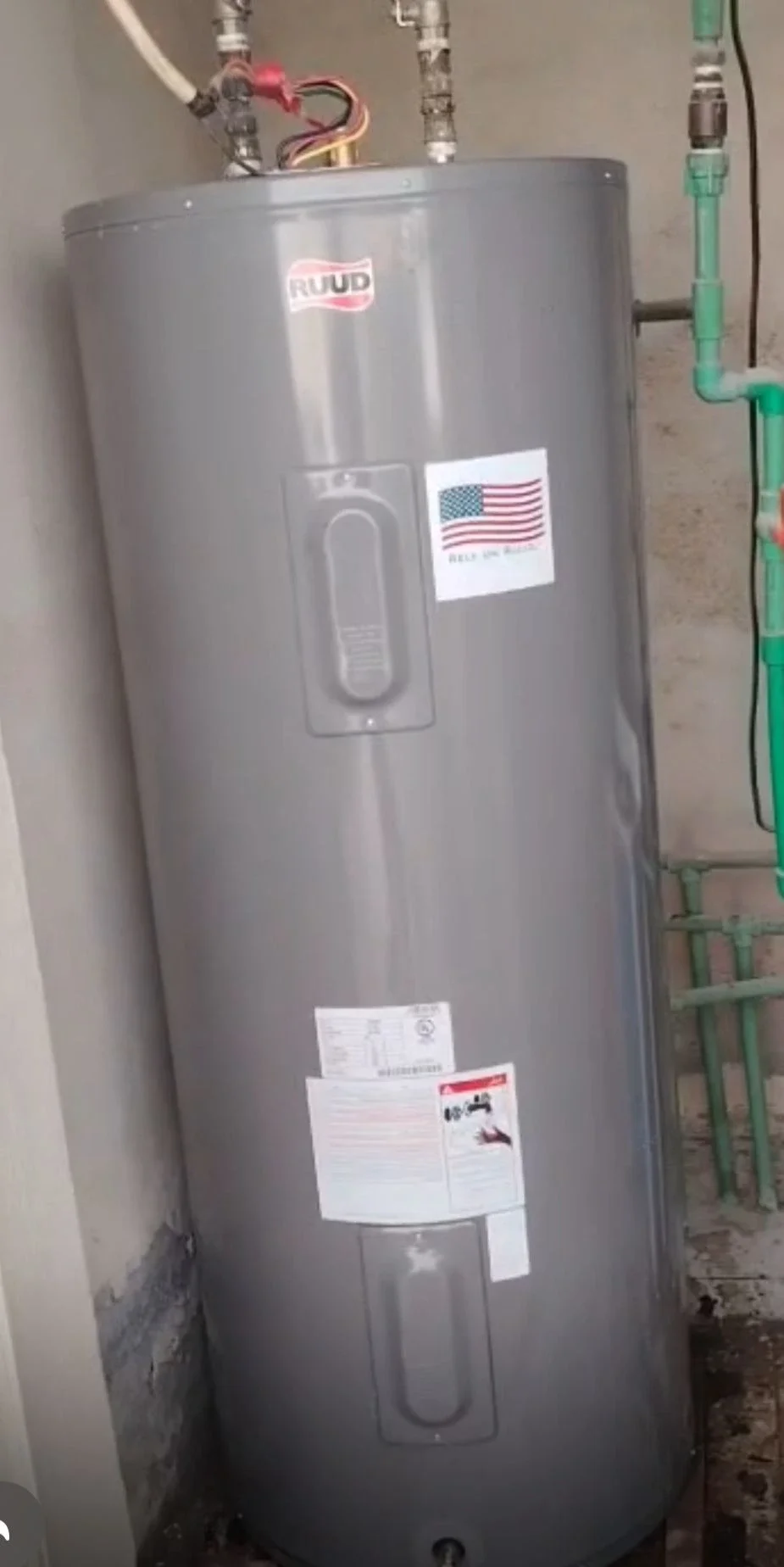
Comparing 65-gallon capacity versus 80 gallons becomes much clearer when you think of the difference as an operating safety margin. The question is not only “Can 65 gallons work?” but “Can it work comfortably, or will it operate close to its limit every day?”
If your Peak Demand is clearly below the First-Hour Rating of the 65-gallon model, you already have a good performance margin and may not need 80 gallons simply for reassurance.
If Peak Demand is very close to the 65-gallon model’s FHR, even a small change such as one extra guest, a longer shower, or two bathrooms being used at once can lead to a noticeable drop in water temperature near the end of the hour. In this case, 80 gallons makes more sense because it gives you an additional buffer.
That buffer has a cost:
Usually a higher purchase price
A larger physical size in many models
More weight
And a greater volume of stored water
Using the current Rheem ProTerra family as an example, one 65-gallon model is approximately 65 inches tall, while an 80-gallon version is around 75 inches tall. The manufacturer also shows performance examples of roughly three consecutive showers for the 65-gallon model versus four for the 80-gallon version under its own assumptions. These figures should not be generalized to every heater in Kuwait, but they provide an excellent example of how storage differences can translate into real differences in performance and installation space.
Before buying the 80-gallon model, make sure the installation area can handle the height, weight, and service clearance. Before buying 65 gallons, make sure you are not choosing the smaller size only because of price even though the household’s regular demand is already higher than what the model can comfortably deliver.
-
Think of the capacity difference as an operating margin rather than simply a larger number on the heater label
-
If 65 gallons covers household demand with a clear margin the 80-gallon option may not provide meaningful daily value in the same property
-
If a 65-gallon heater regularly operates near the edge of household demand an 80-gallon model reduces sensitivity to small increases in use
-
Measure the installation area because the larger tank may require different height and service clearance depending on the specific model
-
The best decision is the smallest capacity that provides the required comfort with a reasonable margin rather than the smallest possible tank or the largest one available
Which Is Better: a 65- or 80-Gallon Water Heater?
The answer to which is better: a 65- or 80-gallon water heater is simple in principle: the better one is the model that matches your household’s actual demand and installation conditions. An 80-gallon heater is not automatically better simply because it is larger, and 65 gallons is not automatically better simply because it may cost less.
A 65-gallon model is usually better for you when:
Hot-water use is moderate
Showers are mostly consecutive rather than simultaneous
The model’s FHR comfortably covers peak demand
Installation space is limited
And there is no clear near-term household change that will significantly increase demand
An 80-gallon model is usually better when:
Simultaneous hot-water demand is regularly high
More than one bathroom is used at the same time
Long showers or bathtub use are common
Or the 65-gallon model would be very close to your calculated Peak Demand
After capacity, compare the actual brand and model. Al Arabi Orchid currently lists 65- and 80-gallon heaters among products from Ruud, Bradford White, A. O. Smith, Americana, Rheem, and Richmond. This means you do not have to make the decision based on size alone. You can compare two actual available models according to current stock.
Written warranty should also be reviewed. Al Arabi Orchid currently states 6 years on the American heater tank and 2 years on the heating elements in its main service information, but it is still better to receive the warranty terms for the exact model in writing because wording can vary across product and service pages.
Do not forget the electrical requirements either. Ask for Voltage and Wattage for the proposed model because choosing capacity is one decision while confirming compatibility with the property electrical system is another.
Finally, contact 99346138 and provide the household usage pattern instead of simply saying, “I want 65 or 80 gallons.” Mention how many bathrooms operate at the same time, household size, average shower duration, and ask for the technical specifications of both proposed models.
-
There is no universal winner between 65 and 80 gallons because the better choice depends on Peak Demand model performance and household use
-
A 65-gallon model is better when it comfortably covers the load because it avoids paying for additional capacity you will not use
-
An 80-gallon model is better when daily demand genuinely needs the extra reserve rather than forcing a 65-gallon heater to operate near its limit
-
Request the written warranty Wattage Voltage and First-Hour Rating of the actual model before confirming the purchase
-
Al Arabi Orchid currently offers both capacities so use 99346138 to compare two real models rather than making the decision from the gallon figure alone
Conclusion
The decision between a 65-Gallon vs 80-Gallon Central Water Heater: Which to Buy? should begin with household usage and end with the actual model, not the other way around.
Sixty-five US gallons equals approximately 246 liters, while 80 gallons equals approximately 303 liters. The difference is around 57 liters, or roughly a 23% increase in nominal storage in favor of the 80-gallon option.
However, that increase does not automatically become 23% more performance or 23% more electricity use.
The real decision depends on:
Peak-Hour Demand
First-Hour Rating
Recovery Rate
Rated Storage
Number of bathrooms used at the same time
Average shower duration
Physical dimensions
Wattage and Voltage
And total installed cost
Manufacturer specifications show why this approach matters. Rheem, for example, currently offers product families with both 65- and 80-gallon capacities where Rated Capacity, First-Hour Rating, and dimensions differ, while electrical input can remain similar in some product families. This is a clear demonstration that storage capacity alone is not the only performance indicator.
In practical terms:
65 gallons is a strong choice for households with moderate hot-water use when the model’s FHR comfortably covers the busiest hour.
80 gallons becomes more logical when the property has higher simultaneous demand, long and closely spaced showers, or when the 65-gallon model would operate close to its maximum capability on a regular basis.
Do not increase tank capacity to solve low water pressure or slow hot-water delivery. Pressure requires pump or network diagnosis, while delayed delivery may require evaluation of hot-water recirculation.
Al Arabi Orchid currently lists 65- and 80-gallon American central water heaters alongside 50- and 120-gallon options from brands including Ruud, Bradford White, A. O. Smith, Americana, Rheem, and Richmond.
Before calling 99346138, prepare:
Number of people in the household
Number of bathrooms used at the same time
Average shower duration
Whether there is a bathtub
Whether kitchen hot-water use overlaps with showers
Available installation space
And the capacity of your current heater if you already have one
Then request a clear comparison between a 65-gallon and 80-gallon model covering Rated Storage, First-Hour Rating, Recovery Rate, Wattage, Voltage, dimensions, warranty, and final installed price.
This approach allows you to choose a capacity that genuinely provides comfort without buying a heater that is smaller than your needs or paying for additional storage that your household will rarely use.
Frequently Asked Questions
What is the capacity difference in liters between 65 and 80 gallons?
Sixty-five US gallons equals approximately 246 liters, while 80 US gallons equals approximately 303 liters, so the nominal difference is around 57 liters in favor of the 80-gallon heater.
Is an 80-gallon heater always better than a 65-gallon heater?
No. An 80-gallon model provides more storage, but it is not automatically better when a 65-gallon model already covers household demand with a comfortable margin. The best choice depends on Peak-Hour Demand and the actual model performance.
How many people can a 65-gallon water heater serve?
There is no fixed number. It can comfortably serve a medium-sized household when usage is distributed, while a smaller household using two bathrooms at the same time and taking long showers may require more performance. FHR and simultaneous demand are more important than household size alone.
When should I choose 80 gallons instead of 65?
Choose 80 gallons when simultaneous hot-water use is frequent, more than one bathroom regularly operates at the same time, showers are long and consecutive, and the 65-gallon model would be close to your peak-hour demand.
Does an 80-gallon heater use more electricity than a 65-gallon heater by the same percentage as the capacity difference?
Not necessarily. Electricity consumption depends on Wattage, efficiency, thermostat settings, actual usage, and heat loss. The capacity difference alone does not determine the difference in the electricity bill.
Is a 65-gallon heater suitable for a medium-sized family?
Yes, it can be very suitable when hot-water use is moderate and distributed and the model’s First-Hour Rating covers the busiest hour. The phrase “medium-sized family” alone is not enough without understanding actual usage habits.
Does the number of bathrooms determine whether I need 65 or 80 gallons?
The total number of bathrooms matters less than the number used at the same time. Four bathrooms used one after another can create less demand than two bathrooms operating simultaneously for long periods.
Will an 80-gallon heater solve slow hot-water delivery to a distant bathroom?
No. If the problem is the time it takes for hot water to reach a distant fixture, the issue is usually related to plumbing distribution and may require evaluation of a hot-water recirculation system. A larger tank does not shorten the plumbing distance.
Does Al Arabi Orchid provide both 65- and 80-gallon heaters?
Yes. The current service information lists 65- and 80-gallon capacities among the available American central water heaters, alongside 50- and 120-gallon options from several American brands.
How do I decide between 65 and 80 gallons before buying?
Calculate your busiest hour of hot-water use, then request the technical data for both proposed models, especially First-Hour Rating, Rated Storage, Recovery Rate, Wattage, Voltage, and dimensions. You can contact Al Arabi Orchid on 99346138 to compare the currently available 65- and 80-gallon models and request a separate quotation for each option.

