Buying a new central water heater should not begin with asking which brand is best or choosing the largest number of gallons you can physically install. The right decision starts before purchase by reviewing seven points: the household’s actual hot-water demand, the specifications of the exact model, energy efficiency, electrical compatibility, installation space, warranty coverage, and the availability of maintenance and spare parts. A heater can come from an excellent brand and still be the wrong choice if its capacity falls below peak demand, its dimensions do not fit the installation area, or its electrical requirements do not match the existing circuit. The U.S. Department of Energy uses indicators such as First-Hour Rating and UEF to evaluate storage-water-heater capacity and efficiency, and those figures deserve to be checked before price becomes the deciding factor.
Buying a New Central Water Heater

Before buying a new central water heater, treat the decision as purchasing a system that should serve your home for years rather than simply buying a unit that will be installed today. The first thing you need to identify is what you actually expect from the heater. Is your old heater too small for your family’s demand? Are you equipping a new villa that does not currently have a central heater? Has the old tank failed and you want a replacement with the same capacity? Or are you trying to improve system efficiency and reduce recurring problems? The answer completely changes the way you should choose the new unit.
The first of the seven points is actual usage. It is not enough to say five people live in the home. What matters more is how many showers operate during the busiest hour, whether a bathtub is used, and whether the kitchen or other fixtures are also drawing hot water at the same time. This is where Peak-Hour Demand becomes important.
The second point is storage capacity and first-hour performance. The U.S. Department of Energy defines First-Hour Rating as an estimate of the maximum amount of hot water a storage heater can provide during one hour that starts with the tank fully heated. FHR therefore gives you a more useful picture of real operating capability than the gallon number written on the product alone.
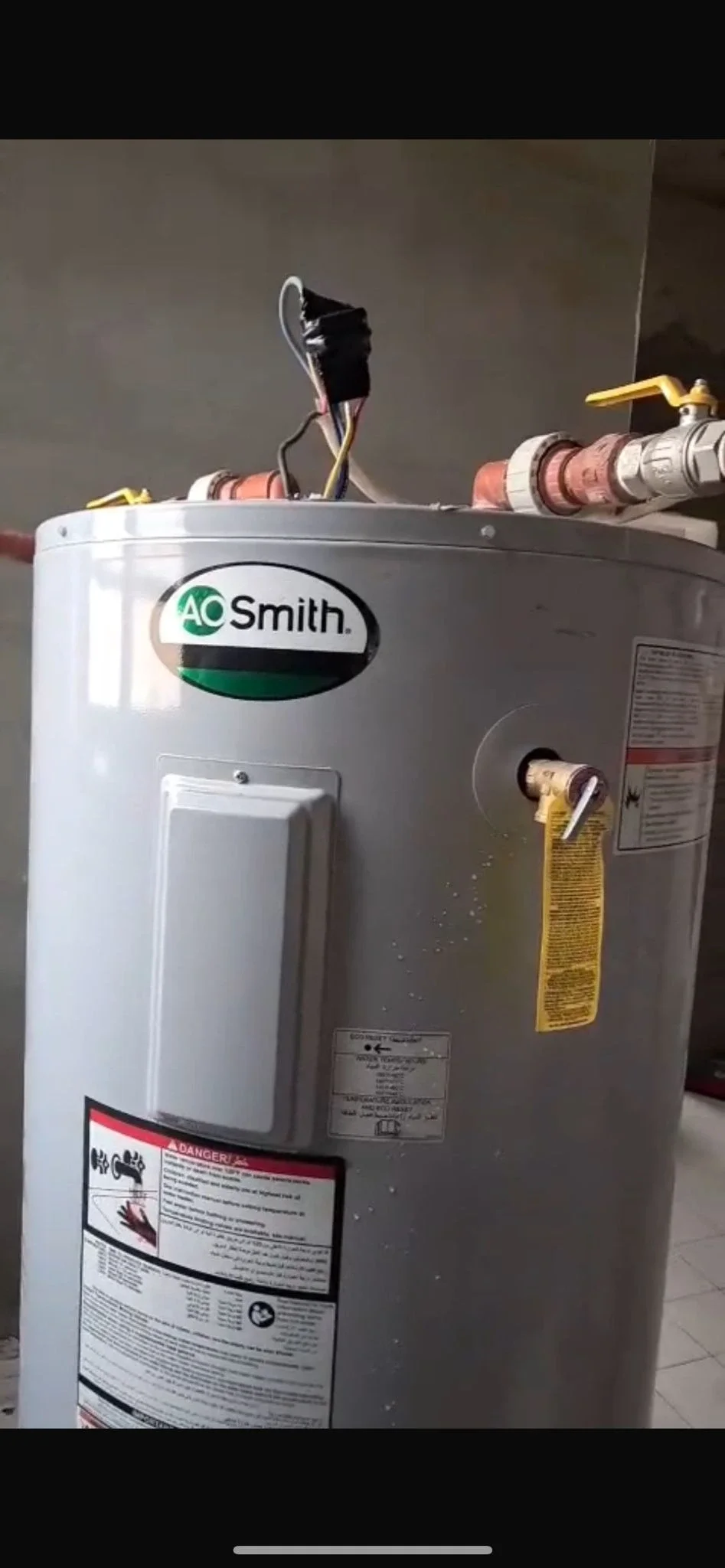
The third point is recovery rate and heating-element wattage. Two heaters with the same capacity can differ in how quickly they replace the heat that has been used. One A. O. Smith example shows a 50-gallon model with a Rated Storage Volume of 46 gallons, a First-Hour Rating of 57 gallons, and maximum power of 4,500 watts on 240 volts. Another model from the same manufacturer in the same nominal 50-gallon class can provide a higher FHR despite having similar actual storage volume.
The fourth point is energy efficiency, the fifth is electrical compatibility and installation space, the sixth is the actual written warranty, and the seventh is parts availability and access to technicians familiar with the model.
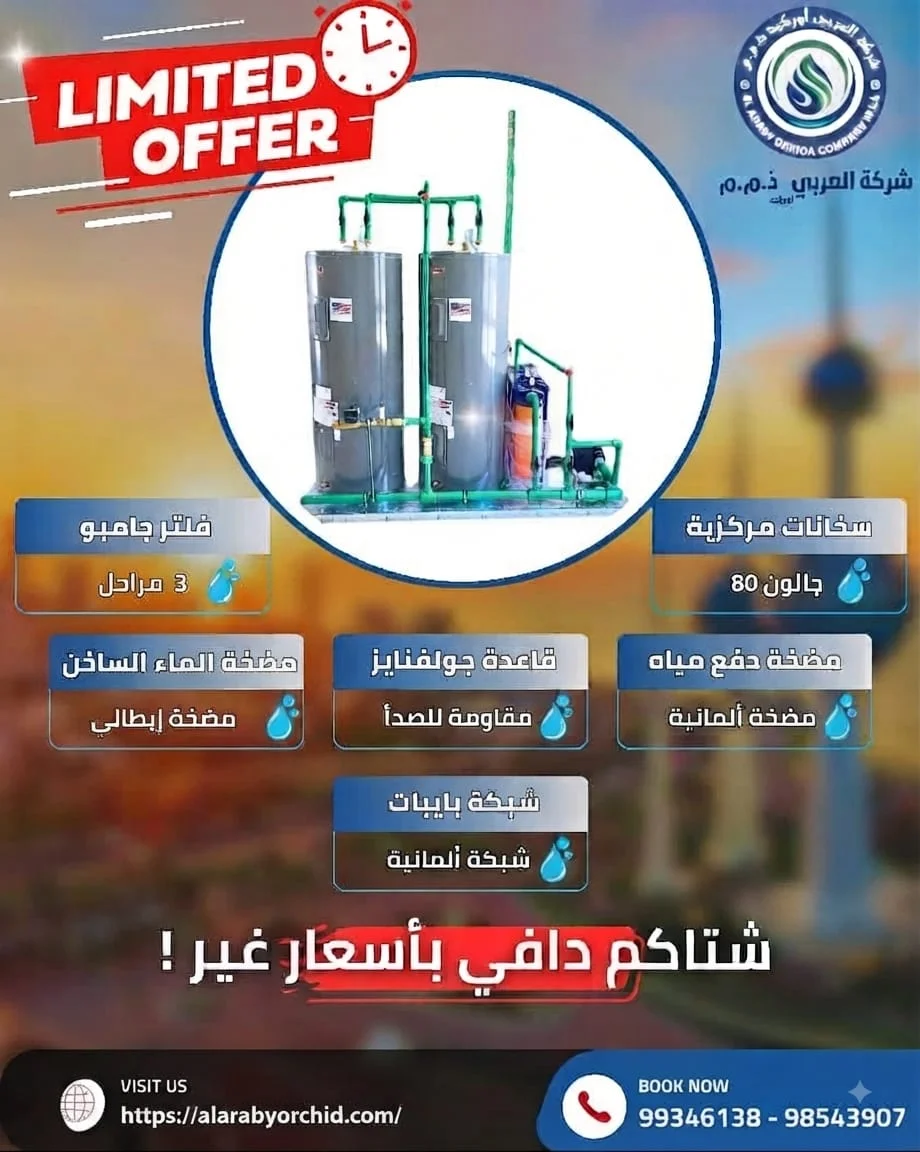
Al Arabi Orchid currently states that it supplies and installs American water heaters from Ruud, Bradford White, A. O. Smith, Americana, Rheem, and Richmond and offers 50, 65, 80, and 120-gallon categories. Its current site also advertises a six-year tank warranty and a two-year heating-element warranty together with removal of the old heater, installation of the new one, and system adjustment.
-
Do not begin the buying process with the brand name before identifying the performance the home actually needs during its highest-demand period
-
Treat First-Hour Rating as one of the most important figures because nominal tank capacity alone does not show how much hot water is available during the peak hour
-
Get the complete model number before paying anything so you can review the manufacturer’s original specifications
-
Confirm that the quotation clearly explains what is included in removal installation connections system adjustment and warranty
-
If the seller gives you only gallons and price without FHR wattage or model number you still do not have enough information for a strong buying decision
Tips for Buying a Central Water Heater
The most useful tips for buying a central water heater are the ones that prevent you from buying a product that looks excellent in an advertisement but does not match your real usage. The first tip is simple: never assume every heater with the same gallon rating performs the same way.
A. O. Smith provides a very clear example. The PNS-50 110 is marketed as a 50-gallon model, has a Rated Storage Volume of 46 gallons, a UEF of 0.92, a First-Hour Rating of 57 gallons, and a maximum rating of 4,500 watts at 240 volts. Another model from the same manufacturer, HESFA-50, also has a nominal capacity of 50 gallons, the same 46-gallon Rated Storage Volume, and a UEF of 0.92, but its First-Hour Rating is 67 gallons. That alone proves that the phrase “A. O. Smith 50 gallon” does not describe the full performance of the heater.
The second tip is to ask for the Spec Sheet or official model specification page before you pay. Do not rely on a WhatsApp image or a verbal description. Look for nominal capacity, Rated Storage Volume, FHR, UEF, voltage, wattage, number of heating elements, dimensions, and warranty.
The third tip is not to buy the largest size simply because you are afraid of running out of hot water. Oversizing can increase purchase cost, require more installation space, and potentially increase standby losses depending on product design, while choosing a heater that is too small creates hot-water shortages. The goal is not the biggest tank. The goal is a tank that covers demand with a sensible margin.
The fourth tip is not to treat warranty as one simple word. The tank, parts, and labor may have different warranty periods. Even within A. O. Smith, similar-looking 50-gallon models can carry different warranties. The PNS-50 is published with a 10-year limited tank and parts warranty, while the HESFA-50 is published with an 8-year warranty. That does not automatically make one model universally better; it means the exact model must be compared.
The fifth tip is to find out what happens if you need a replacement part years later. Are the heating element, thermostat, anode, and control components available? Can the technician obtain the service manual for the model?
The sixth tip is to compare equivalent quotations. It is not fair to compare a price that includes installation and warranty with another price that covers the unit only.
The seventh tip is to make sure you receive the exact model that was agreed on, even if the replacement unit has the same brand and gallon capacity.
-
Ask for the Model Number to be written clearly in the quotation so the agreement does not turn from a specific model into “any 80-gallon heater”
-
Compare specifications through the manufacturer’s own documentation rather than relying on a short advertising description
-
Remember that two models with the same nominal capacity can differ substantially in First-Hour Rating
-
Separate the manufacturer warranty from the installer or service-provider warranty because they may cover different items
-
Do not treat the lowest price as the best deal before confirming that the heater installation warranty and technical specifications are genuinely comparable
What to Inspect Before Buying the Heater

What to inspect before buying the heater includes the installation location just as much as the heater itself. Some purchasing mistakes begin with choosing an excellent model only to discover on installation day that the unit is too large for the space, its electrical requirements need a different circuit, or there is no suitable drain route for the safety valve.
Start with the electrical panel. Confirm Voltage, Element Wattage, breaker capacity, wire size, and grounding according to the exact model requirements and applicable installation rules. The A. O. Smith PNS-50 example mentioned above operates on 240 volts with a maximum rating of 4,500 watts and uses two heating elements. These figures are model-specific and should never be generalized to every American water heater.
Then check the dimensions. That same A. O. Smith model is approximately 49.25 inches high and 23 inches in diameter. Another heater in the same nominal capacity class may be taller, shorter, or wider, so the statement “the old heater is 50 gallons and the new one is 50 gallons” does not guarantee identical dimensions.
Measure the installation area and the access route into it. The mechanical room may be wide enough while the doorway, staircase, roof opening, or access corridor is too narrow for the heater. This becomes even more important with 80 and 120-gallon units.
Review the support base as well. Water is heavy, and once the tank is filled the operating weight becomes substantial. The supporting surface must be suitable for the unit size and total filled weight according to the manufacturer and installation conditions.
Then inspect the cold-water inlet, hot-water outlet, T&P valve location, discharge routing, Drain Valve, and service access to the heating elements and thermostats. The goal is not merely to make the heater “fit.” The goal is to ensure a technician can service it later without dismantling part of the building.
You should also confirm whether the system needs a hot-water recirculation pump. If your current problem is that hot water takes too long to reach a distant bathroom, installing a larger heater is not a direct solution. Al Arabi Orchid offers hot-water recirculation as a separate service, which reflects the fact that delivery speed and tank capacity are different issues.
Finally, inspect the old heater if it is still present. If its capacity served the household comfortably before it failed, that is useful real-world information. If it was always running out of hot water, do not automatically repeat the same capacity.
-
Match voltage wattage and electrical circuit requirements to the exact model before purchase rather than after the unit arrives
-
Measure heater diameter height access path and service clearances instead of using gallon capacity as a substitute for physical dimensions
-
Review the support base drainage arrangement safety-valve access and heating-element service space so the installation remains maintainable
-
Separate capacity problems delayed hot-water delivery and pressure problems because buying a larger tank does not solve all three
-
If the home already has a heater use the old unit’s real performance as evidence of whether the previous capacity was sufficient
Choosing a New Central Water Heater
Choosing a new central water heater becomes more accurate when you build the decision around matching rather than ranking brands. In other words, do not start by asking which manufacturer is number one. Ask which exact model fits the home best.
Begin with hot-water demand during the peak hour. Then look at the First-Hour Rating of the model. The U.S. Department of Energy defines FHR as an estimate of the maximum amount of hot water a storage heater can provide during one hour that starts with the tank fully heated. This links the buying decision to actual usage rather than nominal storage capacity alone.
Next, review recovery rate. If the household has repeated hot-water demand over a short period, recovery becomes important because the tank does not simply store water. It is also reheating the cold water entering as hot water is drawn.
Then look at efficiency. Do not choose an extremely efficient model if its capacity is too small for the home, and do not choose a dramatically oversized heater simply to avoid doing the calculation. The goal is balance between delivery and energy efficiency.
After that, match the electrical supply and physical installation conditions. If two models provide similar performance but one fits the space more easily and leaves better maintenance access, that is a meaningful practical advantage.
Then compare warranty and after-sales support. An excellent product with poor access to replacement parts or limited local technical support can become difficult to own when it eventually needs service.
Another mistake is choosing only on the basis of “American-made.” Origin and brand reputation are useful trust signals, but each manufacturer produces many different models. A. O. Smith, for example, publishes several 50-gallon models with different FHR values, warranties, and features even though the nominal size is similar.
Al Arabi Orchid currently states that it provides Ruud, Bradford White, A. O. Smith, Americana, Rheem, and Richmond. Having several brands available gives you the opportunity to ask for two or three models that meet the same household requirements and then compare the details.
-
Write down the performance requirements of the home first and then search for models that meet them instead of choosing the brand first
-
Evaluate FHR recovery and storage capacity together because the three figures provide a more complete picture of peak-demand performance
-
Exclude any model that does not suit the electrical supply or installation area even if the brand itself is excellent
-
Compare warranty and parts availability only after confirming that all competing models meet the household’s performance needs
-
The best choice is not the model with the biggest numbers but the one that meets the requirement without obvious shortage or unnecessary oversizing
Specifications of a Good Central Water Heater
When reviewing the specifications of a good central water heater, focus on values that can be measured and verified rather than descriptions such as “very powerful” or “the best type.”
The first specification is Rated Storage Volume, not nominal gallons alone. This is the rated amount of water actually stored according to the model. For example, the A. O. Smith PNS-50 is marketed as a 50-gallon unit but has a Rated Storage Volume of 46 gallons.
The second specification is First-Hour Rating. That same model has an FHR of 57 gallons according to its published data. The HESFA-50, also marketed as a 50-gallon model with a 46-gallon Rated Storage Volume, has an FHR of 67 gallons. This difference is a clear reason to review FHR instead of stopping at nominal tank size.
The third specification is Recovery Rate, which reflects how quickly the heater can restore heat after hot water has been drawn and is linked to element wattage and temperature rise.
The fourth specification is UEF. The U.S. Department of Energy uses Uniform Energy Factor as a measure of water-heater efficiency. A higher UEF generally indicates better efficiency when products are compared appropriately within similar usage categories.
The fifth specification is Voltage, Wattage, and the number of heating elements.
The sixth specification is dimensions, weight, and connection layout.
The seventh specification is warranty and technical documentation.
After these fundamentals, evaluate optional features according to your needs. Some modern models include leak detection or automatic shutoff. A. O. Smith offers smart models with electronic controls and additional functions, but those features should never be allowed to hide a weak capacity match, inadequate FHR, or electrical incompatibility.
Tank-protection design also matters. A. O. Smith states that some models use glass lining and anode protection to reduce corrosion, but these details vary by product series. Always confirm them on the exact model specification rather than assuming every product from the brand uses the same design.
-
Rated Storage Volume gives a more precise picture of the actual stored-water quantity than the nominal marketing category alone
-
First-Hour Rating can reveal major performance differences between models that have the same nominal capacity
-
UEF helps compare efficiency but does not remove the need to select the correct capacity and delivery performance
-
Review electricity dimensions and weight with the same seriousness as tank size because the heater must also be installable and serviceable
-
Smart features should be treated as additions after the fundamentals are correct rather than as a reason to ignore core performance specifications
New Central Water Heater Warranty
New central water heater warranty is one of the most commonly misunderstood parts of the buying process. When you hear “six-year warranty,” the immediate question should be: warranty on what exactly?
There may be a tank warranty, a separate warranty on parts such as heating elements or electronic controls, and another warranty covering labor or installation from the service provider. These are not necessarily the same length and may not come from the same company.
One clear example comes from A. O. Smith. The PNS-50 is published with a 10-year Limited Tank Warranty and 10-year Limited Parts Warranty. The HESFA-50 is published with 8 years on the tank and parts. Another 50-gallon model such as the ENS-50 is published with 6 years on the tank and parts. The same manufacturer and approximately the same nominal capacity can therefore have very different warranty coverage depending on the model.
This leads to the first rule: never accept the phrase “manufacturer warranty” without the model number and written coverage.
The second rule is to ask when the warranty begins and whether the claim requires an invoice, serial number, registration, or other proof.
The third rule is to understand exclusions. Incorrect installation, unauthorized modification, or unsuitable replacement components can affect warranty coverage depending on manufacturer terms.
The fourth rule is to separate the replacement part covered by warranty from labor, travel, or installation cost if those items are treated differently under the terms.
Al Arabi Orchid currently advertises six years on the American water-heater tank and two years on heating elements and states that installation and maintenance work also includes warranty coverage. This is useful because the advertised periods are clear, but when purchasing you should still receive the written warranty details for the exact model and service supplied.
A longer warranty does not make an unsuitable heater suitable. If a 50-gallon model does not meet the household’s actual demand, a ten-year warranty does not give you more hot water. Warranty should therefore become a comparison factor after the performance match is confirmed.
-
Ask separately about tank warranty heating-element or parts warranty and installation warranty so you know exactly what is covered
-
Do not assume every model from one manufacturer has the same warranty because official examples show substantial differences between product series
-
Keep the invoice model number serial number and warranty documentation from the installation date
-
Ask who actually handles warranty claims in Kuwait and what the claim process requires
-
Use warranty duration as a comparison factor only after confirming that the heater’s core specifications match household needs
Water Heater Capacity Before Purchase
Water heater capacity before purchase should not be selected from the number of bedrooms, the total size of the house, or a statement such as “we are six people.” Household size is only an initial clue. What actually tests the heater is how much hot water is required within a short period.
A large family whose showers are distributed over several hours may place less peak demand on a heater than a smaller family using two bathrooms at the same time in the morning.
Start by recording the busiest hour. How many showers are used? How long does each shower last? Is there a bathtub? Does the kitchen rely on the same heater during the same period? Then compare that demand with the FHR of the model.
Do not confuse nominal storage capacity with the exact amount of shower-temperature water you will receive. Fifty US gallons equals approximately 189 liters, 65 gallons is about 246 liters, 80 gallons is about 303 liters, and 120 gallons is about 454 liters by direct conversion. However, the amount of usable hot water delivered during an hour also depends on actual stored volume, recovery, storage temperature, and mixing.
There is another important point. Al Arabi Orchid currently advertises 50, 65, 80, and 120-gallon categories, but some liter conversions currently displayed on the site do not match the precise mathematical conversion from US gallons. For comparison purposes, use the gallon rating, model number, and manufacturer specification sheet rather than relying on the advertising conversion alone.
A. O. Smith also demonstrates why the nominal capacity is not enough. The PNS-50 has a 50-gallon nominal rating, 46 gallons of Rated Storage Volume, and an FHR of 57 gallons. The HESFA-50 has approximately the same 46-gallon Rated Storage Volume but an FHR of 67 gallons.
If a smaller category covers Peak-Hour Demand with a sensible margin, you do not need to increase size simply because a larger model is available. If actual household demand repeatedly sits near the model’s limit, choosing the next suitable capacity before purchase is more sensible than living with daily shortages.
-
Calculate peak-hour demand rather than relying on a fixed table that connects a certain number of people with a fixed gallon size
-
Check FHR for the exact model because nominal tank capacity does not reveal complete first-hour delivery
-
Use the correct US-gallon conversion when comparing liters and do not rely on inaccurate marketing conversions
-
Leave a sensible margin for normal household variation and regular guests without dramatically oversizing the heater
-
If confirmed household expansion is expected soon include that additional demand in the sizing calculation before purchasing
Energy Efficiency When Buying a Water Heater
Energy efficiency when buying a water heater should be understood beyond the phrase “this one saves electricity.” You need a measurable figure, and one of the most important is UEF.
The U.S. Department of Energy uses UEF, or Uniform Energy Factor, as a standardized measure of water-heater efficiency. A higher UEF generally indicates better efficiency when comparing suitable products within comparable usage categories.
UEF does not tell you exactly how much you will pay in Kuwait. It is an efficiency measure based on standardized testing. Your actual electricity bill depends on hot-water demand, thermostat setting, incoming-water temperature, local electricity rates, and system conditions.
You should also review the EnergyGuide label. The label is designed to help consumers compare energy use and estimated operating cost among similar appliances under standardized assumptions. Its primary value is comparison, not predicting the exact personal bill for your household in Kuwait.
If you see an annual operating-cost figure in US dollars, do not simply convert it to Kuwaiti dinars and assume that will be your annual cost. The testing assumptions and electricity prices behind that label are different. A more useful approach is to compare Model A with Model B using the same label methodology.
Also review Annual Energy Consumption when it is available, but always bring the decision back to your actual household use.
Capacity matters here too. A heater that is larger than necessary stores a greater volume of heated water and may experience greater standby losses depending on product design. On the other hand, buying a heater that is too small is not automatically an energy-saving strategy if it fails to meet household demand.
Remember that two heaters with similar element wattage do not necessarily have identical monthly consumption because operating time can differ substantially.
The A. O. Smith PNS-50 and HESFA-50 provide a useful example: both are listed with a UEF of 0.92 even though their FHR values differ. This shows that efficiency and hot-water delivery capability are separate performance indicators that should be read together.
-
Use UEF as an efficiency measure rather than relying on the word “energy-saving” without technical data
-
Compare models on an equivalent basis because higher efficiency does not automatically mean the heater capacity is suitable for your home
-
Use EnergyGuide to compare products but do not treat the US estimated operating cost as your exact expected electricity bill in Kuwait
-
Remember that FHR and UEF measure different things one relates to delivery capability and the other to efficiency
-
The best energy decision is a correctly sized heater rather than one that is significantly undersized or oversized
Comparing Water Heater Brands Before Purchase
Comparing water heater brands before purchase should ultimately become a model-to-model comparison rather than a general statement such as “Brand A is always better than Brand B.” The brand matters, but each manufacturer produces multiple products with different warranties, controls, and performance levels.
Al Arabi Orchid currently states that it works with Ruud, Bradford White, A. O. Smith, Americana, Rheem, and Richmond. These manufacturers provide several options, but the comparison should use one consistent technical table.
For every model, list:
Nominal Capacity
Rated Storage Volume
First-Hour Rating
Recovery Rate
UEF
Voltage
Element Wattage
Dimensions
Weight
Tank Warranty
Parts Warranty
Availability of technical documentation
Availability of spare parts in Kuwait
Clarity of local after-sales service
This approach prevents brand reputation alone from controlling the decision.
An example from within A. O. Smith itself shows why. The PNS-50 and HESFA-50 both have a nominal 50-gallon rating, a 46-gallon Rated Storage Volume, and a UEF of 0.92. However, one has an FHR of 57 gallons and a 10-year warranty, while the other has an FHR of 67 gallons and an 8-year warranty together with different controls and features. The phrase “A. O. Smith 50 gallon” therefore does not describe one single product.
The same principle applies to Bradford White, Rheem, Ruud, and other manufacturers. One brand may offer a model with dimensions that fit your installation area better, another may offer a stronger FHR, and another may have easier local parts access.
Also review technical documentation. A proper installation and service manual has real value because it helps technicians diagnose the exact model according to the manufacturer’s method instead of guessing.
Local warranty support also matters. If the manufacturer offers one warranty structure but the local supplier provides another level of coverage, keep both documents and understand which company is responsible for which item.
Do not let price reverse the comparison process. First identify the models that are actually suitable, then compare prices among those models.
-
Do not declare one brand the winner before identifying the exact models because performance and warranty vary even within the same manufacturer
-
Use one standard specification table for all options so you are not comparing one feature from one heater with a different feature from another
-
Give parts availability and technical documentation significant weight because they affect how easy the heater will be to maintain years later
-
Compare the original model warranty with the written local service-provider warranty
-
If a cheaper model is less suitable for household demand or the existing electrical system the lower purchase price is not real long-term savings
Central Water Heater Buying Guide
This central water heater buying guide gives you a practical checklist to follow before approving any quotation, based on the same seven essential points without adding unnecessary complexity.
1. Define actual demand
Write down what happens during the busiest hour in the home and how many hot-water fixtures may operate at the same time. Do not choose gallons before understanding the demand.
2. Review capacity, First-Hour Rating, and Recovery Rate
Gallons tell you the approximate storage size, while FHR and recovery show how the heater behaves under heavy use. The U.S. Department of Energy uses FHR as an important capacity indicator for storage water heaters.
3. Review efficiency
Check UEF and any available EnergyGuide or energy-consumption information. Use numerical data for comparison rather than marketing claims.
4. Match the electrical system
Confirm voltage, wattage, breaker, and wiring requirements for the exact model through a qualified technician.
5. Inspect the installation area
Measure the physical space, access path, support base, service clearances, safety-valve location, and drain arrangement.
6. Read the warranty
Understand tank warranty, parts warranty, element coverage, labor coverage, and claim conditions.
7. Compare the model, service support, and parts
Do not buy a brand name alone. Get the Model Number and confirm that spare parts and technical support are actually available.
Only after these seven steps should price become the deciding factor. At that point, quotations become genuinely comparable because you know exactly what you are buying.
Al Arabi Orchid currently advertises Ruud, Bradford White, A. O. Smith, Americana, Rheem, and Richmond in 50, 65, 80, and 120-gallon categories together with a six-year tank warranty and two-year heating-element warranty, removal of the old heater, installation of the new one, and system adjustment. The published contact number is 99346138.
The website also currently advertises a complete central system starting from KWD 650, but that price applies to a multi-component system rather than one standalone water heater, so it should not be treated as the price of a heater by itself.
Before agreeing, send a photo of the installation area and, if available, the data plate from the old heater. Ask for a written quotation showing:
Brand
Model Number
Nominal Capacity
Rated Storage Volume
FHR
Recovery Rate
UEF
Voltage
Wattage
Dimensions
Warranty
Everything included in installation
That one document can prevent most common buying mistakes.
-
Do not approve a quotation that says only “American heater” or “80 gallons” without identifying the brand and full model number
-
Ask for performance and efficiency specifications in writing before discussing optional upgrades or additional features
-
Confirm that removal of the old heater installation connections testing and warranty are clearly included in the quotation
-
Keep the invoice serial number specification sheet and warranty documents from the first day
-
Contact Al Arabi Orchid on 99346138 and ask for a comparison between specific models that meet the same household requirements instead of automatically choosing the largest or most expensive unit
Conclusion
Buying a new central water heater does not require dozens of rules. It requires carefully checking seven things before paying: household demand, storage capacity and performance, efficiency, electrical compatibility, installation conditions, warranty, and the serviceability of the exact model and its parts.
The first mistake to avoid is relying on gallons alone. The U.S. Department of Energy defines First-Hour Rating as an estimate of the maximum amount of hot water a storage heater can provide during an hour that begins with the tank fully heated, which makes it one of the most useful buying figures.
The second mistake is assuming that two models with the same capacity are equivalent. A. O. Smith provides a clear example. The PNS-50 and HESFA-50 both have a nominal capacity of 50 gallons, a Rated Storage Volume of 46 gallons, and a UEF of 0.92, but the first has an FHR of 57 gallons while the second has an FHR of 67 gallons, and their warranties and features differ.
The third mistake is ignoring energy efficiency. UEF is the modern measure used to compare water-heater efficiency, while EnergyGuide helps compare estimated energy use and operating cost among similar products under standardized conditions.
The fourth mistake is buying a heater before inspecting the electrical supply and installation space. An excellent model is not useful if it does not fit the mechanical room or requires an electrical circuit that was never planned for.
The fifth mistake is reading the word “warranty” without understanding its details. Warranty periods can differ even among models from the same manufacturer.
The sixth mistake is comparing brands generally instead of comparing exact models.
The seventh mistake is buying without understanding what is included in installation and after-sales service.
Al Arabi Orchid currently advertises the supply and installation of Ruud, Bradford White, A. O. Smith, Americana, Rheem, and Richmond in sizes including 50, 65, 80, and 120 gallons, with a six-year tank warranty and two-year heating-element warranty.
Before purchasing, contact 99346138 and ask for a quotation showing Model Number, Rated Storage Volume, First-Hour Rating, Recovery Rate, UEF, wattage, voltage, dimensions, warranty, and the installed price with full installation details. Once these details are clear, your purchase decision is based on a heater that genuinely fits the home rather than on an advertisement, a brand name, or a gallon number alone.
Frequently Asked Questions
What are the most important 7 things to check before buying a central water heater?
Check actual hot-water demand, storage capacity and First-Hour Rating, recovery rate, energy efficiency, electrical compatibility, installation space, warranty coverage, and the availability of service and spare parts. Some of these items are closely connected, so they should be evaluated together rather than separately.
Is gallon capacity alone enough to choose a water heater?
No. Capacity matters, but it does not show the complete performance of the heater. You should also check First-Hour Rating and recovery rate because two heaters with the same gallon capacity can provide different amounts of hot water during peak demand.
What is the difference between Nominal Capacity and Rated Storage Volume?
Nominal Capacity is the marketing capacity category, such as 50 gallons, while Rated Storage Volume is the actual rated amount of stored water for the specific model. For example, the A. O. Smith PNS-50 is marketed as a 50-gallon model but has a Rated Storage Volume of 46 gallons.
Does every 50 gallon water heater provide the same performance?
No. One A. O. Smith example shows two 50-gallon models with a 46-gallon Rated Storage Volume and a UEF of 0.92, but one has an FHR of 57 gallons while the other has an FHR of 67 gallons.
What does UEF mean when buying a water heater?
UEF, or Uniform Energy Factor, is a measure of water-heater efficiency. A higher value generally indicates better efficiency when suitable products are compared correctly, but it does not tell you whether the heater capacity itself matches your household demand.
Does EnergyGuide show the exact electricity bill for the heater in Kuwait?
No. EnergyGuide is useful for comparison because it uses standardized testing assumptions and shows estimated energy use and operating cost, but actual electricity rates, household usage, and local conditions in Kuwait determine your real cost.
Is it better to buy the largest capacity I can afford?
Not necessarily. A larger heater is useful only when the household needs the additional capacity. Oversizing can increase purchase cost, physical size, and standby losses, while the better choice is a heater that covers Peak-Hour Demand with a sensible margin.
What warranty does Al Arabi Orchid advertise on water heaters?
Al Arabi Orchid currently advertises six years on the American water-heater tank and two years on the heating elements and also states that its installation and maintenance work includes warranty coverage. Ask for the written warranty details for the exact model at the time of purchase.
Which water heater brands does Al Arabi Orchid provide?
Al Arabi Orchid currently advertises Ruud, Bradford White, A. O. Smith, Americana, Rheem, and Richmond, with capacity categories including 50, 65, 80, and 120 gallons.
How do I order a new central water heater with the correct specifications?
Contact 99346138, explain how many hot-water fixtures are used at the same time, and send a photo of the installation area and the old heater data plate if available. Ask for a quotation showing brand, model number, Rated Storage Volume, FHR, Recovery Rate, UEF, voltage, wattage, dimensions, warranty, and everything included in installation before approving the purchase.