Choosing a central water filter for a villa is not simply about buying the largest filter available and installing it on the main water line. A central filter treats water as it enters the property so that the water supplied to bathrooms, kitchens, heaters, and appliances passes through it depending on the plumbing design. For that reason, the system must be able to handle peak flow without causing an uncomfortable drop in water pressure. You also need to know exactly what problem you want to treat: sediment, rust, chlorine, taste, odor, or something else, because no single filter removes everything. Point-of-entry systems treat water for the entire property, while point-of-use filters are designed for a specific outlet such as a drinking-water faucet. Al Arabi Orchid currently offers sand filters, Jumbo filters, and stainless-steel filtration systems among its water-treatment options in Kuwait, but the correct choice should begin with the villa’s actual needs rather than the filter type alone.
Central Water Filter for a Villa

A central water filter for a villa, also known as a whole-house filter, is installed on the main water path so that water is treated before being distributed throughout a large part of the property. This is completely different from a kitchen filter that serves only one drinking-water faucet. Systems that treat water as it enters a building are commonly called point-of-entry or POE systems, while under-sink filters and RO systems serving one specific outlet are considered point-of-use systems.
This difference matters because a villa’s central filter must handle a much larger volume of water. If two bathrooms, the kitchen, washing machine, and an outdoor tap operate at the same time, all of that flow may need to pass through the filter. It is therefore not enough to say that the cartridge “filters very well.” You need to know the service flow rate and the amount of pressure drop created at that flow. Manufacturers of whole-house systems publish specific flow and pressure-loss data for different models. Some high-capacity models may be rated for flows such as 25 GPM, while other models have completely different capacities. These figures belong to specific products, but they demonstrate the principle clearly: system size must match the property’s water demand.
The next question is what the filter needs to remove. If the main problem is sand, rust, or sediment coming from the storage tank, a sediment stage or Jumbo filter may be part of the right solution. If the problem is chlorine taste or odor, a carbon stage designed and tested for that purpose may be required. Certification standards for aesthetic improvements can cover specific claims such as chlorine, taste, odor, or particulate reduction, but a certification does not mean that a filter removes every contaminant. The exact reduction claim for the product is what matters.
Another common misunderstanding is that a central filter automatically replaces a drinking-water filter. In many homes, the central system is used to protect the plumbing network from sediment and improve overall water quality, while an RO or kitchen filter remains at the drinking-water point when more specific treatment is required. This creates a treatment train, where each stage performs a different job.
Al Arabi Orchid currently advertises sand filters in several sizes, Jumbo filters, 3-stage filters, and stainless-steel filtration systems, together with maintenance and cartridge replacement. Its website currently lists Jumbo filters starting from KWD 50 and sand filters starting from KWD 165, but these are starting prices for specific types and should not be treated as the price of every central filtration system for a villa.
-
A central filter serves the main household water flow so service flow rate and pressure drop matter more than the number of cartridges alone
-
Identify the exact water problem before choosing the filter because sediment chlorine taste and dissolved substances require different treatment methods
-
A whole-house filter can work together with a kitchen RO system and does not automatically replace it
-
Any claim such as chlorine or sediment reduction should be supported by the actual product specification and certification rather than the words “central filter”
-
A large villa needs realistic simultaneous-flow calculations so you do not install a filter that treats water well but restricts household pressure
Installing a Central Filter for Villas
Installing a central filter for villas begins before any pipe is cut. The first decision is where the filter should be positioned in relation to the storage tank, pump, and plumbing network because equipment order affects pressure, maintenance, and overall system behavior.
A point-of-entry system is generally installed where water enters the property or at a central location before it is distributed to different outlets. However, in villas that use storage tanks, the practical installation point depends on the arrangement of the tank, booster pump, and plumbing network. There is no single installation position that works for every property.
Consider a villa with a ground tank, then a booster pump, followed by the internal plumbing network. If the filter is installed in a location that creates excessive resistance on the pump’s suction line, it can create poor operating conditions for the pump. In another system, treatment may be better located on the pressurized side depending on filter type and pressure limits. The technician therefore needs to know whether the filter is designed to operate under pressure or before the pump and what its minimum and maximum operating pressures are.
Whole-house filter manufacturers normally publish pressure limits and rated flow for each system. This shows that the filter is not just a housing that can be installed anywhere without considering operating conditions.
The second issue is pipe diameter. If the villa’s main water line is 1.5 inches and it is reduced to a very small filter connection without proper calculation, the filtration system can become a bottleneck. Connection size alone does not determine performance, but it is part of pressure-loss calculations.
The third issue is bypass design. A properly installed bypass allows the filter to be isolated for service without shutting off water to the entire villa every time cartridges are changed or the media is serviced. Some central systems use an integrated bypass while others require an external bypass arrangement.
The fourth issue is maintenance space. There must be enough room to open the housing, remove cartridges, or service a media tank. Installing a Jumbo filter directly under a low ceiling can turn every cartridge replacement into a major plumbing job.
The fifth issue is flow direction, valves, and drainage. A sand filter that requires backwashing or media servicing is completely different from a cartridge-based Jumbo filter. If the design requires a drain, space and piping should be planned from the beginning.
The sixth issue is post-installation testing. Water should be introduced gradually, every connection checked for leaks, and pressure measured before and after the filter under realistic demand. Testing only one faucet is not enough for a large villa.
-
Filter location in relation to the tank and pump should follow system specifications because incorrect placement can affect flow and pump suction conditions
-
Main pipe diameter and filter service flow should match the villa’s demand instead of reducing the line at the filtration point without calculation
-
Isolation valves and a bypass make future maintenance easier and reduce the amount of time the property is without water
-
Leave enough physical space to remove cartridges or service filter media because a system that cannot be maintained easily becomes a long-term problem
-
Test pressure before and after filtration with several outlets open so the effect of the filter is evaluated under real household demand
Benefits of a Central Filter for a Villa
The benefits of a central filter for a villa become clear when the system is selected for the right problem and sized correctly. Its biggest advantage is that it treats water at the network level instead of at just one outlet.
If sediment comes from the storage tank or main supply, a central filter can reduce the amount reaching faucets, mixers, water heaters, and appliances depending on the filter’s micron rating and media. This can help protect equipment from particles, but the level of protection depends entirely on the actual filter specification.
If the system includes carbon designed for chlorine reduction, another advantage is that chlorine taste and odor can be treated throughout the property instead of only at the kitchen faucet. Whole-house filters can be certified for specific aesthetic claims such as chlorine, taste, odor, or particulate reduction, but again, certification does not mean the filter removes everything. The exact claim is what matters.
A third benefit is centralized service. Instead of installing a small filter before every appliance, a properly selected main filtration stage can improve incoming water before it reaches different branches of the villa. This is particularly useful in large homes with several bathrooms, heaters, and water-using appliances.
A fourth advantage is the ability to create a multi-stage system. For example, sediment filtration can be used first to capture larger particles, followed by carbon when chlorine reduction is needed, and then a dedicated drinking-water filter in the kitchen. This allows every technology to do the job it is designed for instead of expecting one device to perform every type of treatment.
A fifth benefit is that the system can be sized according to peak flow. Whole-house filters are available in different sizes and capacities because different properties have different flow requirements. A larger villa may require a higher-capacity model than a small house.
However, this advantage becomes a disadvantage if the filter is undersized. A unit that performs well at 5 GPM may not be suitable for a villa requiring significantly higher flow. If pressure drop becomes too high, the homeowner may wrongly assume that “the filter weakened the pump.”
It is also important to understand that improving taste and odor is not the same as disinfection. A standard sediment or carbon filter should not be considered a bacteria-killing system unless the product itself has the appropriate technology, certification, and verified reduction claim.
-
A central filter can reduce sediment reaching plumbing fixtures and equipment when the micron rating and flow capacity are suitable
-
Central carbon treatment can improve chlorine taste and odor throughout the home when the product is designed and tested for that purpose
-
A whole-house system can act as the first treatment stage while a more precise drinking-water filter remains at the kitchen
-
Different system sizes allow the filter to be selected according to peak flow instead of accepting low pressure when several bathrooms are used
-
The word “central” does not automatically mean disinfection RO treatment or removal of all dissolved minerals because every technology has different functions
Best Central Filter for a Large Home
When looking for the best central filter for a large home, do not begin with the brand or the price. Start with hydraulic demand and the water problem that needs treatment.
The first question is how much flow the property needs during peak use. A large villa with 6 or 8 bathrooms can require much more flow than a small home. Some whole-house manufacturers offer high-flow models intended for larger homes, including models designed for 6 or more bathrooms and rated for flows such as 25 GPM. That does not mean every six-bathroom villa needs exactly 25 GPM, but it clearly demonstrates that filter size should be linked to expected demand.
The second question is what needs to be reduced. If the problem is sediment, look for sediment filtration capacity and the appropriate micron rating. If the problem is chlorine taste or odor, look for a carbon system with a clear chlorine-reduction claim. If the property has another issue such as hardness or a specific contaminant identified by testing, a water softener or another treatment technology may be more appropriate than a standard central filter.
The correct process is to identify the actual water issue first and then choose a treatment system with the correct reduction claim. Whole-house treatment can include carbon filtration, softening, UV, or other technologies, and each performs a different function.
The third question is how much pressure drop occurs at the required flow rate. This is one of the most important specifications to request before purchase. Some manufacturer data sheets show pressure drops such as 15 PSI at a particular rated flow. That value applies only to that specific model and should not be treated as a universal acceptable limit. The point is that every central filter creates resistance, and the amount needs to be included in system design.
The fourth question is maintenance. Cartridge systems require replacement cartridges. Media tanks may require backwashing or media servicing depending on design. The purchase price is not the entire ownership cost.
The fifth question is spare-parts availability. A large villa should not depend on a system that works well today but has unavailable cartridges a year later.
Al Arabi Orchid currently advertises stainless-steel filters with 8, 10, 15, and 20 cartridges for residential and commercial applications, together with Jumbo and sand filters. These sizes provide different options, but a 20-cartridge filter is not automatically “better” than a 10-cartridge model. Correct selection still depends on flow, cartridge type, and treatment objective.
-
The best large-home filter is the one that delivers the required flow with an acceptable pressure drop while treating the actual water problem
-
Number of bathrooms helps estimate demand but does not replace simultaneous-use calculations
-
A 20-cartridge system is not automatically better than a 10-cartridge system unless its cartridge type flow capacity and design match the property
-
Confirm replacement-cartridge availability because ongoing maintenance cost and serviceability are part of the purchase decision
-
Choose certification and reduction claims that match your actual goal rather than accepting a general statement that the filter “removes everything”
Whole-Villa Water Filter

A whole-villa water filter means treating water before it is distributed through a complete plumbing network, which is a much larger responsibility than filtering only drinking water.
The first decision is whether you need basic filtration or a multi-stage treatment system. If the main problem is sand or sediment from the storage tank, a Jumbo sediment filter may be sufficient as an initial stage. If chlorine and odor are also concerns, a suitable carbon stage can be added. If you want more precise drinking-water treatment, a kitchen filter or RO system can remain as a separate stage.
The term “whole-villa filter” does not mean that the resulting water automatically has the same characteristics as RO water. Whole-house carbon filtration and reverse osmosis are fundamentally different technologies. RO systems have their own certification standards, while carbon and sediment systems may use other standards depending on their reduction claims.
Hot water also needs to be considered. Most residential whole-house systems are installed on the cold-water line before water is distributed to heaters and other branches, but every product has its own permitted temperature range. Hot water should not be passed through a cartridge designed only for cold water.
Filter location relative to the storage tank also matters. Installing the filter before the tank performs a different function from installing it after the tank. If sediment is being generated or collected inside the storage tank itself, treating the water only before it enters the tank may not stop that material from reaching the house later.
The pump must also be considered. If the filter is installed after the pump, it needs to tolerate the system’s operating pressure. If it is installed before the pump, it must not create excessive suction restriction. The storage tank, booster pump, and filter should therefore be evaluated as one complete system.
-
Whole-villa filtration may be sediment only sediment plus carbon or a larger treatment arrangement depending on the problem
-
A whole-house filter does not automatically replace RO drinking-water treatment because the technologies serve different purposes
-
Confirm the filter’s allowable pressure and temperature before selecting its installation point
-
Installing the filter before or after the storage tank depends on the source of the problem and the direction in which sediment enters the network
-
Review the pump tank and filter together because adding filtration resistance can change household water pressure
Choosing a Central Filter Before Installation
Choosing a central filter before installation should follow a clear checklist instead of simply asking for “the best one.”
1. Identify the filtration problem
Do you see sand? Rust? Cloudiness? Chlorine taste? Or is the problem unknown and better confirmed by water testing? The correct treatment technology depends on what you are trying to reduce.
2. Calculate required flow
How many bathrooms and water outlets may operate at the same time? The filter needs to handle the expected peak flow.
3. Review water pressure
Know the available pressure before the filter. Then review the expected pressure drop at the required flow. If the booster pump is already marginal, adding a restrictive filter can make the problem more noticeable.
4. Confirm connection size
Do not reduce the main water line without hydraulic consideration.
5. Check micron rating
A smaller micron rating does not automatically mean a better central filter. Finer filtration can create faster blockage and higher pressure loss when incoming water carries heavy sediment. Sometimes staged filtration from coarse to finer is the better design.
6. Check certification
Certification standards are not rankings. One standard may apply to aesthetic claims such as taste, odor, or chlorine, while another may relate to specific health-related contaminant claims. The product is certified only for the stated claim.
7. Calculate maintenance cost
How much do replacement cartridges cost? How frequently do they need service? Does the media require maintenance? Is local service available?
8. Leave maintenance space
The system needs enough room for future service.
9. Install bypass and isolation valves
When appropriate for the system design, these make maintenance much easier.
10. Plan post-installation testing
Measure pressure before and after the filter and test flow with several outlets operating.
For example, if a villa has five bathrooms and visible sediment, the starting point might be a high-flow Jumbo sediment stage. If chlorine treatment is also required, a second carbon stage may be added. Buying a stainless-steel unit simply because it looks stronger does not constitute technical selection unless the actual cartridges and performance are known.
-
Clearly describe the water problem before requesting a quotation because the type of contamination determines the required technology
-
Ask for rated flow pressure drop and connection size together with the model instead of only asking how many stages the system has
-
A smaller micron rating is not always better for a main line because finer filtration may increase blockage and reduce flow
-
Include cartridge prices and annual maintenance in the budget instead of focusing only on the initial installation cost
-
The correct certification confirms a specific reduction claim rather than proving that the filter removes every possible contaminant
Cost of a Central Filter for a Villa
The cost of a central filter for a villa depends more on the system type than on the word “central.” A Jumbo cartridge filter is not the same as a sand-media tank, a multi-cartridge stainless-steel unit, or a large carbon-media system.
Al Arabi Orchid currently publishes a starting price of KWD 50 for Jumbo filter installation and describes it as a solution for larger impurities and protection of plumbing lines, while sand filters in different sizes start from KWD 165. The company also advertises stainless-steel filtration systems but does not currently publish a fixed separate price for every 8, 10, 15, or 20-cartridge configuration. It would therefore be incorrect to invent prices for those systems.
A published “starting from” price is not necessarily the final cost for a villa. The total can change because of:
Filter size
Number of cartridges
Cartridge type
Pipe diameter
Valves and bypass
Installation location
Required plumbing modifications
Additional housing or support structure
Filter media
Any initial system maintenance
In a large villa, choosing a very small Jumbo filter only because it is cheaper can create higher costs later through pressure loss and frequent cartridge replacement. The best value is not simply the lowest installation price. It is the lowest total cost for a system that delivers the required flow and has a reasonable maintenance cycle.
Annual cartridge cost should also be included. Some whole-house cartridge systems may specify replacement after a certain number of months or gallons, and larger cartridges may have longer rated capacities than smaller ones. These examples show why filter size affects long-term operating cost.
When requesting a quotation, ask whether the price includes:
Inspection
Filter
Cartridges or media
Installation
Valves
Bypass
Pressure testing
Warranty
-
The current published Jumbo starting price is KWD 50 and the sand-filter starting price is KWD 165 but they represent different technologies and service ranges
-
Do not compare Jumbo sand and stainless-steel systems only by price because filtration method capacity and maintenance are different
-
“Starting from” is not the final villa price when larger sizes or plumbing modifications are required
-
Calculate cartridge replacement and maintenance costs because the cheapest system to purchase may be more expensive to operate
-
Request a written quotation showing model size components and installation scope before comparing different providers
Jumbo Central Filter for a Villa
A Jumbo central filter for a villa is a common option when you need a larger housing and cartridge capable of handling more flow than many small kitchen filters, especially when the main goal is sediment filtration.
Al Arabi Orchid currently describes its Jumbo filter as a solution that reduces larger impurities and helps protect plumbing lines, with installation starting from KWD 50. This gives a general idea of how the company positions the product, but it does not replace the need to know micron rating, cartridge type, and actual flow performance before installation.
With a Jumbo filter, the most important part is the cartridge installed inside it. The same housing can accept sediment cartridges with different specifications, which means the word “Jumbo” does not describe the filtration level. Ask:
Is it 5 micron or 20 micron?
Is it spun or pleated?
What is the rated flow?
What is the pressure drop when new?
When should the cartridge be replaced?
Whole-house cartridge manufacturers commonly state that a persistent pressure drop can indicate cartridge replacement is needed and warn against exceeding the rated service flow of the system.
If the storage tank contains heavy sediment, an extremely fine cartridge can clog quickly. In some cases, staged filtration is smarter: use a coarser first stage and then a finer stage when necessary instead of forcing one cartridge to capture everything.
One advantage of a Jumbo system is straightforward maintenance. The housing is opened and the cartridge is replaced. However, the installation must provide enough room beneath the housing to remove the cartridge, proper isolation valves, and a healthy O-ring. O-ring condition should be checked during cartridge replacement.
A Jumbo system is also not automatically a complete drinking-water filter. If the cartridge is sediment only, its main function is particle removal. If chlorine reduction is required, a carbon cartridge or separate stage designed for that purpose is needed.
-
The word Jumbo describes system size more than filtration performance so cartridge type determines the actual treatment function
-
Choose micron rating according to sediment load because an excessively fine cartridge can clog quickly in dirty water
-
Pressure loss after a period of use is a practical reason to inspect the cartridge rather than automatically blaming the booster pump
-
Isolation valves service clearance and O-ring condition are small details that strongly affect future maintenance
-
The KWD 50 starting price needs to become a specific quotation based on filter size cartridges and plumbing modifications required for the villa
Stainless-Steel Filter for a Villa
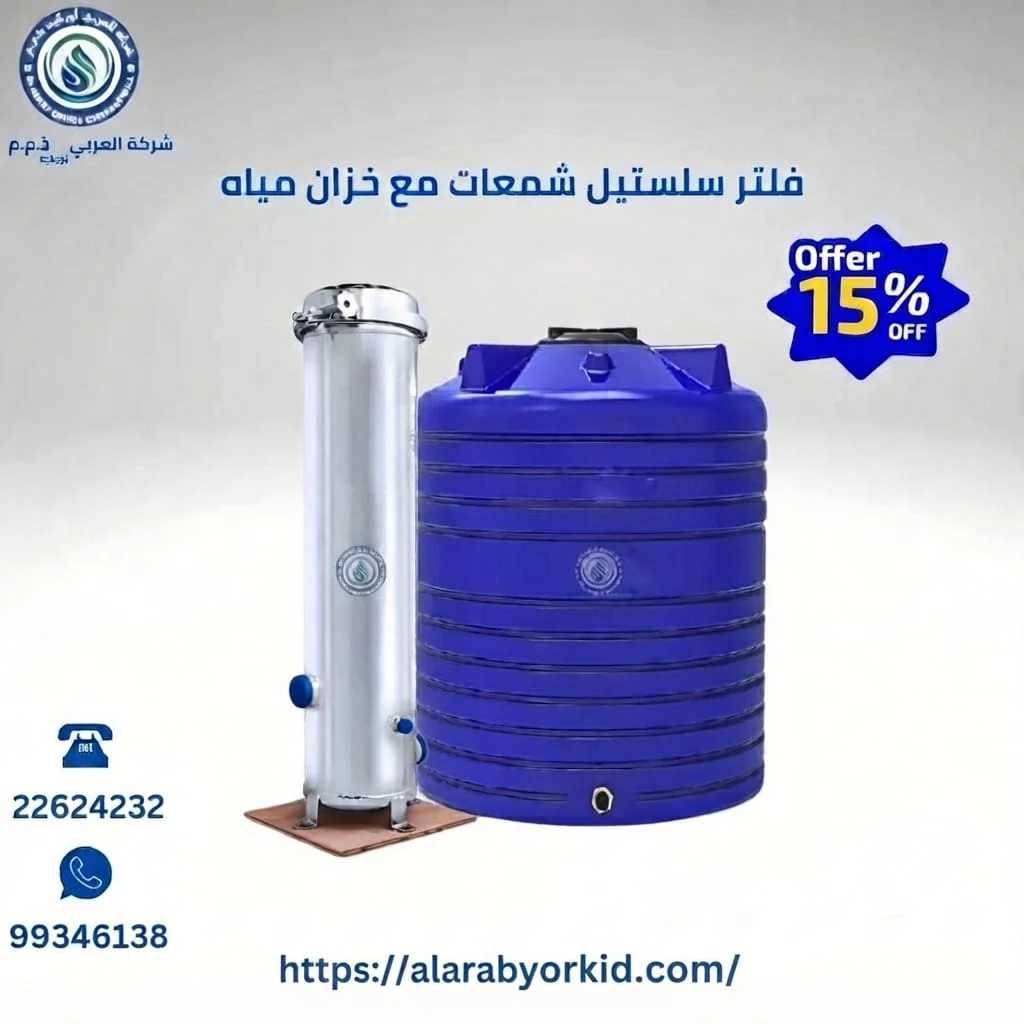
A stainless-steel filter for a villa attracts many homeowners because it is durable and available in larger configurations, but the purchase decision should still be based on filtration performance, cartridge type, cartridge quantity, and flow capacity, not only the housing material.
Al Arabi Orchid currently advertises stainless-steel filters with 8, 10, 15, and 20 cartridges for residential and commercial applications and also provides cartridge replacement. It describes its stainless-steel nano filter as corrosion-resistant and using advanced filtration technology. However, the current pages reviewed do not publish a complete individual data table for every size showing flow rate, pressure drop, exact cartridge type, and specific reduction claims. It is therefore better to request a data sheet or exact model information before choosing a configuration.
A higher number of cartridges may provide a larger filtration area depending on system design, but it is not technically correct to say that 20 cartridges automatically provide twice the performance of 10. Actual performance depends on:
Cartridge length
Cartridge diameter
Filter media
Micron rating
Internal water path
Maximum flow through the housing
It is also important to distinguish between stainless steel as the housing material and “nano” as a treatment claim. The word nano alone does not tell you which contaminants the system reduces. The exact certification and reduction claims should be checked instead of relying on a technology name.
If your goal is only sediment control, ask what sediment cartridge is used and what micron rating it has. If your goal is chlorine reduction, ask whether carbon media is included and whether there are performance data for chlorine. If the provider claims bacterial reduction, request suitable testing or certification rather than assuming that a large number of cartridges proves microbiological treatment.
Maintenance cost also matters. A 20-cartridge system involves a larger number of replacement components than a smaller unit, depending on design. Annual maintenance should therefore be compared with Jumbo or media-tank alternatives.
-
Stainless-steel housing provides durability but filtration quality depends on media cartridges and flow design
-
Cartridge quantity alone does not prove flow micron rating or chlorine-reduction ability so request technical specifications
-
If the product is described as nano ask exactly what the technology does and what reduction claims support it
-
Current 8 10 15 and 20-cartridge options provide different choices for large homes but size should follow calculated demand
-
Compare the cost of replacing the entire cartridge set with the maintenance cycle of alternative systems before making the decision
Central Water Filtration System for Villas
The best way to think about a central water filtration system for villas is as a series of treatment stages designed for the water you actually have, not as one product installed on the line and forgotten.
Scenario 1: You have visible sediment from the storage tank.
A properly sized sediment or Jumbo stage may be the starting point.
Scenario 2: You have sediment together with chlorine taste or odor.
A sediment stage followed by an appropriate carbon system may be more suitable.
Scenario 3: You want cleaner water throughout the property but more precise treatment for drinking.
A whole-house filter can be installed first, followed by an RO or point-of-use filter in the kitchen.
Scenario 4: Water testing identifies a specific issue.
Choose the treatment technology according to that contaminant rather than adding random stages.
Whole-house systems can use different technologies, and the correct process begins by identifying what is in the water and then choosing a treatment solution designed for the required contaminant-reduction claim.
After deciding on treatment stages, calculate peak flow. Every stage adds resistance. If three filters are installed and each creates noticeable pressure loss during peak demand, the combined pressure drop may become very noticeable on upper floors. The complete system therefore needs to be evaluated as one hydraulic arrangement instead of looking at every filter individually.
This is where the booster pump becomes part of the design. If the villa already has marginal pressure, the correct solution may include improving pump sizing or reducing unnecessary restriction rather than simply adding more filtration stages. The goal is not to increase the number of filters. The goal is to deliver treated water at an acceptable pressure throughout the property.
A maintenance plan should also be defined:
When sediment stages are inspected
When cartridges are replaced
When backwashing is required if the system uses it
What normal pressure should be before and after the system
Which symptoms justify early service
Al Arabi Orchid currently advertises a range including sand filters starting from KWD 165, Jumbo filters starting from KWD 50, stainless-steel filters with 8 to 20 cartridges, and 3-stage filters, together with maintenance and spare-parts services throughout Kuwait. You can contact 99346138 and request a pre-installation assessment to identify the correct system for your villa.
-
Design the filtration system in stages with a clear function for each one instead of adding multiple filters without a defined purpose
-
Calculate cumulative pressure drop because every stage adds resistance and the plumbing network experiences the combined effect
-
A drinking-water filter may still be useful after whole-house filtration because treating all household water is not the same as treating one drinking point
-
Establish a maintenance schedule and baseline pressure readings from the day of installation so future cartridge restriction can be identified
-
Contact 99346138 and request confirmation of filter type number of stages and required flow before approving installation
Conclusion
Choosing a central water filter for a villa and understanding what to know before installation begins with two questions that are more important than price: what problem do you need to treat and how much water does the villa require during peak demand?
A central or point-of-entry filter treats water throughout the property, while a point-of-use filter serves one specific outlet. Every filtration technology has different reduction claims, and no single filter should automatically be assumed to remove every contaminant.
If the main problem is sediment, begin with suitable sediment filtration. If chlorine taste and odor are the concern, consider a carbon stage designed and tested for that purpose. If more precise drinking-water treatment is required, an RO or kitchen filter may still be needed after central filtration.
For a large villa, service flow rate and pressure drop are critical. Manufacturer specifications show that whole-house filters come in different sizes and capacities, with larger models designed for higher flow than systems intended for smaller homes.
Al Arabi Orchid currently advertises:
Jumbo filters starting from KWD 50
Sand filters starting from KWD 165
Stainless-steel filters with 8, 10, 15, and 20 cartridges
Together with other filters, maintenance, and cartridge replacement.
However, these options should not be selected only by price or cartridge quantity.
Before installation, prepare:
Number of bathrooms
Number of outlets likely to operate simultaneously
Storage-tank location
Booster-pump location
Main pipe diameter
The actual water problem
Any existing filtration equipment
Then ask the technician to explain:
Filter type
Function of every stage
Rated flow when available
Cartridge micron rating
Expected pressure drop
Maintenance method
Replacement-cartridge cost
Bypass location
Final installed cost
This way, you install a central filtration system that genuinely serves the villa instead of a system that treats water but reduces pressure or requires more cartridge changes than necessary.
Frequently Asked Questions
What is the difference between a central water filter and a kitchen filter?
A central filter treats water as it enters the villa before it is distributed to multiple outlets, while a kitchen filter or RO system is a point-of-use system serving a specific drinking-water point. Both can be used together because they perform different functions.
Does a central water filter reduce water pressure?
Every filter creates some flow resistance, but when the correct size is selected the pressure loss should remain within the system’s design limits. Problems usually appear when the filter is too small for peak flow or the cartridge becomes blocked.
What is the best central filter for a villa?
There is no single best type for every villa. Selection depends on the water problem, flow requirement, available pressure, water characteristics, and maintenance cost. Sediment treatment is different from chlorine treatment and both are different from drinking-water treatment.
How much does a Jumbo filter for a villa cost from Al Arabi Orchid?
Al Arabi Orchid’s current website lists Jumbo filter installation starting from KWD 50. The final price depends on filter size, cartridge type, installation location, and required plumbing modifications.
How much does a central sand filter cost?
Al Arabi Orchid currently lists sand filters in different sizes starting from KWD 165. The final price depends on filter size, media, and installation requirements.
Is a stainless-steel filter better than a Jumbo filter?
Not automatically. Stainless-steel and Jumbo systems have different designs. Compare cartridge type, micron rating, flow capacity, pressure loss, and maintenance requirements before deciding which is more suitable.
How many cartridges does a stainless-steel villa filter need?
Al Arabi Orchid currently advertises configurations with 8, 10, 15, and 20 cartridges, but the correct number cannot be determined from villa size alone. Required flow, cartridge type, and system specifications need to be considered.
Does a central filter replace an RO system?
Not necessarily. A whole-house filter treats water throughout the property according to its technology, while RO is a different treatment method commonly used for more specific drinking-water treatment. Your water needs determine whether both systems are appropriate.
What should I ask before installing a central filter?
Ask about filter media, cartridge type, micron rating, rated flow, pressure drop, connection size, maintenance requirements, cartridge cost, and warranty instead of asking only for the installation price.
How do I request a central villa filter installation from Al Arabi Orchid?
Contact 99346138 and provide the number of bathrooms, water source, storage-tank location, booster-pump location, main pipe size, and the water problem you want to treat. Ask for an assessment covering filter type, capacity, required flow, installation location, and total cost before work begins.

