If you are planning to buy a water filter for your home, you may quickly hear the advice, “Just buy an American one.” But the correct decision is not that simple because the word American by itself does not tell you what the filter actually removes from the water, how long it lasts, how much maintenance costs, or whether its replacement cartridges are readily available in Kuwait. There are excellent American filters that may genuinely suit your needs, and there are regular filters with clear specifications that may be more practical and less expensive to maintain. The right comparison should start with your water quality, the purpose of the filter, the number and type of treatment stages, cartridge quality, certifications, spare-part availability, and the long-term cost of ownership rather than the country name printed on the box.
American or regular water filter
The question American or regular water filter should begin by defining what we actually mean by “regular.” If you compare an American multi-stage filtration system with a simple one- or two-stage filter, the comparison is already unfair because the difference comes from the treatment technology and number of stages rather than nationality. A useful comparison should be between two systems designed for roughly the same purpose so you can see what each one really provides.
A genuine American filter may offer good manufacturing quality, recognized components, independent certifications, and clear technical information about cartridge performance. However, not every product described as “American” is necessarily manufactured entirely in the United States or made exclusively from American components. Sometimes the brand is American while manufacturing takes place elsewhere. In other cases, the design may come from an American company, or the description may simply be a marketing term that needs verification.
A regular or conventional filter, on the other hand, may come from a very good manufacturer, use widely available standard cartridges, and provide exactly what the household needs without a high purchase or maintenance cost. This can be especially practical when the main objective is reducing sediment, improving taste and odor, and treating drinking water through a well-designed system.
The stronger criterion is what the filter is actually designed to treat. A sediment cartridge performs a different job from activated carbon, and a basic multi-stage filter is very different from a reverse-osmosis system. Comparing two filters only by country name hides these important technical differences.
For example, a family in Kuwait looking for a kitchen drinking-water filter and wanting easy cartridge replacement may benefit more from a practical system with locally available parts than from a very expensive filter with difficult-to-source components. In another case, a customer may want specific documented certifications and performance claims and prefer a well-known American system.
-
The word American alone is not enough to judge filter quality because treatment technology component quality and verified certification matter more than the country name
-
A fair comparison should be between systems designed for similar purposes instead of comparing an advanced system with a basic filter and attributing the difference to nationality
-
Cartridge availability in Kuwait should be part of the decision because even an excellent filter becomes inconvenient if every maintenance visit requires a long search for the correct replacement
-
Household water-treatment needs determine the right option because a sediment filter is not the same as a multi-stage drinking-water system
-
The best product is the one that provides suitable water treatment predictable maintenance and reasonable long-term cost for the actual household use
Difference between American and regular water filters
The difference between the American and regular water filter may appear in manufacturing quality, specification detail, cartridge types, product testing, or service support, but there is no reliable rule that every American product is automatically better than every filter made elsewhere. The global market includes excellent manufacturers outside the United States, and American products themselves also come in different quality levels.
One of the most useful differences to examine is how clearly the product information is documented. A good filter should explain its stages, cartridge types, flow rate, operating-pressure limits, and what the system is designed to reduce. The clearer and more specific this information is, the easier it becomes to make a technical decision rather than relying on vague claims such as “very powerful” or “highest purification.”
Independent certification is another valuable point. Some drinking-water treatment standards evaluate areas such as material safety, structural integrity, and the ability of a filter to reduce specific substances or contaminants. A genuine certification for the exact product or component is more meaningful than a certification logo used generally in advertising.
Another difference can be spare-part standardization. Some systems use common cartridge sizes that allow more than one suitable replacement option, while others rely on proprietary cartridges specific to one model. A proprietary cartridge can still be excellent, but the customer becomes more dependent on its future availability and price.
Maintenance convenience also matters. A highly capable filter that requires a specialized technician and difficult-to-find parts may cost more to own than a simpler system that performs the required job and is easy to service.
When the system is intended for drinking water, the final treatment result should remain the priority. Not every home requires the same technology. If the need is primarily sediment, taste, and odor reduction, a properly designed system for that purpose may be enough. If the water requires a different level of treatment, then other stages should be selected accordingly.
-
The real difference appears in specifications performance materials and serviceability rather than simply the country printed on the product
-
Independent certification for a specific model and specific claim provides stronger evidence than broad marketing phrases such as complete purification or premium quality
-
Proprietary cartridges can provide excellent performance but their local availability and long-term cost should be checked before purchase
-
A standard easy-to-service system may be more practical for a family that wants readily available cartridges and predictable maintenance expenses
-
Selecting treatment according to actual water conditions prevents paying for unnecessary stages or choosing a filter that is not sufficient for the problem
Advantages of an American water filter
The advantages of an American water filter become meaningful when the product comes from a reputable company with clear specifications, proven components, and suitable technical support rather than simply carrying an American label. One potential advantage is detailed information about performance, filtration technology, operating limits, and recommended cartridge replacement intervals.
Another potential benefit is the availability of products that have undergone independent testing or certification for specific performance claims. This gives the customer something more reliable than advertising language because an independent body has tested a defined aspect of the system. However, the certification should apply to the actual model or relevant component rather than being associated only with the company name.
Some American filtration systems also provide detailed model numbers and spare-part references. This can simplify maintenance because a technician can identify the correct cartridge, membrane, O-ring, or component rather than installing something that merely looks similar.
The quality of the filter housing, fittings, valves, and supporting components can also be a strength in well-designed products. But this point should always be judged model by model because it does not apply automatically to every American filter.
Clear maintenance instructions are another useful advantage. When the customer knows when the system should be inspected, when a cartridge should be replaced, and what performance changes to watch for, maintenance becomes more organized and predictable.
Advanced systems may also provide a range of treatment stages such as sediment filtration, activated carbon, reverse osmosis, and post-treatment stages intended to improve taste. However, more stages are not automatically better. Every stage should have a clear function that matches the water-treatment objective.
When a recognized American system also has cartridges and service support readily available in Kuwait, this combination can offer the best of both sides: strong product quality together with practical local maintenance.
-
Clear technical specifications help the customer select a system based on documented performance rather than a short marketing description
-
Independent certification becomes a real advantage when it applies to the actual product and clearly identifies what performance claim was tested
-
Clear model and spare-part references make maintenance easier and reduce the chance of installing incompatible components
-
Good housing fitting and valve quality is valuable when it is proven in the specific model rather than assumed from the country of origin
-
The strongest benefit comes when high product quality is combined with reliable local availability of cartridges maintenance and spare parts
Disadvantages of an American water filter for the home
The disadvantages of an American water filter for the home do not mean that the product is poor quality. They simply mean that certain characteristics may make a particular system less suitable for one household than another. One possible disadvantage is a higher purchase price, especially if the system uses proprietary replacement cartridges that are more expensive than common standard sizes.
A second possible issue is spare-part availability. You may purchase an excellent filtration system and then discover a year later that the exact replacement cartridge is difficult to find locally. In that case, the technical quality of the system becomes dependent on a supply chain that should have been considered before purchase.
There is also the problem of paying for the name. Some customers accept a higher price simply because a seller says the filter is American without checking where it is actually manufactured, what certifications it holds, what technology it uses, or how its performance differs from other systems. Country of origin should never become an unlimited reason for a higher price.
Some systems may also be more complicated than the household actually needs. A family whose main requirement is basic sediment, taste, and odor treatment may end up buying a system with many stages and higher maintenance costs without receiving a meaningful additional benefit for their particular water.
If the system uses proprietary cartridges, maintenance choices become more limited. Standard systems usually give the customer more flexibility in suppliers, quality levels, and pricing.
Water flow should also be considered. Certain specialized drinking-water systems operate differently from simple direct-flow filters, and some use storage tanks. Their suitability depends on household size, usage pattern, and available installation space.
Another mistake is assuming that an American system “does not need maintenance.” Any filtration system using cartridges, membranes, or consumable media requires maintenance according to water quality and usage. Ignoring replacement intervals will reduce performance regardless of how good the original equipment is.
-
A higher price is not a problem when it is supported by better performance or quality but it becomes a disadvantage when the premium is based mainly on branding
-
Proprietary cartridges should be checked for local availability before purchase so future maintenance does not become unnecessarily difficult
-
A filtration system that is more complicated than the household needs can increase cartridge and service costs without adding enough practical benefit
-
Relying on the word American without checking actual manufacturing location specifications and certifications can turn a technical purchase into a marketing decision
-
Even high-quality filtration systems require regular maintenance because country of origin does not eliminate cartridge and membrane wear
American drinking water filter in Kuwait
Choosing an American drinking water filter in Kuwait should begin with how the system will actually be used rather than with the number of filtration stages printed on the package. Are you looking for an under-sink drinking-water filter? Do you mainly want to improve taste and odor? Does the water require a deeper level of treatment? The answer determines the most suitable technology.
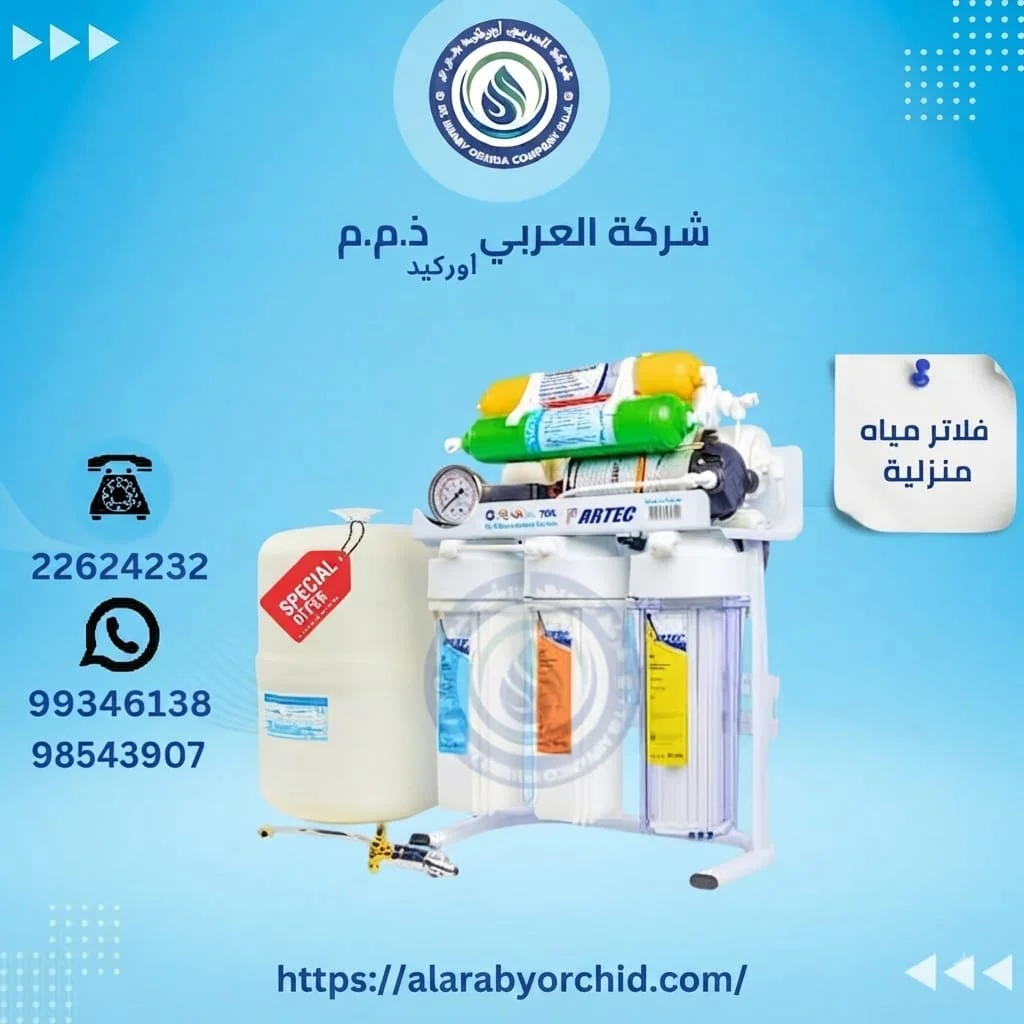
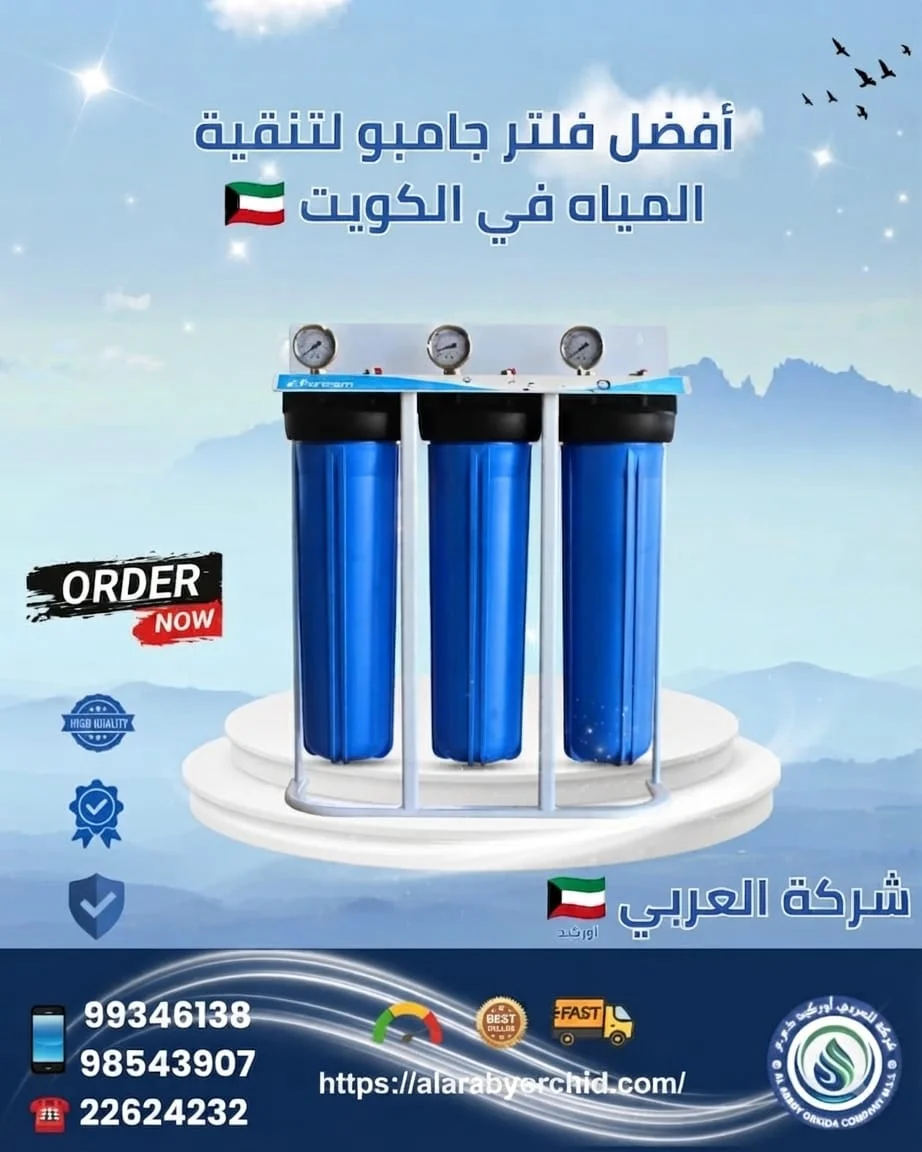
Al Arabi Orchid currently offers kitchen filtration systems with three, five, six, and seven stages among its water-treatment services, in addition to other household filtration options. However, the number of stages alone is not enough to judge performance. What matters is the purpose of each stage and whether it is genuinely useful for your water.
A carbon-based system performs differently from a system using a reverse-osmosis membrane. Calling both of them “American filters” hides a major technical difference that matters far more than the country label.
Before purchase, ask about the cartridges. What types are used? Are the sizes standard? How often does the manufacturer recommend service under normal use? If the system includes a membrane, is it readily available? Are the storage tank, valves, fittings, and other supporting components serviceable locally?
If the seller promotes certification as a major advantage, the certification should be verifiable for the model or component being sold rather than presented as a general logo. Different standards can relate to different performance areas, so seeing one standard number does not mean that the filter removes every possible substance from water.
Local service support is particularly important in Kuwait. A system with technicians, cartridges, and spare parts available locally is far more convenient than a product whose components need to be imported each time maintenance is required.
Having children or high drinking-water consumption does not automatically mean you need the most expensive filter. It means you need a system appropriate for the water conditions, maintained on schedule, with a clear understanding of what it is designed to treat.
-
The number of stages describes the system design but does not prove treatment quality unless you know what each stage is intended to do
-
A drinking-water filter should be selected according to the required treatment rather than simply choosing the most complete system carrying an American label
-
Local availability of membranes cartridges valves and fittings is important when the system will be used every day for many years
-
Good certification supports a specific claim and should not be interpreted as proof that the system removes every possible substance
-
After-sales service and regular maintenance are part of filter quality just as much as the original equipment purchased on the first day
Quality of an American filter versus a regular filter
Quality of an American filter versus a regular filter should be measured using criteria that can actually be checked rather than relying on an impression. The first criterion is the quality of materials, especially components that come into contact with drinking water. The second is whether the housing and system are designed to withstand their intended operating conditions. The third is the actual performance of the cartridges or membrane.
Manufacturing accuracy also matters. Reliable sealing, well-made fittings, proper O-rings, and good housing quality all influence long-term performance. A filtration system with an excellent cartridge but a housing that leaks regularly cannot be considered a high-quality system overall.
Another criterion is performance consistency over time. Some cartridges provide excellent performance at the beginning and then change quickly depending on sediment load and water consumption. This is why the advertised service life alone is not enough. Maintenance instructions should be followed and actual flow and performance should be observed.
The availability of reliable product information is itself a quality indicator. When a manufacturer clearly explains testing, treatment capability, and operating limits, the product becomes easier to evaluate than one that relies on general promises with no clear boundaries.
Local installation and service quality should also be included in the comparison. Even an excellent global product can perform poorly if fittings are installed incorrectly, the filter is placed in an unsuitable location, or routine servicing is neglected.
A regular filter can outperform an American one in a specific household if the first system has clear specifications, suitable components, strong local support, and readily available cartridges while the second is mainly a name with weak local service.
The final comparison should always be product against product rather than country against country. Compare one specific American model with another specific model and evaluate testing, materials, performance, spare parts, and total cost.
-
Filter quality should be judged by materials treatment performance and reliability more than by the country where the brand was registered
-
Housing fittings seals and cartridges all contribute to overall quality because the system depends on every component working correctly
-
Clear documented testing gives a product more value than broad claims whose actual limits cannot be verified
-
Local installation and maintenance quality can preserve the performance of a good filter or undermine it when workmanship is poor
-
Accurate comparison should be between specific models and their specifications rather than between the words American and regular in general
Lifespan of an American home water filter
The lifespan of an American home water filter cannot be described with one number because the life of the complete system is different from the replacement life of each cartridge or membrane inside it. The housing and storage tank may remain in service for years while cartridges are replaced periodically according to their type, water quality, and consumption.
The confusion begins when someone hears that a filter “lasts five or ten years” and assumes this means nothing inside the system needs replacement during that period. That is not correct for filtration systems that contain consumable media or cartridges.
A sediment cartridge may become loaded much faster when the incoming water contains more particulate matter. Activated carbon has a limited working capacity according to its design. Membranes also have a service life influenced by incoming water quality, pretreatment, pressure, and maintenance of the earlier stages.
The best way to extend overall system life is not to delay cartridge replacement. It is to replace each consumable stage at the appropriate time. A clogged pre-filter can reduce flow and place unnecessary stress on later stages.
Water pressure and installation conditions also affect service life. Continuous leakage, excessive heat, or poor handling of the housing during service can cause mechanical components to fail earlier than expected.
Spare-part availability also determines the economic life of the system. The housing may still be capable of operating, but if a critical replacement component disappears from the market, continuing to use the system may become impractical.
If the filtration system is from a recognized manufacturer, replacement cartridges remain available, and maintenance is performed properly, the equipment can continue delivering useful service for a long time. But it would still be inaccurate to promise a fixed lifespan simply because the product is American.
Keeping a record of cartridge replacement dates is especially useful in multi-stage systems because it helps the homeowner know which stage was serviced and when instead of relying on memory.
-
Housing lifespan is different from cartridge and membrane lifespan so the entire filtration system should not be treated as one component with a single expiration date
-
Water quality and household consumption can change the replacement rate of each treatment stage even when the same system is installed in two different homes
-
Replacing the first filtration stage at the correct time can help protect later stages and reduce unnecessary load on them
-
Spare-part availability contributes to the economic service life of the system because equipment has little value if it becomes impossible to maintain
-
Regular maintenance has a greater effect on long-term stable performance than the country of origin alone
American filter spare parts
American filter spare parts should be considered from the first day of purchase rather than becoming a question only after the first service problem appears. Ask the supplier which cartridges the system requires, whether they are continuously available, and whether more than one reliable supplier carries them or whether the system depends on a single source.
A distinction should also be made between consumable items and repair parts. Cartridges are replaced periodically, while O-rings, housings, valves, tanks, and other components are replaced only when their condition requires it.
Some American filters use standard cartridge dimensions, which can provide useful flexibility. Others depend on proprietary cartridges or fittings made specifically for the model. Proprietary components are not automatically a disadvantage, but their price and availability need to be understood before purchase.
If the system uses reverse osmosis, ask about the membrane, flow restrictor, valves, storage tank, and other components rather than asking only about the first three cartridges. Long-term maintenance of the system may require more than the routine pre-filter stages.
Original or compatible replacement parts should be chosen according to technical specifications. It is not enough to say that a cartridge is American. Its dimensions, filtration media, flow characteristics, and function within the treatment stage all matter.
It is also not always wise to buy a large stock of replacement cartridges simply because you are worried they may disappear from the market if storage conditions and shelf life are unclear. A dependable supplier is often more useful than storing years of parts at home.
If Al Arabi Orchid or any other supplier provides a particular filtration system, ask from the beginning about the maintenance schedule and recurring replacement costs. This helps you understand the real ownership cost before the purchase rather than discovering it gradually afterward.
-
Continuous availability of cartridges matters more than receiving a large discount on the filter and then struggling to find replacement parts months later
-
Systems using standard cartridge dimensions offer more options but every replacement still needs to match the treatment function required by that stage
-
Proprietary parts are not necessarily a problem when the supplier can provide them consistently and their cost is acceptable within the maintenance budget
-
Reverse-osmosis systems contain components that require attention beyond the basic pre-filters so long-term maintenance should be considered as a complete system
-
Replacement parts should be selected by function and specification rather than simply by the country of origin printed on the packaging
Choosing an American or traditional filter
Choosing an American or traditional filter becomes easier when you use a simple decision process instead of arguing about which country makes the better product. Start with the water itself, then define the purpose, budget, and expected maintenance.
If the requirement is drinking water at the kitchen sink, identify the treatment needed for that use. If the goal is whole-house sediment filtration at the main water inlet, that is an entirely different system. Buying an advanced kitchen filter will not solve a whole-house piping problem.
Next, determine both the purchase budget and the annual maintenance budget. The least expensive filter can use costly cartridges, while a more expensive system may have lower recurring service costs. Estimate how many replacement stages are expected and what they will cost.
Available space and required flow should also be considered. Some systems require a storage tank and more installation space, while others are more compact. Limited under-sink space can become an important practical factor.
Compare certifications and technical data rather than counting the number of logos printed on the box. If the system claims to reduce a specific substance, look for credible evidence supporting that claim.
Then evaluate the supplier. Will the supplier still have the same cartridge next year? Can the system be serviced properly? Is technical support available? A good filtration system with no practical local support can become a problem at the first maintenance visit.
If an American filter satisfies all these requirements at a reasonable cost, it can be purchased confidently. If a well-specified traditional filter performs the required job, has easier maintenance, and offers better value, it should not be rejected simply because the name sounds less premium.
A professional decision should not favor one country. It should favor the filter that best matches your water, usage, maintenance requirements, and budget.
-
Start by defining the water-treatment problem before looking at the brand or country of origin
-
Calculate at least one year or more of cartridge and maintenance expenses so the real cost of each option becomes clearer
-
Available installation space and actual water demand should be included especially with multi-component drinking-water systems
-
A supplier that consistently provides cartridges parts and maintenance adds real value even when that value is not visible in the initial purchase price
-
An American system is the better choice when its specifications justify the cost while a traditional system is the better choice when it delivers the required result with stronger overall value
Cost comparison between American and regular filters
A cost comparison between American and regular filters should not begin and end with the purchase price. The total includes the filter itself, installation, routine cartridges, membranes where applicable, proprietary parts, maintenance labor, possible repair costs, and the availability of future replacements.
An American filter may cost more initially but use well-documented cartridges with reasonable service life and strong local availability. In that situation, the higher purchase price may be justified. Another system may also be expensive but use proprietary components that are costly and difficult to source, which increases the overall ownership cost much more.
A regular filter may have a lower purchase price and use affordable standard cartridges. This can be excellent value if the overall system quality is suitable. However, if components need replacement frequently or the housing and fittings are less reliable, the initial price advantage may disappear over time.
Expected annual maintenance should be estimated. There may not be one fixed figure because water quality and consumption vary, but the supplier should be able to explain which parts normally require replacement and the recommended service pattern.
Economic lifespan should also be considered. A more expensive system that continues operating reliably with routine maintenance may cost less in the long run than a cheaper filter that needs complete replacement more than once. The opposite can also be true if the premium system depends on rare and expensive proprietary parts.
The quality of the treated water is also part of value, but it should not be reduced to the claim that “the more expensive filter purifies more.” The actual treatment technology needs to match the required result.
Al Arabi Orchid currently offers kitchen filtration systems in several stage configurations, with some options listed at different price points on its site, but any meaningful comparison between an American system and another filter requires identifying the exact models, stages, and components first.
The best decision is based on ownership cost rather than the price shown at checkout. A cheap filter in the first month may become the more expensive option after three years, and the reverse can also be true.
-
Purchase price is only the first cost while cartridges maintenance and proprietary components determine a large part of long-term ownership expense
-
A higher price is justified when it is supported by documented performance reliability and available spare parts rather than the country label alone
-
Standard cartridges can reduce maintenance cost but they still need to provide the correct quality and treatment function for the system
-
Two filtration systems should be compared over the same time period so a low initial price is not unfairly compared with a higher-priced system that may cost less over several years
-
The best value is the balance between treated-water quality operating cost and maintenance convenience rather than simply the lowest or highest purchase price
Conclusion
If you are deciding between an American water filter and a regular one, do not begin with the question, “Which country is better?” Begin with the more useful question: What exactly do I need the filter to do to the water? Then compare treatment stages, cartridge quality, specifications, certifications, spare-part availability, and maintenance cost.
An American filter can be an excellent choice when the model is recognized, its specifications are clear, replacement parts are available, and its performance claims are documented. But the word American by itself is not an unlimited certificate of quality. At the same time, a traditional filter is not automatically inferior if it comes from a good manufacturer, uses suitable materials, and meets the household’s actual needs efficiently.
The smarter purchase is the system you know how to maintain after one, three, and five years rather than the one that simply looks more impressive on the first day. A water filter is not a passport where you choose the nationality you like most. It is equipment whose job is to provide suitable water treatment and remain practical to maintain without turning every cartridge replacement into a search mission.
Frequently Asked Questions
Is an American filter always better than a regular filter?
No. Quality depends on the specific model, components, treatment technology, certifications, and maintenance rather than country of origin alone.
How can I confirm that a filter is genuinely American?
Check the manufacturer information, exact model, and actual country of manufacture rather than relying only on the seller’s description or the word American in an advertisement.
Does a higher number of filter stages mean better filtration?
Not always. What matters is the purpose of each stage and whether the water actually needs that treatment rather than simply increasing the number of stages.
What certification should I look for in a drinking-water filter?
The most important point is not one certification name by itself but whether the product has credible certification or testing that matches the specific performance claim you need and can be verified for the actual model.
Are American filter cartridges more expensive?
Some systems use more expensive proprietary cartridges while others use common standard sizes, so the cost should be checked for the specific model before purchase.
Is a regular filter suitable for drinking water?
It can be, provided that its treatment technology and stages are appropriate for the water and intended use and the system is maintained correctly. The word regular does not automatically mean unsuitable.
Which is better: a five-stage or seven-stage filter?
The better system is the one whose stages match the actual water-treatment requirement because adding two more stages does not automatically create a better result.
How long does an American filter last?
The filter housing and main equipment may last for years, while cartridges and membranes have different maintenance intervals depending on their type, water quality, and household consumption, so there is no single lifespan for the complete system.
Are American filter spare parts available in Kuwait?
Availability depends on the brand and model, which is why cartridge supply, spare parts, and local service should be confirmed before buying the system.
How should I compare the cost of an American filter with a regular one?
Add the equipment price, installation, cartridge costs, maintenance, and expected replacement parts over several years, then compare treatment performance and service availability rather than looking only at the purchase price.