
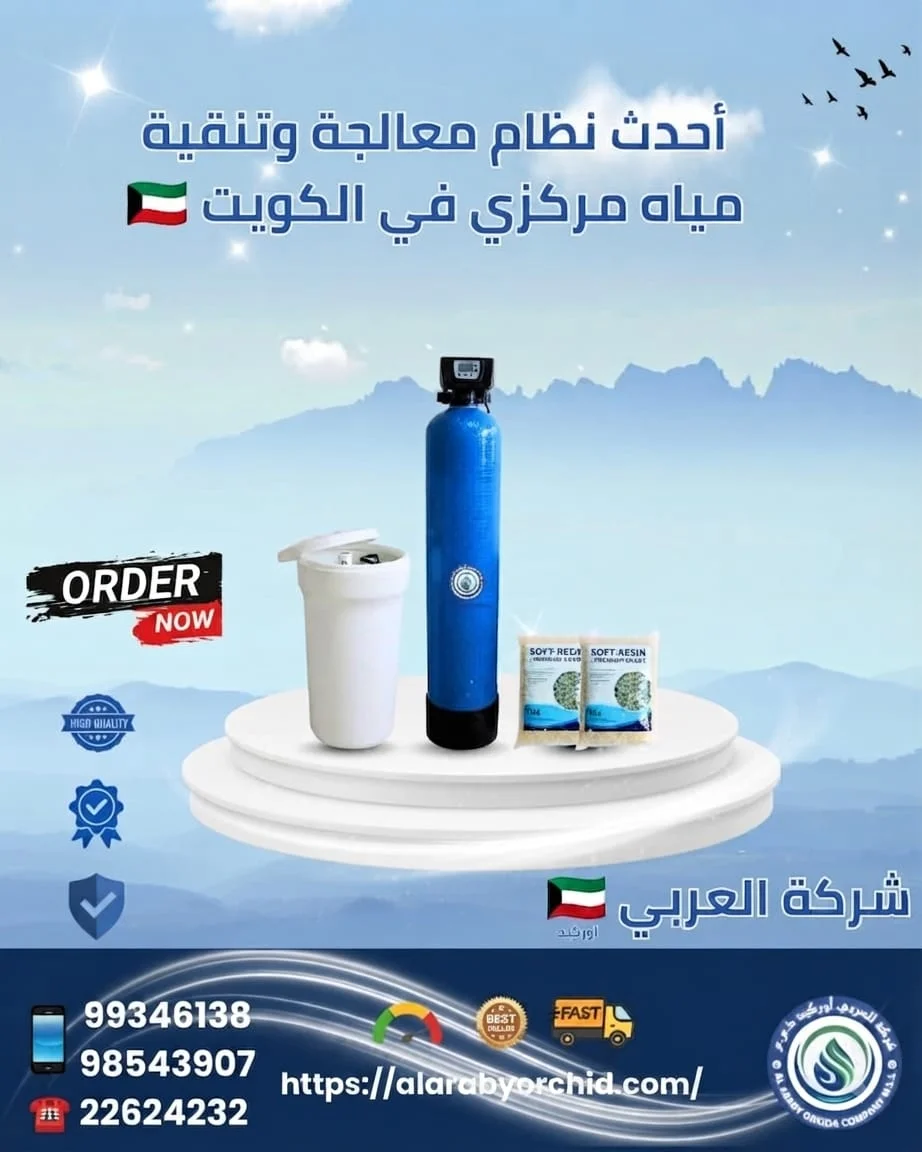
When you are deciding between a whole-house water filter and an under-sink filter, do not start by asking which one is “stronger,” because the two systems are designed for different jobs. A whole-house filter is installed on the main water line and treats a large volume before water is distributed throughout the property, while an under-sink filter focuses on a smaller quantity that is usually intended for drinking and cooking. The first is generally a Point-of-Entry system, while the second is a Point-of-Use system. This difference in installation location changes the required flow rate, equipment size, treatment technology, maintenance, and total cost. Al Arabi Orchid 99346138 provides whole-house solutions such as Sand, Jumbo, and Stainless Steel filters as well as 3-stage, 5-stage, 6-stage, and 7-stage kitchen systems. The correct choice starts by deciding which water inside the home you want to treat and why.
Whole-House Water Filter or Under-Sink Filter
The question whole-house water filter or under-sink filter is not answered by counting treatment stages or comparing the physical size of the units. It is answered by deciding how much of the household water supply you want the filtration system to affect. A whole-house or Point-of-Entry filter treats the water before it reaches most of the internal plumbing network. Sediment captured at this point does not continue downstream toward faucets, the central water heater, or other components installed after the filter. An under-sink or Point-of-Use system treats water at one specific location, usually a dedicated kitchen drinking-water faucet.
Consider a clear example. A villa has a water tank, booster pump, central water heater, and several bathrooms, and the homeowner notices light sediment or particles appearing at more than one outlet. Installing a small RO unit under the kitchen sink may produce treated drinking water, but it will not stop the same sediment from reaching the heater or bathroom faucets because the kitchen system is located much later in the plumbing network. In this situation, the whole-house filter serves a completely different purpose.
On the other hand, if the entire household network is functioning normally and there is no widespread sediment problem, but the family wants more advanced treatment specifically for drinking and cooking water, installing a large treatment system for every liter used in the property may be unnecessary. An under-sink filter allows technologies such as activated carbon or Reverse Osmosis to be applied to a limited quantity of water without passing shower, laundry, and cleaning water through the same advanced treatment.
The decision is also not always one system versus the other. In many homes, the best arrangement is a simple central filter for sediment and network protection combined with a separate kitchen filter for drinking water. Each system then performs the job it is best suited for instead of forcing one device to solve two completely different problems.
-
Choose a whole-house filter when the treatment objective involves most of the water used throughout the property rather than only the faucet used for drinking because installation location determines the scope of the system
-
An under-sink filter becomes more practical when you need specialized treatment for a small amount of drinking and cooking water without forcing the entire household supply through the same advanced stages
-
Sediment appearing at several outlets points more strongly toward treatment earlier in the water line than toward installing a sophisticated filter at the last point in the network
-
If the goal is protecting the heater pump and faucets from suspended particles the position of the filter before those components matters more than adding more stages under the kitchen sink
-
Combining a central filter for general household water with an under-sink system for drinking can provide the most balanced solution when the property has two separate treatment needs
Difference Between Whole-House and Under-Sink Filters
The difference between a whole-house filter and an under-sink filter starts with flow rate before it starts with cartridge type. A central filter may need to support several showers, taps, and appliances operating at the same time, so the housing size, connection diameter, and total filtration area have to accommodate a much higher flow. An under-sink filter usually supplies one faucet or a limited drinking-water point, which allows it to use finer treatment stages at a much lower flow rate.
The second difference is installation location. A whole-house system is installed on the main line or within the tank and booster arrangement depending on the property design. An under-sink system is installed locally beneath the kitchen sink and usually supplies a dedicated faucet or another specific drinking-water outlet.
The third difference is the treatment objective. A central filter may focus on suspended particles, chlorine reduction, taste and odor, or another treatment goal depending on the media and exact system. However, it is not automatically equivalent to an under-sink RO system used for drinking water. In the opposite direction, an RO filter under the sink should not be judged by whether it protects the entire villa because it is not installed on the branches feeding the bathrooms and other fixtures.
The fourth difference is the effect of hydraulic resistance on the property. A whole-house filter that is undersized or heavily restricted can create noticeable pressure loss throughout the home. An under-sink filter with slower flow normally affects only the drinking-water point. This makes housing size and rated flow much more critical in central filtration.
The fifth difference is maintenance. A main-line cartridge may handle a very large quantity of water and a high sediment load, while an under-sink multi-stage system may have more individual components to replace despite processing less total water.
-
Whole-house systems require higher flow capacity because any restriction can affect several bathrooms and fixtures while an under-sink system usually affects only one drinking-water outlet
-
The central system becomes part of the main plumbing structure while the kitchen filter remains a local addition that does not change how water reaches the rest of the property
-
An RO stage under the sink performs a completely different function from a central sediment cartridge so comparing the two only by stage count is technically misleading
-
Pressure drop must be considered more carefully in whole-house filtration because incorrect sizing can appear as low water pressure across the complete property
-
Maintenance for central systems is influenced heavily by total household consumption and sediment while under-sink maintenance depends more on the number of treatment stages and drinking-water production
Whole-House Water Filter

A whole-house water filter makes the most sense when the treatment objective is distributed across the property. If you have a storage tank followed by a pump, heater, and numerous plumbing fixtures, and you want to prevent part of the sediment load from reaching those components, early filtration on the main line provides a clear practical benefit because the same water passes through that central point before being distributed.
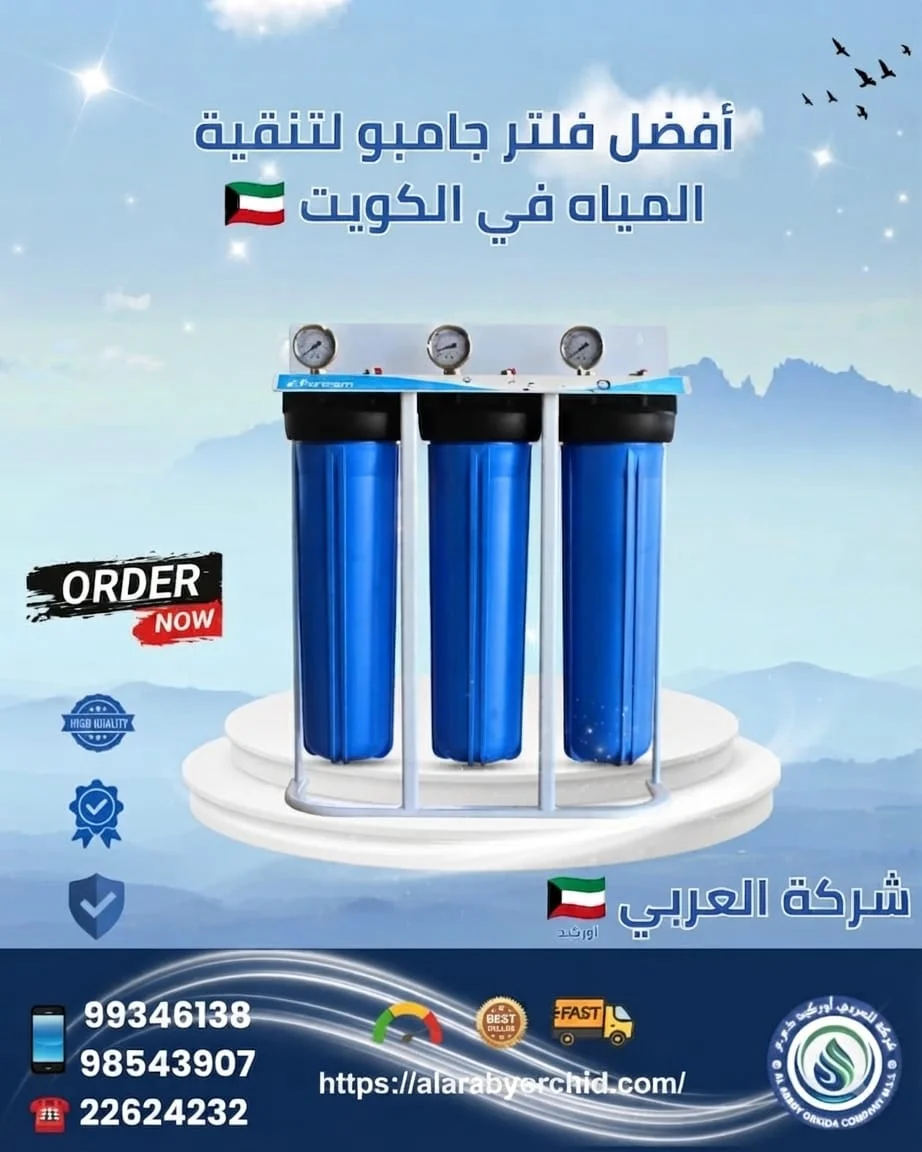
However, the term “whole-house filter” does not refer to one single technology. The system may be a Sand Filter for a particular application, a Jumbo cartridge housing, a 3-stage main-line system, or a Stainless Steel multi-cartridge filter depending on sediment load, flow rate, and site conditions. Al Arabi Orchid provides different central solutions, including sand filters in several sizes, Jumbo Filters, 3-stage systems, and stainless-steel filters using multiple cartridges for homes and larger buildings.
The most important issue in central filtration is flow capacity before extreme filtration fineness. This does not mean filtration quality is unimportant. It means that installing an extremely fine cartridge inside a small housing on a high-demand villa can create a system that filters effectively but does not deliver enough water during normal use. A successful system balances filtration level with required flow.
A whole-house filter should also never be assumed to “remove everything.” Its actual performance depends on the media used, the product design, and the specific treatment claims associated with that system. If the central system is intended mainly for sediment control, it should not automatically be expected to perform the same function as a Reverse Osmosis drinking-water system simply because it is physically larger.
-
A central filter provides greater value when the same water-quality issue appears at several outlets because treating the supply before distribution prevents part of the load from entering the household network
-
Selecting enough housing size and filtration area for the required flow helps preserve pressure when several fixtures are used at the same time
-
The presence of a storage tank can make central filtration particularly useful when sediment is introduced during storage or from internal property plumbing
-
The treatment media should be chosen according to the actual problem because Sand Jumbo and Multi-Cartridge systems are not simply different names for the same filtration process
-
A whole-house filter does not automatically replace specialized drinking-water treatment because its function depends on the media and documented performance of the exact system
Under-Sink Filter for Drinking Water
An under-sink filter for drinking water offers one major advantage: advanced treatment can be focused on the water the family actually drinks and uses for cooking instead of treating thousands of liters used for bathing and cleaning to the same level. This is exactly the practical idea behind Point-of-Use treatment.
An under-sink system may be relatively simple with several cartridges or may include Reverse Osmosis depending on the objective. The system should be selected based on what you want to reduce or change in the water rather than the appearance of the unit or stage count alone.
Installation space also matters. Under the sink, there may be an RO storage tank, several cartridges, a membrane housing, and possibly a booster pump depending on the model. Before purchase, the available space and future service access should be checked carefully. A technically excellent filter becomes inconvenient if every cartridge replacement requires dismantling the entire cabinet arrangement.
Another advantage is that the required flow rate is much lower than for whole-house treatment. This allows more specialized technologies to be used practically on drinking water. However, an RO system also has a production rate, storage capacity, wastewater ratio, and inlet-pressure requirement depending on the model. It should not be selected only because “RO” sounds more advanced.
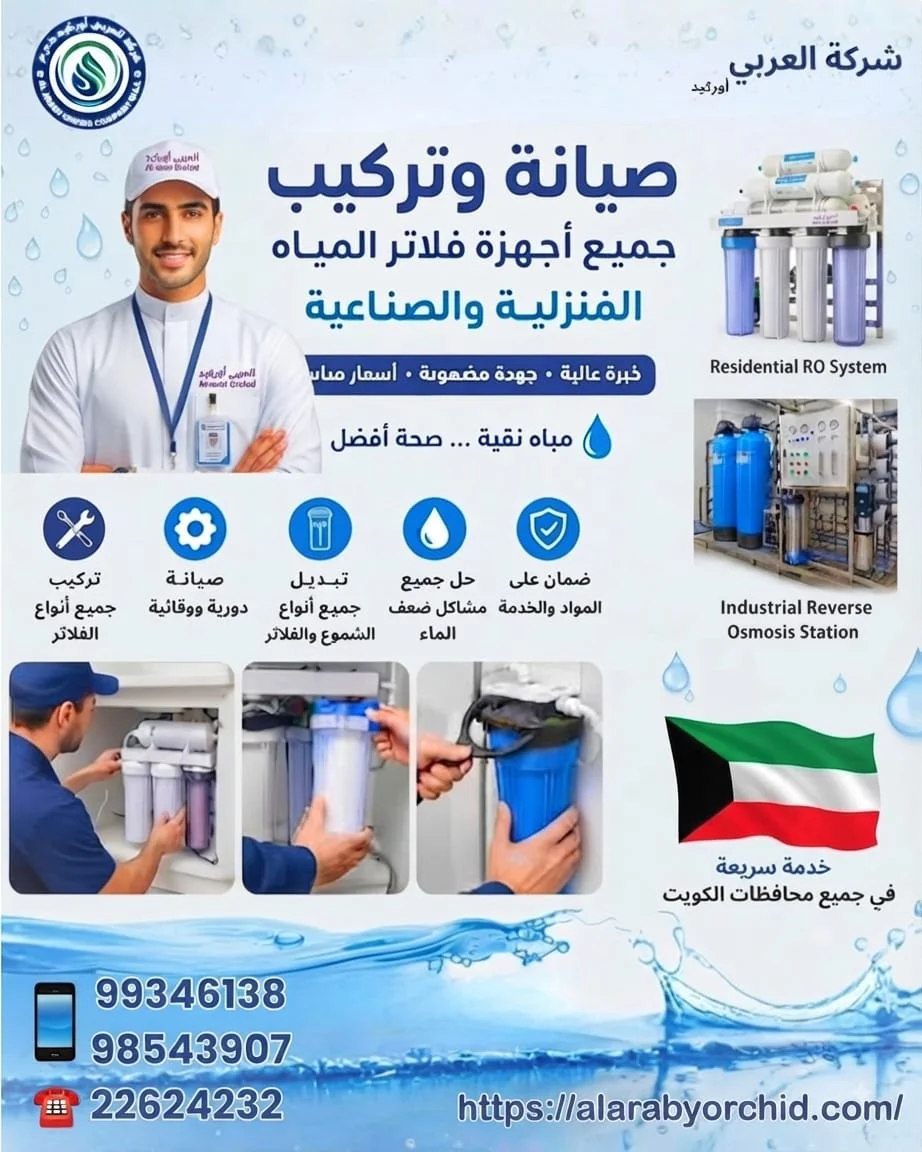
Al Arabi Orchid currently provides 3-stage and 5-stage kitchen filters as well as 6-stage, 7-stage, and alkaline-filter options in Kuwait.
-
Under-sink filtration is suitable when drinking and cooking water are the priority because it allows finer treatment without placing the entire household flow under the same cost and hydraulic resistance
-
A local system is usually easier to isolate and service because maintenance affects a small treatment area rather than the complete plumbing network
-
An RO system should be compared by membrane performance production rate storage tank and operating pressure rather than only by labels such as seven stages
-
Available cabinet space should be part of the decision because tanks cartridges and tubing need an arrangement that allows future service without dismantling the kitchen setup
-
A kitchen filter has a specialized objective so its success should be measured by drinking-water performance rather than by its effect on bathroom water
Comparing Home Water Filtration Systems
When comparing home water filtration systems, it is better to use five practical criteria rather than one general question. The first is treatment scope: the whole property or one drinking-water point. The second is required flow rate. The third is the type of substances or water characteristics you want to address. The fourth is installation and maintenance cost. The fifth is how a restriction or failure would affect daily household use.
In terms of coverage, the whole-house system is obviously broader, but broader does not automatically mean better. If the only treatment need is in the kitchen, treating the entire property may simply add cost without delivering meaningful additional value.
For flow, the under-sink system is easier to manage because it processes a smaller volume. The central system requires significantly more careful sizing because it may need to support several fixtures at once.
In terms of treatment technology, under-sink systems can practically use options such as Reverse Osmosis for drinking water, while central systems may be better suited to sediment management or other whole-house objectives depending on the selected media.
The effect of clogging is also different. If an under-sink cartridge becomes restricted, the drinking faucet becomes inconvenient, but the rest of the house continues to operate. If a central filter becomes restricted, water pressure may drop across a large part of the property. This makes monitoring and correct sizing particularly important.
-
Whole-house filtration provides greater coverage while under-sink filtration provides greater treatment focus so the better option depends on where the need exists rather than on a general hierarchy
-
Drinking-water systems can use more specialized treatment because the required water volume is much smaller than the complete household demand
-
Central systems need stronger flow management because any restriction can affect bathrooms kitchens and appliances located after the filter
-
Maintenance cost is not determined by equipment size alone because a smaller under-sink system may contain more individual stages and replacement components
-
When comparing systems calculate one or two years of cartridge and service costs rather than comparing only the initial purchase price
Advantages of a Whole-House Water Filter
The clearest advantages of a whole-house water filter come from treating the water before it is divided among many outlets. Instead of placing separate protective devices at every fixture, one central treatment point can capture part of the sediment load or provide another defined function according to the selected filter media.
The second advantage is protection for components located downstream of the filter from the particles the system is designed to capture. This can be particularly useful in properties where sediment repeatedly reaches faucets, valves, heaters, or other equipment.
A third advantage is operational convenience. For the function provided by the central system, the user does not have to remember which faucet is treated because most water passing beyond that point receives the same filtration.
However, this advantage only exists when sizing is correct. An undersized central filter can turn the benefit of “whole-house treatment” into a problem where the entire property experiences poor pressure.
-
Treating water at the main entry point extends the intended filtration function across most of the downstream network instead of limiting it to a single faucet
-
Reducing sediment reaching selected plumbing components and equipment provides a different benefit from simply improving drinking-water characteristics at the kitchen
-
A central system allows a large portion of the household filtration process to be managed from one service location which can simplify maintenance in larger homes
-
Larger filtration area in systems designed for higher flow can support several fixtures without creating premature restriction
-
The strongest advantage of whole-house filtration appears when the selected system addresses a real network-wide problem rather than being installed simply because the word central sounds more powerful
Advantages of an Under-Sink Filter
The advantages of an under-sink filter begin with efficient use of the treatment budget. Instead of paying to apply advanced filtration to every liter used in the household, the investment is focused on the water that is actually consumed directly by people or used for cooking.
The second advantage is flexibility in treatment technology. Point-of-Use systems can include carbon filtration, Reverse Osmosis, or various multi-stage arrangements depending on the required treatment objective.
A third advantage is easier installation in an existing property. Many under-sink systems can be added without major modifications to the main plumbing line, making them practical for apartments or homes that do not have a suitable service room for larger filtration equipment.
The system can also be upgraded more easily if drinking-water requirements change. Moving from a simpler kitchen filter to a more specialized arrangement is often easier than redesigning the main-line filtration system for the entire property.
-
An under-sink filter directs the cost of advanced treatment toward water used directly for drinking and cooking rather than toward shower and cleaning water
-
The variety of Point-of-Use technologies allows the system to be selected around a defined objective such as carbon treatment RO or another multi-stage arrangement
-
Local installation can suit apartments and homes where the main water line cannot easily be modified or where there is no space for large central equipment
-
Maintenance problems normally remain limited to the drinking-water point rather than reducing pressure across the complete property
-
Upgrading a kitchen system is often easier than redesigning a complete whole-house filtration arrangement when family requirements change
Whole-House Filtration or Kitchen Filtration
The decision between whole-house filtration or kitchen filtration becomes clearer when real household scenarios are used instead of general statements. If the only complaint is the taste of drinking water and there is no visible sediment elsewhere in the property, the kitchen is the logical place to begin. If particles repeatedly appear in showers, faucets, and the heater, then the problem extends beyond one drinking-water point.
If both conditions exist, there is no need to force one device to do everything. A central sediment filter followed by a separate kitchen drinking-water system can distribute the treatment tasks more intelligently.
The general principle is simple: identify what you want to reduce or change, then select a system that has the appropriate technology and documented performance for that purpose. No single filtration system should be assumed to address every possible water concern.
-
Choose kitchen filtration when the concern is limited to drinking water and there is no technical reason to treat the complete household supply to the same level
-
Choose whole-house filtration when the particles or water characteristics being addressed affect several points throughout the plumbing network
-
If the property needs both sediment protection and specialized drinking-water treatment the two systems can complement each other instead of being treated as competing alternatives
-
Do not expand treatment from one faucet to the entire property unless flow requirements maintenance and practical benefit justify the additional investment
-
Give each filtration system a clear objective so its success can be measured after installation instead of using a vague statement such as the water feels better
Whole-House vs Under-Sink Filter Cost
The cost of a whole-house filter versus an under-sink filter should be compared as a complete project rather than only by equipment price. A central system may require a larger housing, isolation valves, additional piping, installation space, and sometimes several cartridges. An under-sink system may require a storage tank, RO membrane, multiple cartridges, and possibly a small booster pump depending on the design.
According to currently published Al Arabi Orchid examples, some Jumbo Filters start from around KWD 50, while selected Sand Filters start from around KWD 165, and some 3-stage and 5-stage kitchen filters also start from around KWD 50. These are starting reference prices, not a direct product-to-product comparison and not guaranteed final installation totals because size, configuration, plumbing work, and site conditions vary.
Maintenance cost can change the comparison significantly. A large central filter may use bigger or more numerous cartridges, while an under-sink RO system may include pre-filters, an RO membrane, and post-treatment stages with different service schedules.
A central filter installed on an already prepared line can be much less expensive to install than one requiring new pipework and valves. Likewise, an under-sink system can become more expensive if it requires a pump, additional faucet, or extensive cabinet modification.
-
Starting price does not determine which system is cheaper over time because cartridge count replacement intervals and installation work all affect total ownership cost
-
Installing a whole-house filter on a prepared main line is very different from a project requiring new piping valves and changes around the tank or pump
-
An under-sink RO unit may be physically smaller but its membrane storage tank and multiple stages mean maintenance is not automatically cheaper than every central system
-
Compare quotations based on the same scope of supply and installation so you do not compare the price of one device with the price of a complete installed project
-
Published prices can change so they should be treated as a starting reference before the exact system and installation site are assessed
Choosing a Whole-House or Under-Sink Filter
Choosing a whole-house or under-sink filter can be turned into a simple decision process. First ask: where does the problem appear? If it is limited to one point, local treatment may be enough. If it appears throughout the network, central treatment becomes more relevant. Second ask: what exactly do you want to reduce? Sediment? Taste and odor? A specific substance? Third ask: what flow rate is required? Fourth consider the maintenance budget. Fifth ask whether the best design may actually require both systems.
Al Arabi Orchid currently provides Sand, Jumbo, 3-Stage, and Stainless Steel solutions for central filtration as well as 3-stage, 5-stage, 6-stage, 7-stage, and alkaline kitchen filters. This variety only becomes useful when selection begins with the household problem rather than with the product name.
The property layout should also be considered. The location of the tank, booster pump, heater, and kitchen all affect where filtration is most effective. Installing a central filter after the component you were trying to protect defeats part of the reason for choosing central filtration.
-
Begin with where the problem appears because treatment location determines whether the decision should be whole-house or under-sink before individual models are compared
-
Identify the substance or water characteristic you want to change because selecting the correct treatment technology matters more than choosing the largest housing or highest stage count
-
Calculate household flow if choosing a central system so the new filter does not become the cause of low water pressure after installation
-
Calculate drinking-water demand and required production if choosing an under-sink system especially when using an RO unit with a storage tank
-
You can contact Al Arabi Orchid on 99346138 and explain the property size tank location and water concern so the system can be selected around actual household use
Conclusion
There is no single answer saying that a whole-house water filter or under-sink filter is better for every home. A whole-house system is the better choice when filtration needs to affect the household network or when you want to capture sediment before it reaches downstream components such as the heater, pump, and faucets. An under-sink system is better when the main objective is focused treatment of drinking and cooking water without applying the same technology to the entire household supply.
In many homes, the strongest solution is not “one against the other” but rather a simple central filter for protection combined with a specialized kitchen filter for drinking water. The two systems then serve different purposes and complement each other.
Al Arabi Orchid currently provides Sand, Jumbo, 3-Stage, and Stainless Steel filters as well as multi-stage kitchen filtration systems in Kuwait. You can contact 99346138 for help selecting the appropriate arrangement. The correct system is not the largest filter and not the one with the greatest number of stages. It is the one that treats the right water at the right location with the right technology without creating unnecessary cost or pressure loss.
Frequently Asked Questions
Which is better, a whole-house filter or an under-sink filter?
It depends on the objective. A whole-house filter is more suitable for treating water across a broad part of the property, while an under-sink system is designed for more focused treatment of drinking and cooking water.
Does a whole-house filter eliminate the need for a kitchen filter?
Not always. If the central system is designed mainly for sediment or another specific function, a more specialized kitchen system may still be useful when drinking-water treatment has a different objective.
Does an under-sink filter protect the water heater and pump?
Not if it is installed only at the kitchen after the plumbing branches have already separated. Its effect is limited to the Point-of-Use outlet and it does not protect equipment located upstream.
Can a whole-house filter reduce water pressure?
Yes. If the housing or cartridge is too small for the required flow or becomes heavily clogged, pressure can drop throughout the property. Correct sizing and maintenance are therefore very important.
Is RO better than a whole-house filter?
RO describes a treatment technology, while “whole-house” describes the location and scope of the system. They are not direct alternatives. RO is commonly used as Point-of-Use treatment for drinking water, while central systems may use many different filtration technologies.
Can I install both a whole-house filter and an under-sink filter?
Yes. In some homes this is the most practical design because the central filter handles sediment or another general household requirement while the kitchen filter provides more specialized drinking-water treatment.
Which is cheaper, a whole-house filter or an under-sink filter?
It depends on the exact system. Al Arabi Orchid currently publishes starting examples of around KWD 50 for certain Jumbo Filters and some 3-stage and 5-stage kitchen systems, while selected Sand Filters begin from around KWD 165. Installation and maintenance costs vary by site and configuration.
Does a larger filter mean better filtration?
No. A larger housing may be required for higher flow or greater filtration area, but treatment quality depends on the filter media, system specification, and the exact performance objective.
How do I know if my home needs a whole-house filter?
If the same issue appears at several faucets or if you want to capture sediment before water is distributed through the property, a whole-house filter is worth evaluating.
Who installs whole-house and under-sink filters in Kuwait?
Al Arabi Orchid provides installation and maintenance for Sand, Jumbo, 3-Stage, Stainless Steel, and multi-stage kitchen filters in Kuwait. You can contact 99346138 to select a system according to the household plumbing network and drinking-water requirements.
