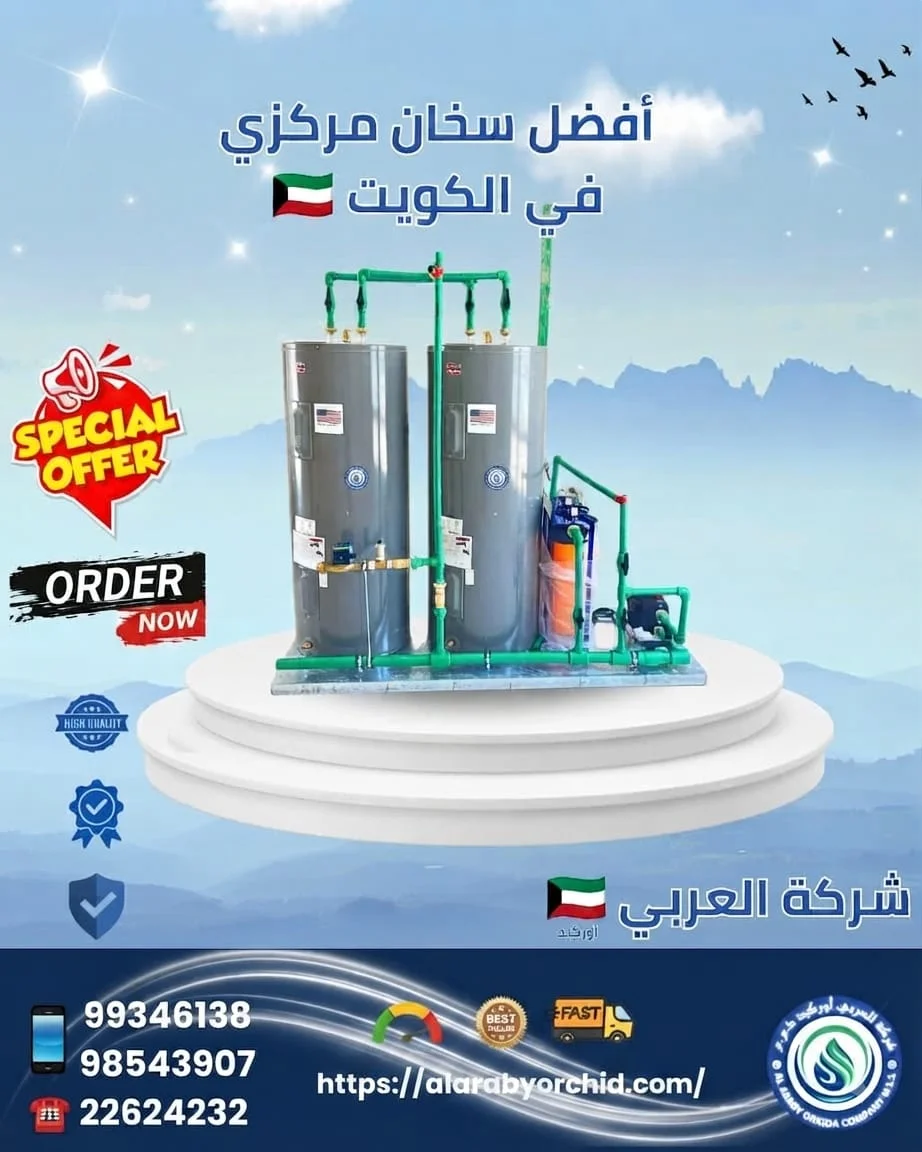
When you ask about the best types of central water heaters in Kuwait, do not begin with the brand name or the number of gallons. The right type is determined first by the heating technology, the household’s hot-water demand, the available energy source, and how heavily hot water is used throughout the day. Residential water-heating technologies include electric storage heaters, hybrid heat pump water heaters, gas storage or tankless systems, and solar water-heating systems, and each works in a completely different way. Al Arabi Orchid 99346138 currently provides several American central water-heater brands and capacities in Kuwait together with installation and maintenance services. The better decision therefore starts by identifying the type of system that suits the property rather than automatically buying the largest water heater available.
Best Types of Central Water Heaters in Kuwait
Determining the best types of central water heaters in Kuwait requires separating the word “best” from the word “largest.” The best heater is the one that can cover the household’s real hot-water demand during peak periods, recover the used hot water at an appropriate rate, match the available electricity or gas supply, fit the installation area, and work correctly with the plumbing network. This means an American electric storage water heater may be an excellent choice for a villa that relies completely on electricity, while a Heat Pump Water Heater may be more attractive in a property where long-term energy efficiency is a stronger priority and the installation area can provide the ventilation and space the technology needs. A tankless system may also suit certain applications, but it is not automatically the best choice for a villa where several bathrooms may be used at the same time.
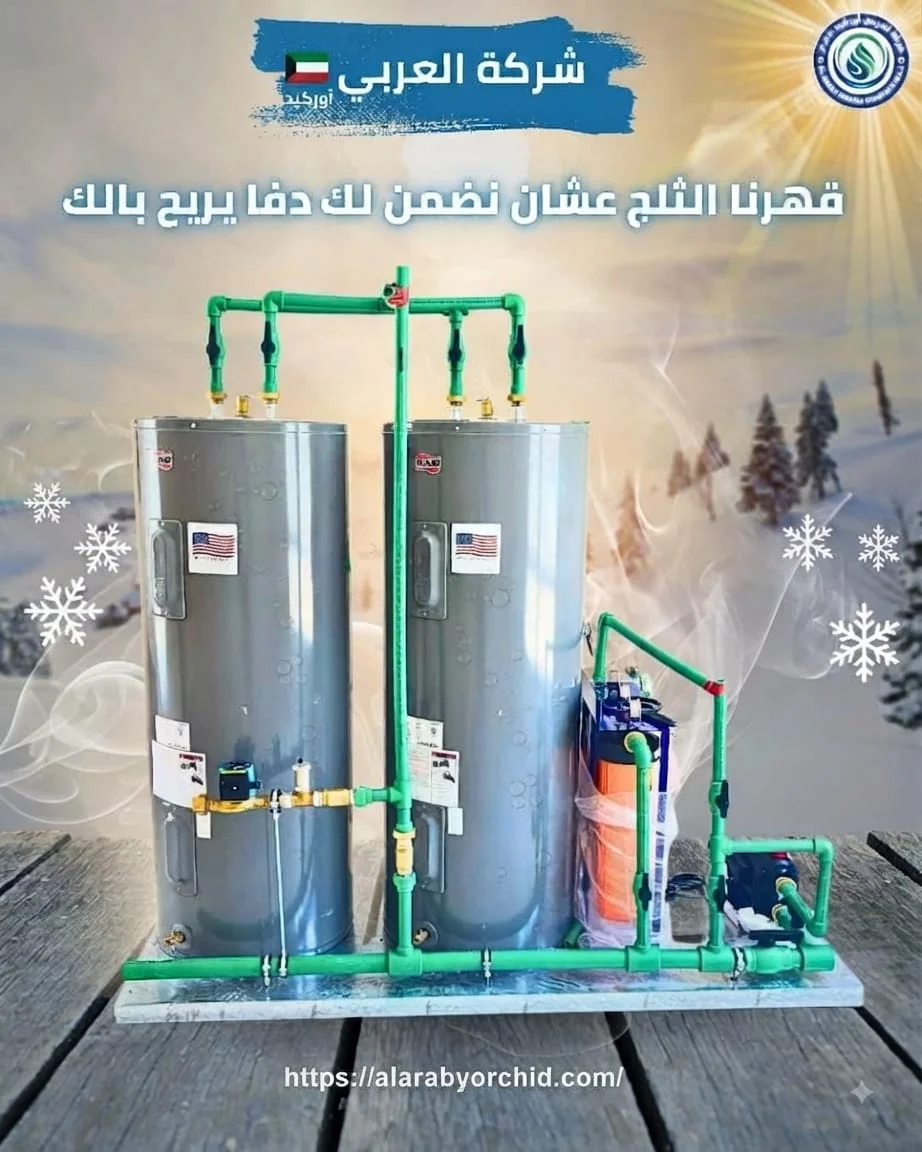
One of the most common systems in traditional residential central water-heating installations is the Storage Water Heater. It stores a defined quantity of hot water inside a tank and maintains it close to a selected temperature. In an electric model, heating is normally provided by electrical elements located inside the tank. The major advantage is that a ready volume of hot water is available before demand begins. However, real performance depends on tank capacity, heating power, insulation quality, and recovery rate rather than on tank size alone.
The second category is the Heat Pump Water Heater, sometimes described as a hybrid heater. Instead of producing all of its heat directly through electrical resistance, it transfers heat from the surrounding air into the stored water. The operating principle is similar to a refrigerator working in reverse. Many models can operate in several modes and may use backup electric resistance when hot-water demand becomes unusually high. This technology can achieve substantially higher efficiency than conventional resistance heating, but it requires suitable installation conditions, airflow, and service space.
Other categories include tankless heaters, gas-fired storage systems, and solar water-heating systems. Each one has a completely different operating philosophy. None of these technologies is universally the best in every home, so the correct choice has to be matched to the property and its actual usage.
-
The best type in Kuwait is the one that covers the household’s actual peak demand while remaining compatible with the available energy source electrical system and plumbing configuration
-
A storage water heater provides a ready volume of hot water so it should be evaluated through storage capacity recovery rate and First Hour Rating rather than the product family name alone
-
A Heat Pump Water Heater can achieve much higher efficiency because it transfers heat instead of producing all of it with resistance but the installation area must provide suitable ventilation and operating conditions
-
A tankless heater must be evaluated through simultaneous flow demand and required temperature rise rather than selected simply because it does not use a storage tank
-
Before purchasing from Al Arabi Orchid on 99346138 it is better to identify the number of users simultaneous bathrooms energy source and installation space so the comparison remains technical rather than purely promotional
Types of Central Water Heaters for the Home
Understanding the types of central water heaters for the home becomes much easier when households are classified by their hot-water usage pattern instead of only by whether the property is a house or villa. A household with two or three people whose showers are spread across the day does not have the same peak load as a large family where several bathrooms may be used during the same morning hour. The same water-heating technology can therefore perform extremely well in the first property and feel inadequate in the second even when the buildings are similar in physical size.
An electric storage heater suits many homes because it combines stored hot water with relatively straightforward operation. However, nominal tank capacity does not tell the whole story. One important performance measure is the First Hour Rating or FHR, which estimates how much hot water a storage heater can deliver during the first hour starting with a fully heated tank. This measurement includes both the stored hot water and the system’s ability to recover during use, making it more meaningful than asking only how many gallons the tank holds.
For homeowners focused strongly on long-term electricity use, a Heat Pump Water Heater may deserve serious consideration. The technology transfers heat from the surrounding air into the tank instead of depending completely on electrical resistance. Some current models achieve very high efficiency ratings. However, the installation needs to account for available room volume, ventilation, condensate drainage, and the manufacturer’s operating conditions because the system should not be treated like a standard electric tank that can simply be placed anywhere.
Tankless systems also become relevant where space is limited or the household has a usage pattern suited to continuous on-demand heating. However, the unit’s gallons-per-minute capability has to cover the total fixtures that may operate simultaneously. Solar systems use roof-mounted collectors together with a tank and usually require a backup energy source depending on the design.
-
A smaller home does not automatically require the smallest heater because simultaneous showers and kitchen use can create a high short-term demand even in a modest property
-
First Hour Rating provides a practical picture of storage-heater performance during peak use because it combines stored volume with the ability to recover hot water
-
A Heat Pump Water Heater suits a home that has the right installation environment and a clear efficiency objective but it should not be treated as a direct installation substitute for every conventional electric tank
-
Tankless systems are evaluated through flow rate and temperature rise so realistic simultaneous fixture demand matters more than a storage capacity that the system does not have
-
The best home system provides stable comfort during the highest-demand hour without forcing the owner to purchase unnecessary capacity or technical complexity for the rest of the day
Types of Central Water Heaters

From a technical perspective, types of central water heaters can be classified according to how heat is produced and whether hot water is stored. The first category is Electric Storage. This system uses a tank, electric heating elements, thermostatic control, insulation, and safety devices. It is the traditional type many homeowners mean when they refer to a central water heater. Its main advantage is that hot water is stored and ready, but energy is also used to maintain the tank temperature, so insulation quality and temperature settings influence overall efficiency.
The second category is Heat Pump Storage. It still stores hot water inside a tank, but the heating method is different. Instead of converting electricity directly into heat through resistance during normal operation, a heat pump transfers thermal energy from the surrounding air into the stored water. Modern heat-pump models can achieve very high Uniform Energy Factor values compared with conventional electric resistance systems. This is a major technical difference that cannot be understood simply by comparing tank capacity.
The third category is Tankless. It produces hot water when demand occurs and does not rely on a large storage tank. Performance is determined by flow rate, temperature rise, and heating power rather than gallons of storage. Tankless technology can reduce standby losses associated with keeping a large tank hot, but the system must have enough instantaneous capacity to serve simultaneous fixtures if it is being used as a central solution.
The fourth category is Gas Storage, which uses combustion to heat a stored water volume. It has different ventilation, flue, combustion-air, gas-supply, and safety requirements from electric systems. The fifth category is Solar Water Heating, which uses solar collectors, a storage tank, circulation components, and usually an auxiliary backup source. It is a complete system rather than simply another version of an electric tank.
Al Arabi Orchid currently focuses strongly on American storage-type central water heaters and provides brands such as Ruud, Bradford White, A. O. Smith, American, Rheem, and Richmond in several capacities.
-
Electric Storage suits homeowners who want a familiar conventional system with straightforward operation but tank capacity heating power and insulation should all be properly balanced
-
Heat Pump Storage adds a much more efficient heating method to the storage-tank concept but requires evaluation of room conditions ventilation and operating characteristics
-
Tankless removes the large stored volume and depends on instantaneous capacity so comparison with a storage heater must use flow rate and temperature rise rather than gallons
-
Gas Storage requires combustion ventilation and safety infrastructure that is completely different from an electric installation so purchase price alone does not create a fair comparison
-
Solar Water Heating is a genuine central system but it involves collectors tanks controls circulation and backup heating rather than one standalone appliance
Comparing Central Water Heater Types
A proper comparison of central water heater types should cover at least six points: hot-water delivery speed, peak-demand capability, energy consumption, installation cost, space requirements, and maintenance complexity. Comparing two systems only by the equipment price produces an incomplete decision.
A conventional electric storage heater is relatively simple in its operating concept and provides a ready reserve of hot water. However, once peak demand exceeds the stored volume and recovery capability, the household may have to wait for the system to raise the water temperature again. A Heat Pump Water Heater can reduce energy consumption significantly, but the technology is more complex and its performance depends partly on surrounding-air conditions and the operating mode selected.
A tankless system eliminates the need to recover a large stored tank after depletion, but it must be able to heat the required water flow instantly. If three showers are likely to operate at the same time, the equipment must be sized for that actual combined load rather than for one fixture.
A solar system can reduce dependence on purchased energy but requires suitable roof space, collector orientation, storage, controls, circulation arrangements, and an appropriate backup source.
Maintenance requirements also differ. A conventional storage heater may require attention to the tank, heating elements, thermostats, anode rod, and safety valve depending on the model. A Heat Pump Water Heater adds refrigeration-cycle components, fans, air filters, and other airflow-related parts. Tankless units contain heat exchangers and flow controls and may have maintenance requirements related to mineral accumulation depending on water conditions.
-
If simple installation and familiar servicing are the main priorities a conventional storage heater remains a practical option for many households
-
If long-term energy efficiency is a major priority a Heat Pump Water Heater deserves serious comparison as long as the property provides suitable installation conditions
-
If installation space is the major concern and the household flow pattern is compatible a tankless system can be useful but instantaneous demand must be calculated before purchase
-
If the property is designed to benefit from solar energy and roof conditions are suitable a solar water-heating system can be included in the economic comparison rather than treated as an unrealistic option
-
The correct comparison includes life-cycle operating cost maintenance and installation requirements instead of looking only at the purchase price on the first day
Best Central Water Heater for the House
The best central water heater for the house is the one you barely have to think about during normal use. You should be able to open the shower in the morning while the kitchen is being used and still receive comfortable hot water without a sudden temperature collapse or the need to raise the thermostat excessively just to compensate for insufficient capacity.
This is why the starting point should be Peak Hour Demand. How many showers may operate during the busiest hour? Is there a bathtub? Does any appliance use hot water from the central network? How long do showers normally last? Once this pattern is understood, the demand can be compared with First Hour Rating for a storage heater or flow capability for a tankless system.
If household use is moderate and the correctly sized storage capacity is available, a conventional electric storage heater can be the simplest practical choice. If the homeowner wants significantly better efficiency and the installation area allows it, Heat Pump technology can be considered seriously.
The number of people alone should never be the only sizing rule. Two households with the same number of residents can have completely different morning routines. One may take showers at separate times while the other uses two bathrooms simultaneously every day. Their required central water-heating performance will therefore be different.
-
A home where hot-water use is spread throughout the day can operate comfortably on a different system from a home where most demand occurs within one concentrated hour
-
First Hour Rating is more informative than tank capacity alone because two heaters with the same nominal gallons can provide different first-hour performance
-
Insulation quality recovery capability and control design influence real user comfort alongside the physical size of the tank
-
If household demand has increased because more people live in the property or another bathroom has been added do not automatically replace the old heater with the same capacity
-
Al Arabi Orchid 99346138 can compare available capacities and models after the household usage pattern is identified instead of beginning from one preferred brand name
Best Central Water Heater for the Villa
Choosing the best central water heater for the villa requires a broader view because villas often have more bathrooms, longer hot-water pipe runs, remote fixtures, and sometimes a hot-water recirculation pump. In this situation, the heater itself is only one part of the complete hot-water system.
A villa with six bathrooms does not mean that all six will operate simultaneously. What matters is the realistic peak scenario. If three showers can operate during the same period, the system should be capable of supporting that demand without a major drop in delivered temperature.
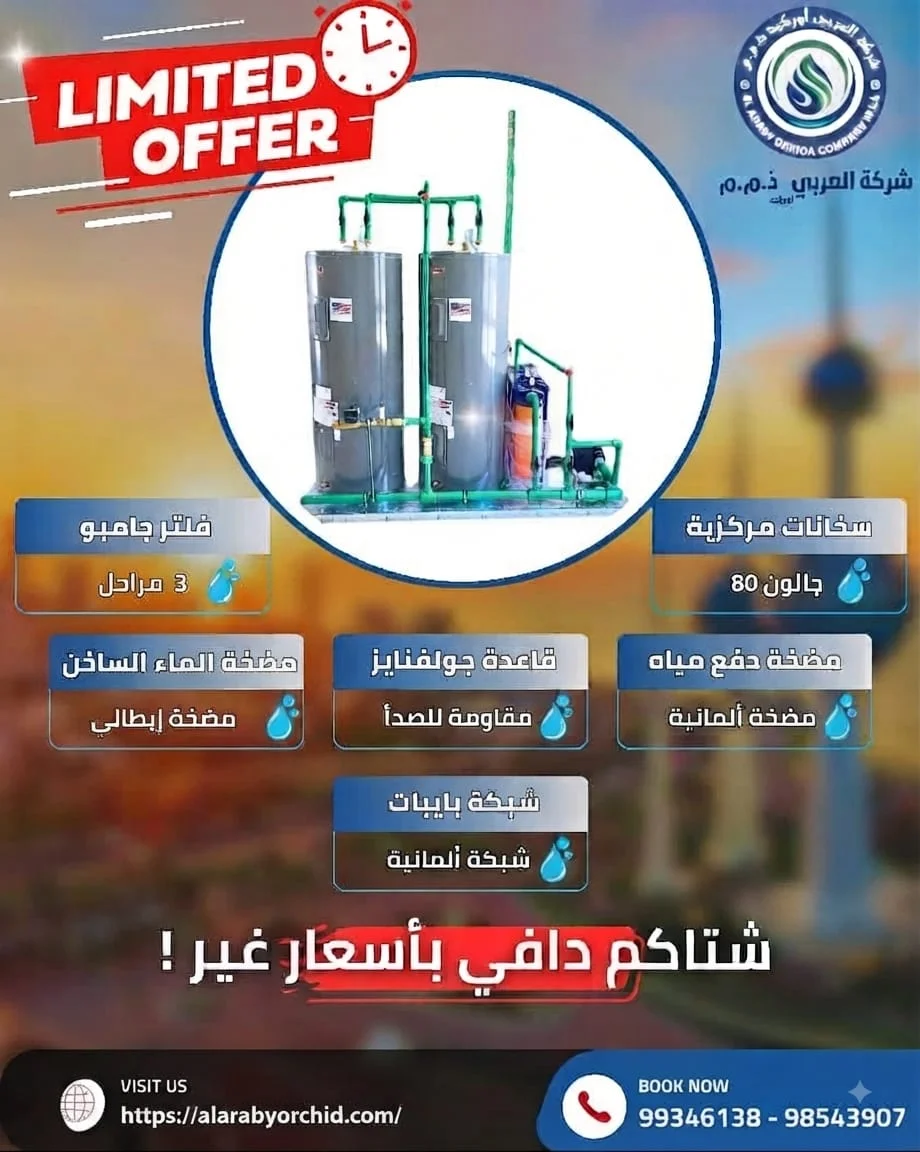
Capacities such as 80 gallons and 120 gallons frequently enter villa discussions, but neither should be treated as a universal rule. Selection depends on First Hour Rating, heating power, actual usage, and recovery capability. Al Arabi Orchid currently provides American central water heaters in capacities that include 50, 65, 80, and 120 gallons, giving villas several sizing options without implying that the largest unit is automatically the correct one.
Long pipe runs also matter. A homeowner may complain that hot water takes too long to arrive at distant bathrooms even though the heater itself has more than enough capacity. In this case, the real issue can be distribution rather than storage volume. A hot-water recirculation pump can improve delivery time to distant points, but continuous uncontrolled recirculation can increase heat losses through the piping.
-
A villa should be sized around realistic peak demand and the number of fixtures likely to operate together rather than simply counting every bathroom as simultaneous demand
-
Long hot-water pipe runs can create waiting-time complaints that are related to distribution rather than heater capacity so installing a larger tank does not solve every issue
-
80-gallon and 120-gallon units are possible choices rather than fixed formulas because recovery rate and First Hour Rating vary from one model to another
-
A hot-water recirculation pump can improve comfort at distant outlets but should be controlled intelligently so unnecessary circulation does not increase heat loss
-
In larger villas the heater pump recirculation loop and hot-water piping should be evaluated as one integrated system rather than buying a very large tank and assuming the job is complete
Energy-Efficient Central Water Heaters
When looking for energy-efficient central water heaters, the most useful approach is to move away from vague claims such as “very economical” and look at measurable performance indicators. One of the main indicators is the Uniform Energy Factor or UEF. As a general rule, a higher UEF indicates greater overall water-heating efficiency within the relevant test conditions and equipment category.
However, equipment should still be compared within appropriate categories because different technologies operate differently. Heat Pump Water Heaters, for example, can achieve substantially higher UEF values than conventional electric resistance storage heaters because they transfer heat instead of creating all of it directly through resistance elements.
Energy savings also depend on much more than the heater itself. Tank insulation, hot-water pipe insulation, temperature settings, recirculation controls, plumbing leakage, and usage behavior all affect total consumption. A highly efficient water heater connected to an uncontrolled recirculation loop running twenty-four hours through uninsulated pipes can lose part of the expected efficiency advantage.
Sizing also matters. An excessively large storage heater may carry unnecessary standby losses, while an undersized heater may force the household to use higher settings or operate backup heating more often.
-
Compare UEF within the appropriate product category instead of trusting the words Energy Efficient when no measurable performance information is provided
-
Heat Pump technology follows a different efficiency path because it transfers heat into the water rather than producing all of it through electrical resistance
-
Good insulation reduces standby losses in storage heaters so the system does not have to continuously replace heat lost from the tank
-
Controlling the recirculation pump according to actual demand can reduce unnecessary hot-water circulation during periods when nobody is using the system
-
Real energy savings come from an efficient heater combined with properly designed piping sensible controls and suitable operating settings rather than from the appliance alone
High-Efficiency Central Water Heater
The phrase high-efficiency central water heater should be translated into measurable performance rather than treated as a marketing expression. UEF is one of the most useful efficiency indicators, while First Hour Rating is one of the most useful indicators of hot-water delivery capability in a storage system. A highly efficient heater that cannot cover the household’s peak demand may still create poor comfort, while an extremely powerful heater with weak efficiency can increase energy consumption unnecessarily.
It is also important to separate Efficiency from Capacity. A larger tank is not automatically more efficient, and a stronger heating element does not automatically reduce electricity consumption. Higher heating power can improve recovery speed, but recovery speed and energy efficiency are different concepts.
Heat Pump Water Heaters may also use performance measures such as coefficient of performance, or COP. This describes the relationship between useful heat delivered to the water and the electrical energy used to operate the heat-transfer process. Because the unit moves heat instead of simply generating it through resistance, the useful heat delivered can be significantly greater than the electrical input.
System-level efficiency must also include what happens after the hot water leaves the heater. Heat lost through long uninsulated pipes and recirculation loops still represents energy the household paid to produce.
-
High efficiency should be confirmed through actual product performance indicators together with hot-water delivery capability rather than general promotional descriptions
-
A very large tank with weak insulation does not become highly efficient simply because it stores more hot water
-
Fast recovery improves convenience but does not independently define efficiency because heating power and energy performance are different concepts
-
A Heat Pump Water Heater can combine storage with very high efficiency but installing it outside the environmental conditions intended for the technology can reduce its practical advantage
-
Final system efficiency includes the heater piping recirculation and control settings because heat lost after water leaves the tank still becomes an energy cost for the homeowner
Central Water Heater Brands in Kuwait
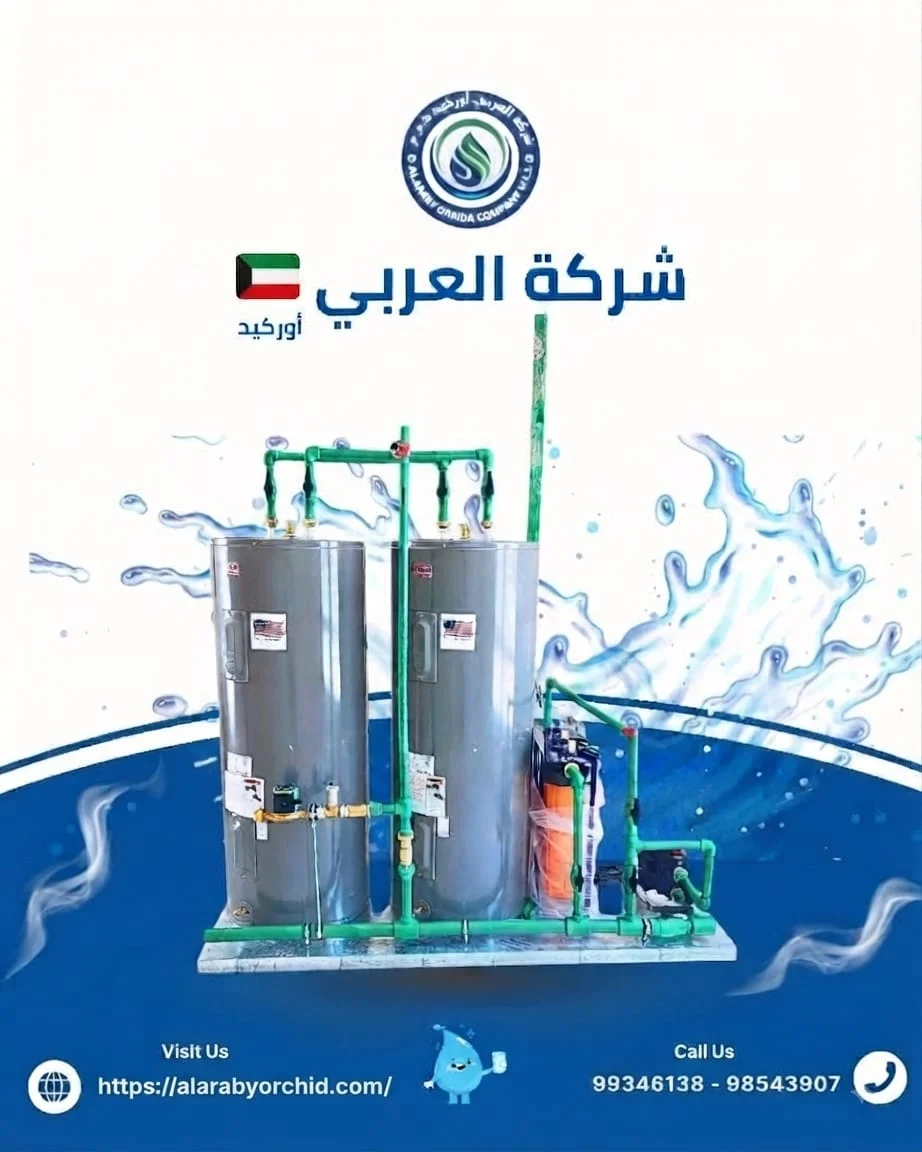
The subject of central water heater brands in Kuwait should be approached carefully rather than assuming there is one brand that wins every comparison. Brand matters because it relates to tank design, available models, warranty structure, spare parts, and service support. However, one brand can offer several products with very different capacities, heating powers, and intended applications.
Al Arabi Orchid currently works with American central water-heater brands including Ruud, Bradford White, A. O. Smith, American, Rheem, and Richmond, and provides capacities such as 50, 65, 80, and 120 gallons within its American central-heater range.
The correct comparison is therefore model against model rather than brand name against brand name. Look at actual storage capacity, heating power, First Hour Rating, tank construction, anode design, electrical requirements, physical dimensions, warranty terms, and local availability of service parts.
The exact model being supplied should also be confirmed before installation. A well-known brand name alone does not tell you whether the unit is 50 gallons or 80 gallons, whether it has the correct electrical configuration for the property, or whether its physical dimensions suit the available space.
Local serviceability matters as well. A heater with excellent specifications but difficult-to-source parts can become inconvenient later, while a model with good local support may provide a better ownership experience over many years.
-
A respected brand does not remove the need to evaluate the exact model because differences within one manufacturer can be greater than differences between two familiar brand names
-
Spare-part availability and technician familiarity in Kuwait have practical value throughout the heater’s life and should be considered alongside the original specifications
-
Compare the written warranty and its conditions instead of relying only on general claims such as long warranty without knowing what is actually covered
-
Al Arabi Orchid provides several American brands which allows customers to compare multiple options instead of forcing every property into one manufacturer
-
The final decision should begin with a model that matches demand electrical supply installation space and local service support with the brand acting as an additional confidence factor rather than replacing technical evaluation
Choosing the Type of Central Water Heater
The correct choice of central water heater type can be made through a clear sequence instead of beginning with a product catalogue. First ask: what energy source is available and preferred? Second: what is the household’s Peak Demand? Third: does the installation area allow a large storage tank, a Heat Pump Water Heater, gas equipment, or a solar system? Fourth: what are the acceptable initial and long-term operating costs? Fifth: what level of maintenance complexity is the homeowner comfortable with?
Only after answering these questions should the technology be selected. If the homeowner wants straightforward operation, conventional service, and has suitable electrical infrastructure, Electric Storage is a strong candidate. If reducing long-term energy consumption is a major objective and the location is suitable, Heat Pump technology deserves serious evaluation. Where the infrastructure and demand pattern are appropriate, Tankless or Gas systems may also be considered. If the project is designed to use solar energy effectively, a Solar Water Heating system can be included in the overall design.
Once the technology is selected, then capacity or heating power is chosen. For a storage heater, examine First Hour Rating, storage volume, and recovery. For a tankless system, examine gallons per minute and required temperature rise. This sequence is much stronger than buying a 120-gallon heater first and then trying to justify why the house supposedly needed it.
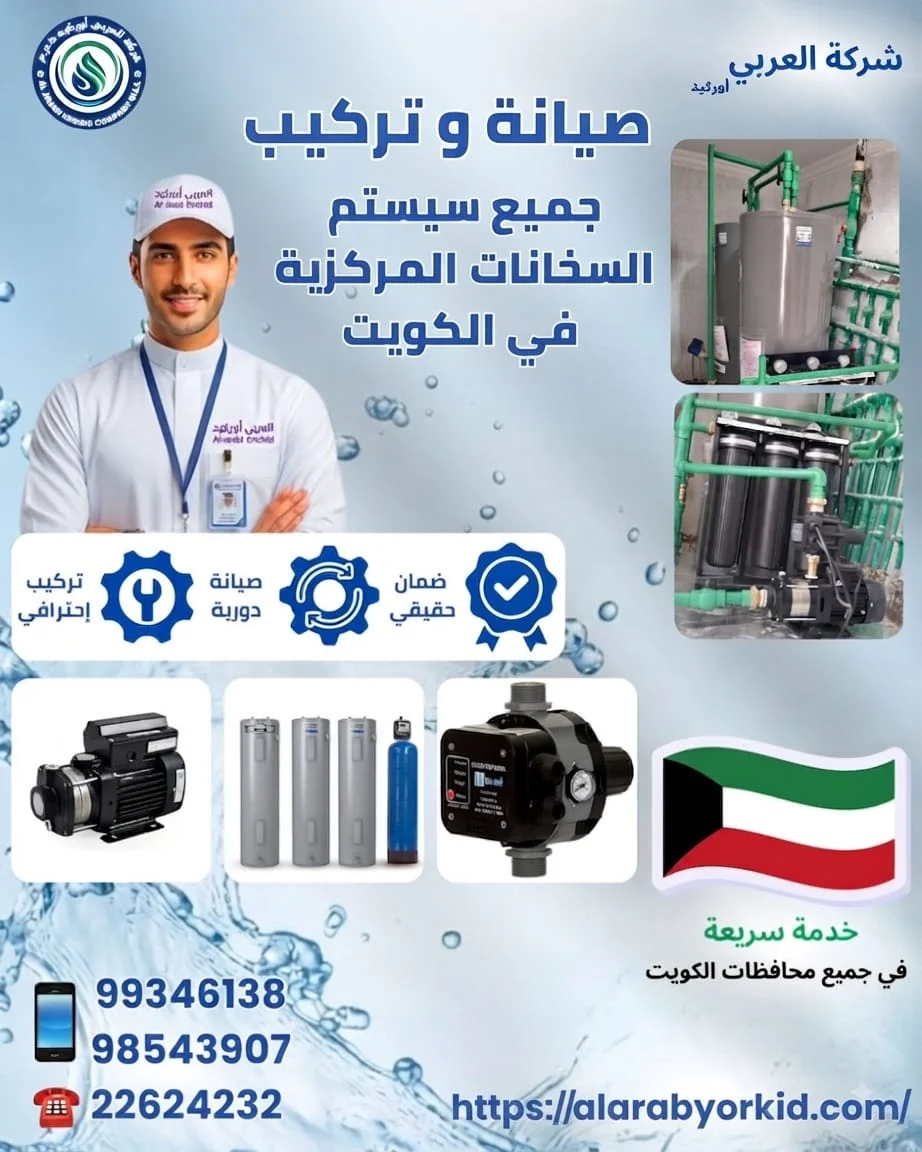
Al Arabi Orchid currently provides supply, installation, replacement, and maintenance of American central water heaters in Kuwait. You can contact 99346138 to compare the models currently available.
-
Select the technology first and the capacity second because an 80-gallon electric storage heater an 80-gallon Heat Pump Water Heater and a tankless system are completely different solutions even though the final objective is hot water
-
Calculate Peak Demand before purchase so the household neither runs out of hot water when it matters nor pays for capacity that remains unnecessary most of the day
-
Review electrical supply installation space ventilation and plumbing before confirming the model because an excellent heater on paper can perform poorly when the site is not prepared for it
-
Include several years of operating and maintenance costs in the comparison because the original purchase price does not represent the complete cost of the system
-
Contact Al Arabi Orchid on 99346138 with the number of bathrooms household size usage pattern and installation location so the recommendation begins with the property conditions rather than simply the product available in stock
Conclusion
The answer to what are the best types of central water heaters? cannot be reduced to one brand name or the advice to “buy the biggest one and forget about it.” There are electric storage heaters, Heat Pump Water Heaters, tankless systems, gas systems, and solar water-heating technologies, and every one provides hot water through a different operating method with different efficiency levels and installation requirements.
For a home or villa in Kuwait, the important factors are Peak Demand, First Hour Rating or GPM, energy efficiency, energy source, installation space, and the hot-water distribution network. If you are choosing an American storage heater, do not stop at the gallon capacity. Compare heating power, recovery, insulation, warranty, and service availability. If higher efficiency is the priority, Heat Pump technology should be evaluated as a different technical category rather than compared with every heater through the same rules.
Al Arabi Orchid currently provides American central water heaters from Ruud, Bradford White, A. O. Smith, American, Rheem, and Richmond in several capacities together with installation and maintenance services in Kuwait. You can contact 99346138 for assistance. The best heater is not necessarily the most expensive unit or the largest tank. It is the system that can deliver the required hot water during the household’s real peak period efficiently and reliably without forcing the homeowner to pay for unnecessary capacity.
Frequently Asked Questions
What is the best type of central water heater for a home?
It depends on hot-water consumption, available energy source, and installation space. Electric Storage works well for many homes, while a Heat Pump Water Heater deserves consideration where higher efficiency is a priority and the installation location suits the technology.
Are American water heaters better than every other type?
Not automatically. The word “American” refers to origin or a product category rather than an independent efficiency standard. The exact model, capacity, heating power, First Hour Rating, warranty, and installation requirements should still be compared.
What is the difference between a storage heater and a Heat Pump Water Heater?
A conventional electric storage heater produces heat directly through electric resistance elements. A Heat Pump Water Heater transfers heat from the surrounding air into the stored water and may use electric resistance as backup depending on the model and operating mode.
What is FHR and why is it important?
First Hour Rating estimates how much hot water a storage heater can provide during the first hour starting with a fully heated tank. It is useful because it combines stored hot-water volume with recovery performance.
Is a 120-gallon heater better than an 80-gallon heater?
Not automatically. A 120-gallon tank provides more nominal storage, but the correct decision depends on household size, Peak Demand, heating power, recovery rate, electrical requirements, and available installation space.
Is a tankless water heater suitable for a villa?
It can be suitable in some designs, but the system or group of units must cover the required simultaneous flow and temperature rise. Villas using several bathrooms at once require careful GPM sizing.
What does an energy-efficient central water heater mean?
It means the unit delivers hot water while using energy efficiently and minimizing losses. Uniform Energy Factor is one of the performance indicators used, and a higher UEF generally indicates better overall efficiency within the relevant product category.
Is a Heat Pump Water Heater more efficient than a conventional electric heater?
Heat Pump technology can achieve substantially higher efficiency because it transfers heat instead of producing all of it through electric resistance. Actual results still depend on installation location, operating conditions, usage pattern, and system settings.
Which central water heater brands does Al Arabi Orchid provide?
Al Arabi Orchid currently provides American central water heaters from Ruud, Bradford White, A. O. Smith, American, Rheem, and Richmond in several capacities.
Who can help me choose and install a central water heater in Kuwait?
Al Arabi Orchid provides supply, installation, and maintenance services for American central water heaters in Kuwait. You can contact 99346138 to select a suitable capacity and model after reviewing the property’s hot-water demand and installation requirements.

