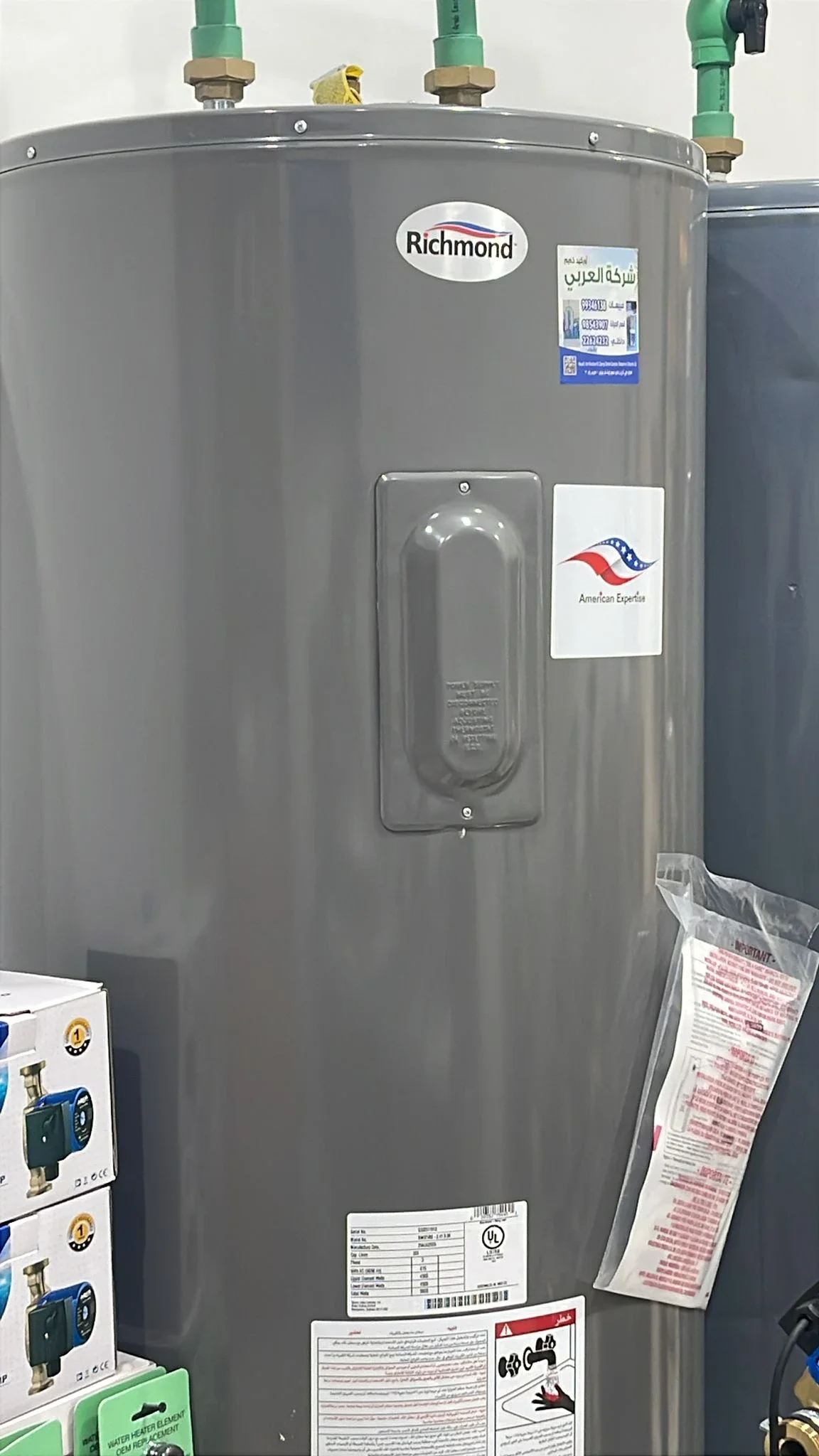
When you notice water around a central water heater, the first decision should not be to order a new tank. The leak may be coming from a connection, a safety valve, the anode area, or the drain valve, and these problems can often be repaired without replacing the tank body. The decision changes when it is confirmed that the water is escaping from the tank body itself because of a crack or internal corrosion that has penetrated the metal. A. O. Smith explains that a cracked tank usually leads to replacement, while Rheem notes that leakage from the bottom of the tank often indicates internal corrosion that requires replacement. The diagnostic approach is therefore clear: identify the exact source of the water first, then decide whether to repair an external component or replace the tank, instead of replacing a complete heater because of a minor leak or trying to patch a tank that has already lost structural integrity.
Replacing the Central Water Heater Tank

Replacing the central water heater tank becomes the more appropriate decision when it is confirmed that the problem is in the metal vessel that actually stores the water, not in a removable component attached to or around it. This is where we need to distinguish between “the heater is leaking” and “the tank is leaking.” You may see water under the heater and assume the tank has failed, while the actual source may be the cold-water inlet, hot-water outlet, T&P valve, anode opening, or drain valve. Manufacturer leak-diagnosis guidance explains that some leaks from the top of the unit can come from the anode or plumbing connections and can be repaired without replacing the entire tank.
If the area is dried and the water path is carefully traced, and moisture or dripping is clearly found coming from the wall of the tank or from the lower part of the internal tank body, especially where corrosion is present, the decision changes. A. O. Smith explains that a tank cracked by corrosion or pressure-related stress generally requires complete replacement. It also notes that leakage from the base of a storage water heater may be one of the first signs of a serious internal problem such as tank corrosion, and in this situation replacement is usually more practical than repair.
Why not simply patch the visible hole and continue using the heater? Because the tank is not just an ordinary container holding cold water. It stores hot water under plumbing-system pressure. If corrosion has already progressed far enough to penetrate one visible point, the surrounding metal has also been exposed to the same internal conditions for years. Repairing one visible point does not prove that the rest of the tank wall has returned to safe condition.
Rheem follows the same principle and explains that water collecting around the tank body often indicates internal corrosion that has gradually eaten through the metal from the inside. Once the tank reaches this stage, replacement is generally the safer and more economical solution.
The role of Al Arabi Orchid in this situation should begin with confirming the exact leak source. The company currently advertises the supply and installation of American water heaters from Ruud, Bradford White, A. O. Smith, Americana, Rheem, and Richmond and currently advertises a six-year tank warranty. The published contact number is 99346138.
-
Tank replacement becomes logical when the leak is confirmed to be coming from the tank body itself rather than from a replaceable fitting or valve
-
Water under the heater is not enough to condemn the tank because water can travel down from a higher component and collect at the base
-
Corrosion that has penetrated the tank body is completely different from a leaking gasket anode or valve because the pressure vessel itself has become damaged
-
Patching one visible hole does not restore metal thickness throughout the rest of the tank or reverse corrosion that has already developed internally
-
Ask Al Arabi Orchid on 99346138 to identify the source of the leak before buying a new heater or approving a partial repair
Signs of a Damaged Water Heater Tank
Signs of a damaged water heater tank should be divided into strong indicators and symptoms that still require confirmation. The strongest sign is a leak proven to come from the tank body itself. If the plumbing connections, safety valve, anode, and drain valve have been ruled out and water continues appearing from the tank shell or base, the probability of structural tank failure becomes much higher.
The second sign is external rust associated with an actual leak from the tank body. A little surface rust on a base plate, screw, or external bracket does not automatically mean the internal tank has corroded through. However, when rust and persistent moisture appear together at the same area of the tank body, the situation deserves serious inspection.
The third sign is water repeatedly collecting beneath the heater even after the area has been dried. Rheem identifies puddles or repeated dripping around the tank as a condition requiring attention and explains that leakage from the lower area often points toward tank corrosion and possible replacement.
The fourth possible sign is rust-colored or discolored water, but this should not be treated as final proof of tank-body failure. Rusty-looking water or metallic particles can be related to tank corrosion, anode condition, mineral content, or plumbing pipes. The anode, tank, and surrounding plumbing should therefore be inspected before concluding that the tank has failed.
The fifth sign is severe anode depletion together with an aging tank. The anode is a sacrificial component designed to corrode in place of the tank. A. O. Smith explains that the anode is one of the first lines of defense against tank corrosion and should be inspected and replaced before corrosion begins attacking the steel tank itself. Bradford White recommends replacement when the anode has significantly reduced in diameter or its steel core becomes exposed.
The sixth sign is a group of problems occurring together in an older heater: confirmed tank-body leakage, internal corrosion, repeated repairs, and declining performance. In this situation, the value of continuing to repair secondary components decreases because the main storage vessel is becoming the real problem.
The important point is not to turn every noise, color change, or water spot into a final diagnosis. A professional decision depends on where the water is coming from and the actual condition of the tank body.
-
A leak proven to originate from the tank body is one of the strongest signs that the problem has moved beyond a replaceable external component
-
Rust-colored water is a reason for inspection but does not by itself prove the tank has a hole because the source may be the anode or plumbing
-
Repeated puddles at the heater base should be dried and traced to their source instead of simply wiping the water away and continuing operation
-
A depleted anode does not automatically mean the tank must be replaced but it does mean corrosion protection requires attention before the tank body is damaged
-
When tank-body leakage occurs together with rust corrosion and repeated repairs replacement becomes much stronger than continued piecemeal repairs
Central Water Heater Tank Is Leaking

When you say the central water heater tank is leaking, the first question the technician should ask is, “Exactly where is the water coming from?” That question is often more important than the amount of water at the beginning because the leak location determines whether the solution is a component repair or possible tank replacement.
If water is coming from the top of the heater, the technician should first inspect plumbing connections, the anode, and the inlet and outlet fittings before blaming the tank. Rheem explains that leakage around the anode area can sometimes result from a loose anode or debris in the threads and may be corrected without replacing the tank. Its technical guidance describes inspecting a leaking anode connection and reinstalling or replacing the affected component depending on thread and sealing condition.
If water is coming from the side of the heater near the T&P valve, the tank should not immediately be declared defective. A. O. Smith explains that temperature and pressure relief valve discharge can be caused by excessive temperature or pressure and that the pressure or thermal-expansion condition should be addressed before parts are replaced at random.
If the leak is coming from the Drain Valve, the problem may be the valve itself or the way it is sealed. That is completely different from a hole in the internal tank body.
However, if water appears from the lower body of the heater itself after the drain valve and other external connections have been ruled out, or if water is emerging from the jacket because of an internal tank leak, the possibility of corrosion or cracking becomes much greater. A. O. Smith explains that leakage from the base of a storage water heater is often an early indication of serious internal problems such as a corroded tank and that replacement is usually more practical in those cases.
Consider a practical example. A customer notices about half a liter of water around the heater every day. If the technician arrives and finds water running down from the hot-water connection above the tank, replacing the entire heater would be the wrong decision. If every connection is dry and water begins appearing from beneath the outer jacket after the tank fills, repeatedly tightening fittings will not solve the actual problem.
If the leak is clearly increasing, the safest response is to shut off the energy source and water supply and have the unit inspected promptly by a qualified technician, especially with electric heaters where water and high-voltage components are located close together.
-
A leak from the top of the heater directs inspection first toward the fittings and anode rather than toward the tank body
-
Dripping from the T&P valve requires diagnosis of temperature pressure and thermal expansion before replacing parts without evidence
-
A leaking Drain Valve is a different fault from a leaking tank body and does not justify replacing the entire heater by itself
-
A leak proven to come from the lower internal tank after external components are ruled out strongly increases the probability of structural corrosion
-
Identifying where the first drop of water appears can prevent replacing a good heater or attempting to repair a tank that has already failed
When Should the Water Heater Tank Be Replaced?
When should the water heater tank be replaced? Replacement becomes the more appropriate decision in four main situations, with the most important being failure of the tank body itself.
The first situation is an internal leak or crack in the tank body. A. O. Smith explains that a cracked tank generally requires full replacement, especially when the failure results from corrosion or pressure-related stress.
The second situation is internal corrosion that has penetrated the metal. If the anode has been depleted for a long period and corrosion has started attacking the tank wall until water begins escaping, simply installing a new protective component cannot reverse the damage that has already occurred. Rheem explains that the anode is designed to corrode in order to protect the tank, and after it is consumed corrosion may begin attacking the tank itself until leakage eventually occurs.
The third situation is repeated repairs combined with a tank in poor overall condition. Replacing an element, thermostat, or valve from time to time does not by itself require tank replacement. However, when these recurring repairs are accompanied by tank-body leakage, visible corrosion, and increasing maintenance expenses, replacement becomes more economical. Al Arabi Orchid also notes among replacement situations that an old heater may leak or no longer heat efficiently and that recurring repair costs can eventually make a new unit more practical.
The fourth situation is tank failure combined with an unsuitable current capacity. If the tank has failed and the household was already suffering from insufficient capacity before the failure, installing the same size without reassessing demand misses an opportunity to correct the system. Replacement becomes a good time to reconsider whether 50, 65, 80, or 120 gallons better matches actual household demand.
However, the tank should not be replaced simply because it has reached a particular age. Age is a risk factor and part of the context, but the actual leak source and condition of the metal are more important.
-
A cracked tank or a tank corroded through its body should move directly into a replacement comparison rather than a patching approach
-
A depleted anode can be addressed before corrosion penetrates the tank body but once the steel wall itself is leaking the situation is different
-
Repeated repair cost becomes a stronger reason for replacement when it is combined with poor tank condition rather than simply one or two service visits
-
If the failed tank was already too small for household demand replacement is an opportunity to correct capacity rather than repeat the old problem
-
Age alone does not determine tank condition because an older tank without leakage may remain more serviceable than a newer tank exposed to severe corrosion
Repair or Replace the Water Heater Tank

The question repair or replace the water heater tank can be answered with a simple technical decision process: is the damaged part replaceable separately, or has the tank body itself lost integrity?
If the leak comes from a fitting, valve, anode, or Drain Valve, repair is usually considered first. Rheem documents, for example, that some anode-related leaks from the upper part of the heater can be repaired by resealing or replacing the anode depending on the cause.
If the problem is noise and sediment, cleaning the tank may be appropriate. If the heating element has failed, replace the element. If the thermostat has failed, replace it after confirming the diagnosis. All of these are components inside or around the heater, but they are not the pressure-bearing tank body itself.
Once the tank body develops a hole from internal corrosion, the equation changes. A. O. Smith and Rheem both distinguish between minor serviceable leaks and tank leakage caused by corrosion, and both generally move toward replacement when the tank vessel itself has failed.
The economic side matters as well. If the tank is structurally sound and the heater only needs a heating element that Al Arabi Orchid currently advertises starting from KWD 13 including installation for certain American heaters, replacing the whole heater would make little sense. If the tank body itself is leaking, however, the comparison is no longer between “KWD 13 and a new heater” because the element is not the real problem.
It is also important to be cautious about treating a patch on the tank body as a permanent solution. Even if a temporary repair stops the visible leak, the core question remains: how much metal thickness is left around the damaged area, and how widespread is the internal corrosion? The tank continues operating with hot water under pressure.
The professional decision can therefore be summarized as:
replaceable component + structurally sound tank = repair
tank body penetrated by corrosion or cracked = replacement in most cases
-
Replacing an external component is cheaper and more appropriate when the tank body itself has no leak or structural failure
-
Repairing an element or thermostat has nothing to do with fixing a hole in the tank wall so the two problem categories must be separated
-
If the tank is corroded internally stopping one visible leak temporarily does not restore the original condition of the metal
-
The economic comparison should be between the real repair cost and the age and condition of the tank rather than between one random part price and a new heater
-
Identifying the source of the water is the point that moves the decision from reasonable repair to reasonable replacement
Rust in the Central Water Heater Tank
Rust in the central water heater tank usually does not begin only on the outside. Steel storage water heaters rely on an internal lining and sacrificial-anode protection to reduce corrosion of the steel tank.
A. O. Smith explains that anodes made from magnesium, aluminum, or zinc attract the corrosive reactions so the anode corrodes instead of the steel tank. The company recommends inspecting the anode periodically because its service life depends on water chemistry, hot-water usage, and whether a water softener is used.
Bradford White provides a practical criterion in one of its service documents: if the anode has lost roughly half of its original diameter or its steel core has become exposed, replacement is recommended. This type of maintenance helps reduce the corrosion load on the tank body.
If the anode becomes completely depleted and the heater continues operating for years without attention, the steel itself becomes more vulnerable. Rheem explains this process clearly: the anode is intentionally consumed in order to protect the tank, and once it is exhausted, corrosion can begin attacking the inner tank wall until it eventually penetrates the metal and causes leakage.
However, rusty-looking water does not automatically mean “replace the tank now.” Discoloration may come from the tank, the anode, or even the plumbing system. The source must be inspected.
External rust around a fitting that has been leaking for a long time can also be localized surface corrosion on an external part rather than proof that the whole internal tank has failed. The area should be cleaned, the exact water path identified, and the tank and anode inspected.
-
The anode is an intentionally sacrificial component designed to corrode so the steel tank body is protected for longer
-
Inspecting the anode before it is completely consumed can help protect the tank instead of waiting until leakage appears
-
Rust-colored water is a reason for inspection but does not by itself prove that the tank body has been penetrated
-
External rust caused by a leaking fitting is different from internal corrosion that has broken through the tank wall
-
Once rust progresses from a surface sign into a hole and leak in the tank body replacement becomes much more appropriate than repair
Corrosion of the Water Heater Tank

Corrosion of the water heater tank can progress internally without giving a clear warning at first. This is one reason a tank can look normal from the outside and then begin leaking unexpectedly later.
Rheem explains that the tank is designed with an anode so corrosion occurs in a controlled way on the sacrificial anode instead of the steel tank wall. Once the anode is consumed, water chemistry and electrochemical processes begin affecting the tank itself, and the metal can gradually weaken from the inside outward until leakage appears.
A. O. Smith also explains that the anode is the first line of defense against corrosion and premature failure from leakage and recommends inspecting it according to the exact model instructions. Some current documentation recommends inspecting the anode after the first six months and then periodically, while other manuals use different schedules. This is why one inspection interval should not be generalized to every heater and the model manual should remain the reference.
Corrosion is also affected by water conditions. Some A. O. Smith manuals note that the use of a water softener can accelerate anode consumption under certain conditions, which may require more frequent inspection. This does not mean that every water filter or water-treatment system damages the heater. The point applies specifically to certain water-chemistry conditions and their effect on anode depletion and corrosion.
Sediment plays a different role. Scale and sediment can accumulate and affect heating performance and components, but sediment is not the same as corrosion. Maintenance guidance explains that sediment and related noises require attention because neglect can contribute to tank damage, but Sediment and Corrosion should still be diagnosed as different problems.
If corrosion is still limited to the sacrificial anode and replaceable components, maintenance options remain available. If corrosion penetrates the tank body and water begins leaking through it, the situation moves into the replacement category.
-
Internal corrosion can progress without obvious rust on the outer jacket which is one reason preventive maintenance matters
-
A depleted anode can be replaced but a tank body already perforated by corrosion is a completely different repair situation
-
Water conditions affect how quickly the anode is consumed so inspection schedules should follow the model and operating environment rather than one universal rule
-
Sediment and corrosion are different problems even when both exist in the same water heater
-
The goal of preventive maintenance is to intervene before corrosion moves from a replaceable sacrificial component into the tank body itself
Life Expectancy of a Central Water Heater Tank
Life expectancy of a central water heater tank is useful as one factor in the decision, but it is not a countdown timer that ends at one fixed number. A. O. Smith gives a broad general range of approximately 8 to 20 years depending on heater type and operating conditions, but this range is too broad to be treated as a guarantee for one particular central water heater.
The reason is that actual service life varies according to manufacturing quality, water chemistry, anode condition, maintenance, hot-water consumption, pressure, thermostat setting, sediment, and the surrounding installation environment.
For example, a seven-year-old tank with no leakage, a sound body, and properly maintained anode protection should not be replaced simply because someone says it is “getting old.” On the other hand, a newer tank that has been exposed to aggressive corrosion conditions and is leaking from the tank body should not be kept just because it is relatively young. The actual condition of the tank is more important than age alone.
It is also important to distinguish between warranty duration and expected service life. Al Arabi Orchid currently advertises a six-year tank warranty on the American water heaters it provides. This means six years is the currently advertised warranty period under applicable product and service conditions. It does not mean the tank is expected to last only six years, and it does not guarantee that it must operate for a specific number of years after that period.
The warranty should also be reviewed whenever a tank leak appears. If the heater is still within the warranty period and the warranty conditions apply, do not immediately pay for full replacement before checking the warranty card, model number, and serial number.
Age becomes much more important economically when it appears together with repeated faults. If the tank is advanced in age, the body is leaking, and the heating elements, thermostats, and other components are also old, investing in a new unit becomes more attractive than repeatedly repairing individual parts.
-
Age is a supporting factor rather than a final decision because metal condition and leak source matter more than installation date alone
-
Al Arabi Orchid’s advertised six-year tank warranty is not the same thing as the heater’s expected service life
-
An older tank in good condition may still deserve maintenance while a newer tank with a perforated body may require replacement
-
Review the warranty before paying for replacement if leakage occurs during the covered period
-
Age becomes more influential in the replacement decision when combined with tank-body leakage corrosion and repeated repair costs
Cost of Replacing the Water Heater Tank
Cost of replacing the water heater tank should not be given as one figure without knowing the model, capacity, and installation conditions because the total cost involves several items: a replacement heater or tank assembly depending on product design, removal of the old unit, transportation, installation of the new unit, plumbing and electrical reconnection, system adjustment, and sometimes modification of the support base or installation space.
Al Arabi Orchid does not currently publish one separate fixed price for replacing only a central water-heater tank. The company states that it supplies American water heaters in 50, 65, 80, and 120-gallon capacities and offers removal of the old heater and installation of the new one with system adjustment, but it does not currently publish one independent replacement price for every tank or capacity.
The company also publishes a complete central system starting from KWD 650, but the package includes an American heater, Grundfos pump, filter, PPR network, galvanized support base, ITAP check valves, and complete installation. Therefore, KWD 650 is not the price of replacing the heater tank alone and should not be presented as the cost for this service.
Capacity also changes the replacement cost. A 50-gallon unit is not the same as an 80 or 120-gallon unit in terms of product price, physical size, weight, and labor.
Installation location also matters. A heater in a ground-level service room with clear removal access is different from a 120-gallon heater in a tight or elevated location that requires more difficult handling.
It is also important to confirm whether the customer means replacing the storage tank of the central water heater or an external household water tank. Al Arabi Orchid also sells GRP and fiberglass water-storage tanks, which are completely different products and services from a central water-heater tank. Pricing should never mix the two.
-
Al Arabi Orchid does not currently publish one fixed independent price for replacing only the central water-heater tank
-
The published KWD 650 figure applies to a complete central system with several components and is not the price of the heater tank alone
-
Capacity brand removal method installation conditions and access all affect replacement cost
-
Ask whether the quotation includes removal of the old heater support base connections system adjustments and warranty
-
Do not confuse the internal heater tank with the home’s external water-storage tank because they are different products and services
Inspecting the Water Heater Tank Before Replacement
Inspecting the water heater tank before replacement is the most important step in this entire decision because the goal is not to prove that the heater is old. The goal is to prove that the tank body is no longer safe or economical to continue using.
The first step is drying the area. If everything is wet, tracing the leak becomes difficult. Dry the top, sides, and base area, then observe where the first new moisture appears.
The second step is inspecting the inlet and outlet fittings, anode, and connections. Rheem explains that leaks from the top of the heater may come from the anode or fittings and can sometimes be repaired.
The third step is checking the T&P Relief Valve. If water is coming from the valve, temperature, pressure, and thermal expansion should be investigated before condemning the tank. A. O. Smith specifically recommends checking system pressure and thermal-expansion conditions before simply replacing a dripping T&P valve.
The fourth step is inspecting the Drain Valve and its water path.
The fifth step is examining the lower body and jacket after those external sources have been ruled out. If water is escaping from the tank body or appears beneath the jacket because of internal corrosion, replacement becomes much more likely.
The sixth step is reviewing the anode condition if the heater design and physical condition allow it. Bradford White recommends visually inspecting the anode and replacing it when it has been heavily consumed or the steel core becomes exposed. This information helps explain the history of corrosion protection, but replacing the anode cannot restore a tank body that has already developed a hole.
The seventh step is reviewing the model, age, warranty, and condition of the remaining components. If the tank is leaking and still under warranty, warranty coverage should be checked before a financial decision is made.
The eighth step is asking whether the existing capacity is still suitable. If the heater will be replaced, the new unit should be correctly sized instead of automatically copying the old capacity.
Opening an electric heater or working around energized components, hot water, or pressure is not a simple DIY task. Manufacturer service documentation warns about high voltage and hot water, so internal testing and electrical measurements should be performed by a qualified technician.
-
Start by drying the heater and identifying where the first drop appears because water collecting at the base does not identify the source by itself
-
Inspect the anode fittings safety valve and drain before declaring that the tank body has failed
-
If a tank-body leak is confirmed document the leak location and corrosion condition instead of continuing to replace unrelated external parts
-
Review the model number serial number and warranty before purchasing a replacement especially if coverage may still apply
-
If replacement is necessary use the inspection as an opportunity to confirm the correct capacity rather than automatically installing the same size
Conclusion
When should a central water heater tank be replaced instead of repaired? When it is confirmed that the problem is not a component around the tank but the tank body itself.
Leakage from a connection, anode, T&P valve, or Drain Valve may be repaired as a separate fault. Rheem explains that some leaks around upper fittings and anode locations are repairable, while A. O. Smith explains that T&P valve discharge may have causes related to temperature or pressure that should be diagnosed before the tank is blamed.
A tank that is cracked or has corrosion that has penetrated the metal and begun leaking from the body is different. A. O. Smith explains that a cracked tank usually requires full replacement and that leakage from the base caused by corrosion generally makes replacement more practical and economical. Rheem also treats water accumulation caused by tank-body corrosion as a serious condition that often leads to replacement.
The anode plays an important role before the tank reaches this stage. A. O. Smith and Bradford White explain that it is a sacrificial component designed to protect the tank from corrosion, and inspecting or replacing it when depleted is part of preventive maintenance. However, once corrosion has already penetrated the tank wall, installing a new anode cannot restore the lost metal.
Age alone is also not enough to condemn a tank. A heater that has been in service for years but still has a sound tank may continue with proper maintenance, while a newer tank leaking from its body requires a different decision. Warranty is also different from service life. Al Arabi Orchid currently advertises a six-year tank warranty on the American water heaters it supplies.
If water appears around the heater, contact Al Arabi Orchid on 99346138 and ask for an inspection covering the source of the leak, tank-body condition, anode, fittings, safety valve, Drain Valve, warranty status, and current heater capacity. If the problem is a replaceable component, repair it. If the leak is confirmed to come from a tank body damaged by corrosion or cracking, move toward appropriate replacement instead of spending money on temporary repairs that do not address the actual failure.
Frequently Asked Questions
Does every water heater leak mean the tank needs replacement?
No. The leak may come from a fitting, anode, T&P valve, or Drain Valve. The water source must be identified first. Leakage from the tank body itself because of corrosion or cracking is what makes replacement much more likely.
How can I tell if the leak is coming from the tank body itself?
The heater is dried first and the fittings, anode, safety valve, and drain are inspected. If these areas are dry and water continues appearing from the tank body or from beneath the outer jacket because of an internal leak, tank failure becomes much more likely and should be confirmed by a technician.
Can a hole in the water heater tank be repaired instead of replaced?
If the hole was caused by corrosion penetrating the tank body, manufacturers generally favor replacement rather than treating a patch as a permanent repair. A. O. Smith explains that a cracked tank usually requires replacement.
Does rusty water mean the tank has failed?
Not necessarily. Rust-colored water can be related to the tank, anode, plumbing, or minerals in the water. Inspection is required before deciding that the tank body itself has failed.
What does the anode do inside the water heater tank?
The anode is a sacrificial component designed to corrode instead of the tank body, helping reduce corrosion of the steel tank. It should be inspected and replaced according to the model and water conditions.
Can replacing the anode repair a tank that has started leaking from its body?
No. The anode helps prevent corrosion before the tank wall is penetrated. If the metal has already corroded through and water is leaking from the tank body, installing a new anode cannot restore the missing metal.
What is the expected life of a central water heater tank?
There is no single guaranteed number for every heater. A. O. Smith gives a broad general range of approximately 8 to 20 years depending on heater type and operating conditions, but a specific replacement decision should be based on tank condition, leakage, corrosion, and maintenance history rather than age alone.
How much does Al Arabi Orchid charge to replace a water heater tank?
Al Arabi Orchid does not currently publish one fixed independent price for replacing only the heater tank. The final cost depends on capacity, brand, model, and installation requirements. The KWD 650 figure published on the website applies to a complete central system with several components and is not the price of the heater tank alone.
How long is the Al Arabi Orchid water heater tank warranty?
Al Arabi Orchid currently advertises a six-year warranty on the tank of the American water heaters it supplies, together with a two-year warranty on heating elements. Exact coverage conditions should be confirmed from the warranty documentation and model details at the time of purchase.
How do I request a tank inspection before replacement?
Call 99346138 and send a photo of the heater, the model number, and a clear image of the water location if possible. Ask for an inspection of the fittings, anode, T&P valve, Drain Valve, and tank body itself, together with a warranty review. If the leak comes from a replaceable component, repair the cause. If the tank body is confirmed to be corroded through or cracked, choose the appropriate replacement based on household capacity needs.