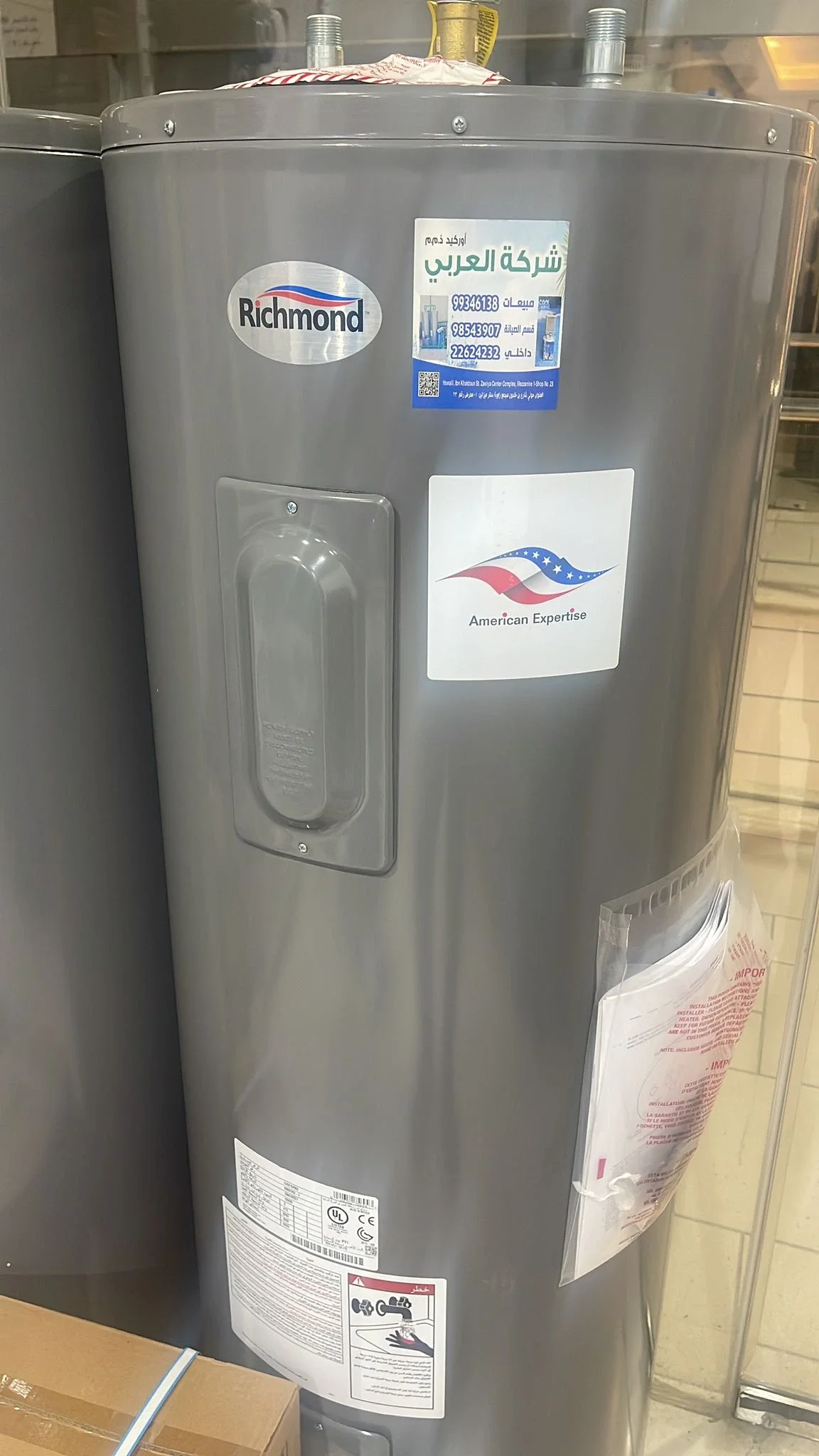
Buying an American central water heater for your home should not start with the brand name, price, or even the number of gallons alone. Proper American central water heater selection means matching the family’s real hot-water demand with First Hour Rating, heating power, electrical supply, energy efficiency, physical dimensions, warranty, and serviceability in Kuwait. A simple example is that two heaters both labeled 50 gallons can have different FHR values, Recovery Rates, and electrical inputs, which means they can perform very differently when several bathrooms are used close together. Bradford White itself explains that FHR depends on both storage capacity and recovery performance. That is why the correct buying decision is to choose the right model for your home, not simply a well-known American brand.
Choosing an American Central Water Heater

Choosing an American central water heater should begin by writing down the requirements of the home before opening any manufacturer catalog. The first question is how much hot water the family needs during its busiest hour. After that, you can begin estimating whether the home may need around 50, 65, 80, or 120 gallons, but the tank size should never be considered by itself. First Hour Rating must also be checked because it indicates how much hot water the heater can provide during the first hour when it starts with a fully heated tank. Bradford White explains that FHR is affected by both storage capacity and Recovery Rate, which makes it an important performance figure when selecting a heater for household demand.
The second step is checking the electrical supply available at the property. The same brand, and even the same nominal capacity, may be available with different heating powers or with single-phase and three-phase electrical configurations. Buying a 9 kW model simply because it appears “more powerful” is not useful if the installation point does not have the required electrical supply. On the other hand, choosing a lower-powered model for a high-demand household may produce a Recovery Rate that feels slower than expected.
The third step is reviewing the actual installation area. Diameter, height, cold- and hot-water connection positions, T&P valve location, and the space required for service all matter just as much as the gallon figure. Some homeowners purchase an excellent heater and only later discover that an element access panel or anode service point is pressed against a wall, making future maintenance unnecessarily difficult.
The fourth step is reviewing warranty and service support. The word “American” is not enough by itself. You should know the exact model, serial number, warranty terms, and who is responsible for tank coverage, heating elements, and installation. Bradford White itself provides technical documentation according to model and serial number, which shows why identifying the exact unit is more important than simply knowing the manufacturer name.
Al Arabi Orchid currently works with Ruud, Bradford White, A. O. Smith, American, Rheem, and Richmond and offers central heater capacities including 50, 65, 80, and 120 gallons.
-
Start with the home’s real peak hot-water demand and then narrow down the available models instead of choosing a brand first and trying to force the household requirement to fit whatever product is available
-
Compare FHR and Recovery together with gallon capacity because tank volume alone does not show how well the heater continues supplying hot water after usage begins
-
Confirm Voltage Phase and kW before paying so you do not buy an excellent heater that later requires electrical modifications that were never included in the original project budget
-
Measure the utility area and the heater access path while leaving enough service clearance because even the best heater becomes an inconvenient choice if maintenance cannot be performed properly later
-
Ask for the exact model number and written warranty conditions before confirming the purchase because the phrase American water heater does not provide enough technical information for a long-term buying decision
Best American Central Water Heater for a Home
The idea of the best American central water heater for a home needs to be understood correctly because there is no single heater that is best for every property. The best unit is the one that covers your family’s Peak Demand without excessive oversizing, works with the existing electrical supply, allows proper access for service, and has known replacement parts and technical support available.
A clear technical example can be found in Bradford White specifications. One residential 50-gallon model has a nominal capacity of 50 gallons but a DOE Rated Storage Volume of around 45 gallons, a First Hour Rating of approximately 64 gallons, and a Recovery Rate of around 21 gallons per hour at a 90°F temperature rise in that particular configuration. The point is not that this exact model should automatically be purchased, but that the phrase “50 gallons” does not reveal the complete performance of the heater.
A four-person household whose hot-water use is spread throughout the day may need a different heater from another four-person household where everyone showers between six and seven in the morning. A home with a rain shower or large bathtub is also different from a home with standard showers. A. O. Smith’s residential sizing guidance identifies households with more than two full bathrooms, a large tub, or concentrated hot-water use as higher-demand situations and connects sizing to required FHR rather than just the tank label.
The best heater also has to remain practical after the purchase. Is maintenance available? Can heating elements, thermostats, and anode components be sourced for the model? Are technical manuals available? Do local technicians understand the control system? These questions become much more important after five years than they appear on the day of purchase.
In the Kuwait market, Al Arabi Orchid currently offers several American brands rather than relying on one manufacturer. This gives the customer the opportunity to select equipment according to the actual project requirements instead of being limited to one logo.
-
The best heater for a home is the one whose FHR comfortably covers household peak demand rather than the heater with the largest gallon number or the most expensive brand name
-
Having two or three bathrooms is not enough by itself to determine the best heater because the timing of use shower flow rate and bathtub demand can change the load substantially
-
The correct heater must be compatible with the available electrical supply because buying higher power than the site can support turns a product advantage into an additional modification cost
-
Availability of model documentation and service parts matters as much as tank quality because a central water heater is expected to operate for years and will eventually require maintenance
-
Compare several actual models among the brands available from Al Arabi Orchid instead of searching for one manufacturer name and treating it as universally best for every household
American Central Water Heater Specifications
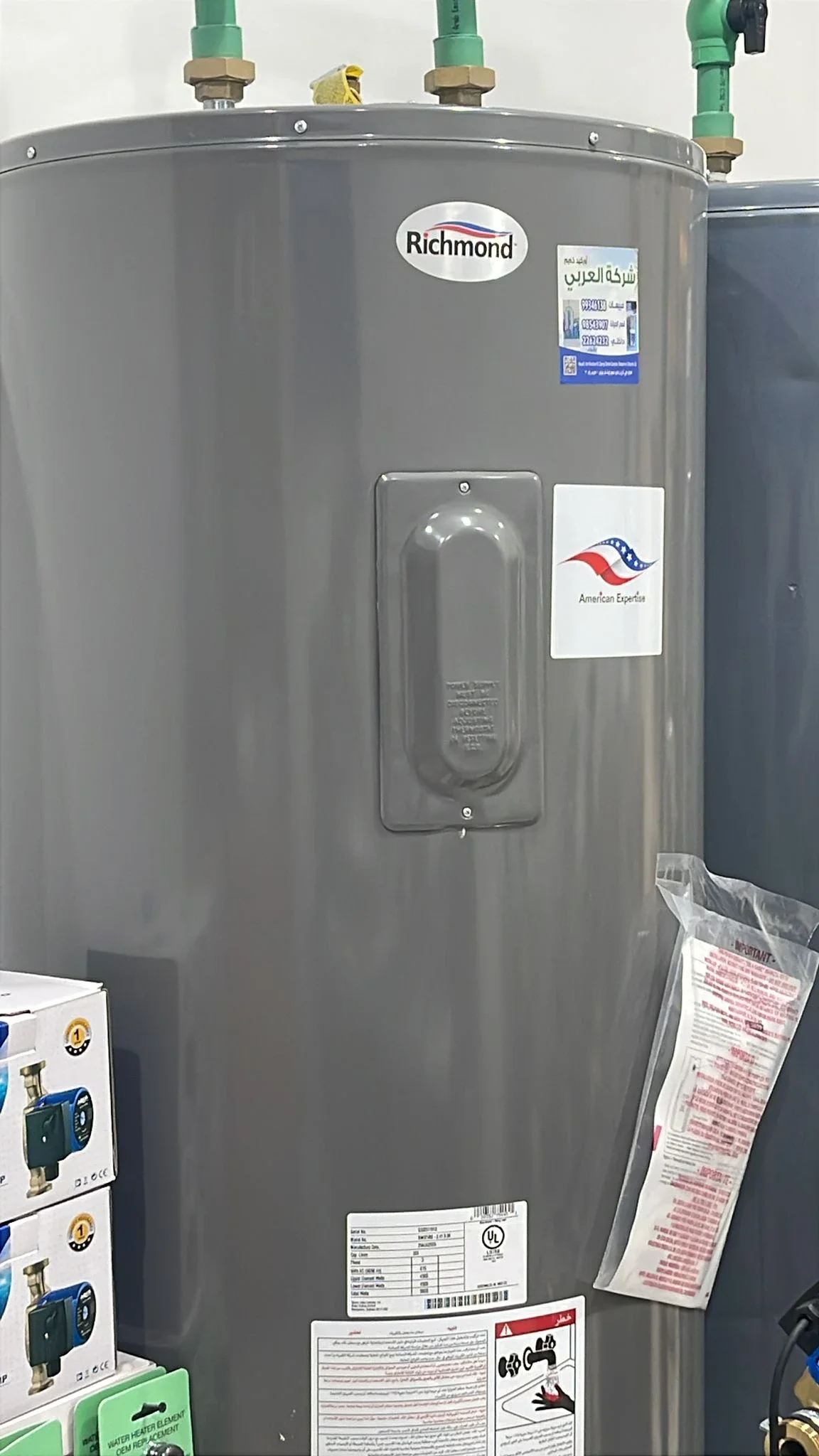
Understanding American central water heater specifications is one of the most important skills before buying because the specification sheet reveals details that product images and store advertisements often do not show. The first figure is Nominal Capacity, but it should not be the only one considered. Some manufacturers also publish Rated Storage Volume because the measured storage volume under standardized testing may differ from the marketing capacity. In one Bradford White RE350T6 example, the heater is marketed as 50 gallons while the DOE Rated Storage Volume is about 45 gallons.
The second specification is First Hour Rating. This number measures first-hour hot-water performance and is more useful for understanding family comfort than tank volume alone. The third is Recovery, which indicates how quickly the heater reheats incoming cold replacement water after hot water is used.
The fourth specification is Heating Input or electrical power. When purchasing an electric central water heater, you should know the kW rating and whether the heating elements operate simultaneously or non-simultaneously in that exact design because this affects the electrical circuit and how the heater recovers. Bradford White documents several electrical configurations including double-element non-simultaneous, simultaneous, single-phase, and three-phase arrangements depending on the model.
Next come Voltage and Phase. These are not details that only an electrician should care about; they are part of the purchase decision itself. Then comes UEF, or Uniform Energy Factor, which provides a standardized measure of energy efficiency. A higher UEF generally indicates lower energy use when products are compared within the appropriate fuel type and draw category rather than comparing unrelated heater technologies.
Finally, dimensions, operating weight, connection positions, and warranty should be reviewed. These specifications work together, and no single number can represent the entire buying decision.
-
Nominal Capacity gives the commercial size category while Rated Storage Volume can provide a more standardized measure of actual storage and may be lower than the nominal label
-
FHR explains how much hot water the unit can supply during the first hour and should be included whenever two similar models are compared
-
Recovery indicates how quickly the heater can replace used hot water and becomes especially important in homes where several family members use hot water consecutively
-
kW Voltage and Phase determine electrical compatibility so the heater should not be purchased before those values are checked against the installation site
-
UEF dimensions operating weight and warranty complete the technical picture because a heater with excellent performance is still not the right choice if it does not fit the space or cannot be serviced properly
Right American Water Heater Capacity
The right American water heater capacity cannot be determined from statements such as “I have a house” or “I have a villa.” The process should begin with the number of household members and then be adjusted according to simultaneous bathroom use, bathtub demand, shower flow rate, and peak-use periods.
A. O. Smith currently provides approximate FHR guidance by household size, beginning around 38–49 gallons for two people, 49–62 for three, 62–74 for four, 74–95 for five, and 95–124 for six people, while noting that high-demand households may need to move into a higher performance level. The important point is that these are First Hour Rating requirements, not instructions to buy a tank with exactly the same gallon number.
This means that a family of four does not automatically need a 65- or 80-gallon tank without reviewing the actual model specifications. One heater with a smaller storage tank may provide an adequate FHR because of stronger Recovery, while another heater with the same nominal size may perform differently.
Al Arabi Orchid currently lists American central water heater capacities including 50, 65, 80, and 120 gallons. The practical approach is therefore to estimate household demand first and then identify which model within those sizes can meet the required performance while remaining compatible with the electrical supply and installation space.
One common mistake is to choose 120 gallons “so the hot water never runs out.” Excessive storage means a larger and heavier appliance, higher purchase cost, more demanding installation space, and more water being kept hot even when the household does not need it.
-
Convert household size into a demand estimate and then adjust it according to real usage habits instead of assigning a fixed number of gallons to every person
-
Use FHR as a performance reference when comparing capacities because a larger tank does not automatically recover used hot water faster
-
If the home includes a large bathtub or several people using hot water during the same hour the demand estimate should be increased rather than relying on daily average consumption
-
50 65 80 and 120-gallon sizes provide different performance levels but each must be matched to an actual heater model and the property’s electrical infrastructure
-
The goal is not the largest tank but a capacity that provides reliable comfort during peak demand without unnecessary increases in equipment cost installation space and operating weight
Best American Central Water Heater Brand

Asking about the best American central water heater brand is completely reasonable, but the manufacturer name alone is not enough to create a fixed ranking. Ruud, Rheem, Bradford White, A. O. Smith, and other manufacturers offer multiple product families, and the differences between two models from the same company can sometimes matter more than the difference between two brand names.
Bradford White, for example, offers electric water heaters with features such as Vitraglas tank lining for corrosion protection and Hydrojet systems on selected residential series, along with insulation and control designs that vary by product. A. O. Smith also offers several residential product lines that differ in capacity, FHR, UEF, heating input, and technology. Rheem likewise offers multiple product ranges with technical guidance covering First Hour Delivery, EnergyGuide information, maintenance, and warranty.
The better method is therefore a Model-to-Model Comparison. Compare capacity, FHR, Recovery, UEF, element power, electrical configuration, tank dimensions, and warranty. Then add the local Kuwait factors: is technical support available, are common service parts accessible, do technicians understand the model, and is the warranty clearly documented by the supplier?
Al Arabi Orchid currently works with Ruud, Bradford White, A. O. Smith, American, Rheem, and Richmond. The advantage of having several brands available is that the customer does not have to decide, “This brand is the best, therefore I must buy it.” Instead, the process can begin with the home’s requirements and then move toward the model that matches those needs.
-
Do not rank manufacturers from best to worst without specifying the model because every brand offers several product families with different performance and efficiency characteristics
-
Compare FHR Recovery heating power and warranty between actual models instead of relying only on general brand reputation or one person’s experience in a completely different home
-
Tank protection insulation and service components are important but they should be evaluated from the exact product specifications rather than from the manufacturer name alone
-
Local availability of parts and technicians who understand the model can provide more practical value than a marketing feature that the household may never use
-
Having several brands available through Al Arabi Orchid allows the heater to be selected according to the project instead of turning the purchase into a competition between brand names
Choosing the Size of an American Water Heater
Choosing the size of an American water heater is not only about selecting how much water will be stored. It is also about choosing a physical appliance that actually fits the utility area. Once the required capacity range has been determined from hot-water demand, the next step is reviewing actual dimensions such as Height, Diameter, water-connection positions, T&P valve location, service-panel access, and the clearance required for anode replacement where applicable.
American manufacturer specification sheets provide these dimensions in detail. A Bradford White 50-gallon specification sheet, for example, lists tank height, diameter, connection locations, operating weight, FHR, and UEF. This matters because two heaters labeled 50 gallons may not fit the same installation space equally well.
The next consideration is operating weight. Fifty US gallons of water is approximately 189 liters, which means the water alone weighs roughly 189 kilograms before the weight of the tank is added. Eighty gallons is approximately 303 liters, while 120 gallons is about 454 liters. Choosing a larger size therefore means more structural load on the base and more physical space required during installation and future replacement.
Service clearance must also be considered. If the space above the heater is completely blocked and the anode rod cannot be removed, or access panels cannot be opened properly, the homeowner will pay for that poor installation decision during future maintenance.
Finally, the entire access route should be measured, not just the utility room. A room may be large enough for the heater while the doorway is too narrow or a hallway corner prevents the tank from reaching the space.
-
After identifying the required capacity compare the exact dimensions of each model because the phrase 80 gallons does not automatically tell you the heater height diameter or service locations
-
Include the weight of both the water and the appliance when evaluating the support base because large tanks become extremely heavy once filled
-
Leave enough clearance around and above the unit for anode element thermostat and valve service instead of positioning the heater where normal maintenance becomes difficult
-
Check doorway stairway hallway and future removal access because the route to the installation area is part of selecting the correct heater size
-
Successful size selection combines the hot-water requirement with the ability to install and maintain the heater without unnecessary modifications to the property
American Water Heater for a Family
An American water heater for a family should be selected according to the household lifestyle rather than simply the number of names living in the property. A five-person family can have a lighter hot-water load than a four-person family when the five people use hot water at different times while the four all prepare for work and school during the same hour.
Begin with a practical question: what happens during the busiest hour in the morning? If the household uses two showers one after another with limited kitchen use, that is one demand pattern. Two showers running at the same time followed immediately by a bathtub is a completely different load. Then ask whether that situation happens every day or only once a week.
A. O. Smith considers more than two full bathrooms, a large tub, and certain concentrated-use patterns to be indicators of High Demand and recommends moving toward a higher FHR range when necessary. This approach is more useful than a rule such as “five people equal this tank size” because it recognizes that two households with the same number of residents may use water very differently.
Near-future household changes can also be considered. If three people live in the home now but permanent household size is expected to increase soon, a reasonable performance margin can make sense. However, buying a very large tank today because “maybe one day ten people might live here” is not a strong sizing strategy.
Families also benefit from serviceability. In a home with children, elderly residents, or complete dependence on one central heater, reliability and access to maintenance may matter more than an additional feature that rarely changes daily use.
-
Observe the real morning or evening hot-water period because timing of use provides more accurate information than household size by itself
-
Treat large bathtubs and simultaneous showers as high-demand events that require suitable FHR rather than treating every bathroom as an equal load
-
Add a reasonable margin for expected household growth but avoid major Oversizing based on distant and uncertain possibilities
-
If one central heater supplies the entire home ease of maintenance and local parts availability become essential family considerations
-
The best heater for a family is the one that provides stable hot water during the busiest period without purchasing far more capacity or heating power than the household actually needs
American Water Heater Efficiency for the Home
American water heater efficiency for the home should not be judged by kW rating or by a “High Efficiency” marketing phrase alone. For modern residential water heaters, UEF or Uniform Energy Factor is one of the key standardized comparison metrics. Bradford White explains that UEF comes from standardized testing and that a higher figure generally represents lower energy use when comparing products within the same fuel type and appropriate draw category.
A common misunderstanding is to see a 9 kW heater and assume it must be more efficient than a 4.5 kW model. Higher kW means greater heating input and may produce faster Recovery in certain designs, but it does not automatically mean better energy efficiency. A more powerful heater can heat water faster while drawing more electrical power during operation. Efficiency is about the relationship between energy input and the useful hot-water service delivered under standardized conditions.
There is also the issue of Standby Losses. A central storage heater keeps water hot even when nobody is using it, so insulation quality and tank design affect how much stored heat escapes over time. Bradford White notes that selected models use foam insulation to reduce heat loss and support efficiency.
UEF should not be compared blindly between completely different technologies. The type of heater, draw pattern, fuel or energy source, and operating method should be reasonably similar before the number becomes a meaningful comparison.
Efficiency of the heater itself is also different from efficiency of the whole system. A recirculation pump running continuously through poorly insulated hot-water pipes can waste significant heat even if the heater itself has an excellent UEF.
-
Use UEF to compare products with similar technologies and draw categories instead of choosing the highest number from completely different water-heating systems
-
Higher kW means greater Heating Input but it does not prove that the heater converts electricity into useful hot water more efficiently
-
Better insulation reduces Standby Heat Loss which matters significantly in a storage tank that keeps water hot for many hours
-
A continuously running recirculation line and poorly insulated piping can waste part of the energy savings created by an efficient heater
-
The best selection balances UEF with FHR because low energy use without enough hot-water capacity during peak demand does not provide a successful household solution
American Central Water Heater Warranty

An American central water heater warranty should be read as a set of specific coverage terms rather than as one large number of years in an advertisement. The first question should be: what exactly is covered? Is the warranty for the tank itself, heating elements, thermostat, labor, transportation, or all of them? Are the coverage periods the same for each component?
Bradford White, for example, provides warranty information by individual product SKU and allows technical documentation to be accessed using model and serial information. Some specific residential products list a six-year warranty, but that does not mean every product from the manufacturer automatically has identical conditions. Rheem also uses the serial number to verify warranty terms for a particular unit, which is a practical reminder that the phrase “Rheem warranty” does not describe every product in exactly the same way.
As of August 2026, Al Arabi Orchid currently advertises six years on the heater tank and two years on the heating elements for selected American heater offerings. Even so, when buying, the better approach is to request the written warranty for the exact model and exact offer being supplied, because commercial terms can differ or change over time.
The next question involves claim requirements. Is the original invoice required? Does the serial number need to be registered? Which types of failure are excluded? Can improper installation, abnormal water pressure, or unauthorized electrical modification affect coverage? These details should be understood before a failure occurs rather than after it.
One final point is that Warranty Period and Expected Lifespan are not the same thing. A heater can operate long after warranty expiration, and a long warranty does not guarantee that every component will perform without service.
-
Read warranty coverage for each component separately because Tank Warranty can be different from Element Warranty labor coverage or service conditions
-
Keep the purchase invoice model number serial number and a copy of the warranty document because these records simplify any future warranty claim
-
Verify manufacturer and supplier conditions for the exact model instead of depending on a general statement such as long American warranty
-
Al Arabi Orchid currently advertises six years on the tank and two years on the heating elements but the written terms provided with the actual purchase should remain the final reference
-
Do not rank heater quality by warranty duration alone because performance efficiency serviceability and compatibility with the property remain independent factors
American Central Water Heater Buying Guide
A practical American central water heater buying guide should finish with a short comparison sheet that can be used when evaluating two quotations. The first field should be Brand and Exact Model. If a quotation does not list the model, ask for it. The second field should be Nominal Capacity and Rated Storage Volume when available. The third should be FHR. The fourth should be Recovery. The fifth should include kW, Voltage, and Phase. The sixth should be UEF. The seventh should include dimensions, weight, and required service clearance. The eighth should cover warranty. The ninth should confirm service and spare-parts availability. The tenth should explain what is included with installation.
This method prevents two quotations from appearing identical merely because both say “80-gallon American heater.” One may be 6 kW while another is 9 kW, one may be three-phase while another is single-phase, or they may have different First Hour Ratings and Recovery capabilities.
The next step is matching the comparison sheet back to the property. Does the heater cover Peak Demand? Is the electrical system compatible? Can the unit physically enter and fit in the installation area? Can the base support it? Will technicians be able to reach the anode and heating elements later? Will the T&P valve and water connections be installed correctly? Is the warranty written and clear?
Price should come after this stage. That does not mean price is unimportant, but comparing prices of technically different heaters does not produce a useful decision. The cheaper heater can be an excellent choice if its specifications fit the home, while the more expensive heater may be unnecessary if the property does not need its additional performance.
Al Arabi Orchid currently supplies several American brands in 50, 65, 80, and 120-gallon capacities and advertises supply, installation, and maintenance services. When contacting 99346138, it is better not to say only, “I want an American heater.” Provide the number of residents, number of bathrooms, electrical configuration, current heater details, and a photo of the installation area when possible, then ask for the Exact Model Number before approving the quotation.
-
Do not accept a quotation that does not identify the Exact Model because the phrase 80-gallon American heater is not enough to compare performance electricity or warranty
-
Put FHR and Recovery next to the price so you understand the performance being purchased instead of looking only at the amount being paid
-
Match kW Voltage and Phase with the site before delivery because electrical compatibility is a buying condition rather than a detail to discover after the heater arrives
-
Confirm dimensions maintenance clearance support base and water connections so an excellent technical choice does not become a difficult installation
-
Request a written warranty and confirm local service and parts availability then select the model that gives the strongest balance between household demand and long-term ownership cost
Conclusion
How do you choose an American central water heater that is right for your home? Do not begin by comparing Ruud, Bradford White, A. O. Smith, and Rheem as though the brand name itself is the complete decision. Begin with the property: what is the Peak Demand, what FHR is required, what electrical supply is available, and how much installation space exists? Then compare actual models using capacity, FHR, Recovery, kW, Voltage, Phase, UEF, and warranty.
Bradford White specification sheets themselves show that Nominal Capacity, Rated Storage Volume, FHR, Recovery, and UEF are all separate performance figures within the same product documentation. That alone demonstrates why gallon capacity cannot be the only basis for choosing a central water heater.
Al Arabi Orchid currently supplies and installs American water heaters from Ruud, Bradford White, A. O. Smith, American, Rheem, and Richmond in 50, 65, 80, and 120-gallon capacities and advertises written warranty coverage with selected products.
Before buying, contact 99346138 and provide the number of household members, number of bathrooms, usage pattern, electrical configuration, and heater installation location. Once a recommendation is provided, ask for the complete brand name, exact model, technical specifications, and warranty terms before making the final decision. This way, you are not simply buying “an American heater”; you are selecting a specific unit for a clear technical reason that matches your home.
Frequently Asked Questions
What is the most important thing to check before buying an American central water heater?
Start with FHR, tank capacity, heating power, Voltage, and Phase, then review UEF, dimensions, and warranty. Brand name matters, but it cannot replace these specifications because an excellent model may still be unsuitable for the household demand or electrical supply.
Is an 80-gallon American heater always better than a 50-gallon model?
No. An 80-gallon heater provides more storage, but it is also larger, heavier, and generally more expensive. If the FHR of a 50- or 65-gallon model comfortably covers the household’s Peak Demand, there may be no technical reason to choose 80 gallons simply because the number is larger.
What does First Hour Rating mean on an American water heater?
First Hour Rating estimates how much hot water a storage heater can supply during the first hour when it begins with a fully heated tank. It depends on both stored hot water and Recovery Rate, so it provides more useful information than Tank Capacity alone.
Does a higher kW rating mean a better water heater?
No. Higher kW means greater heating input and may provide faster Recovery in some designs, but it also requires compatible electrical infrastructure and does not automatically mean greater energy efficiency. Efficiency should be evaluated with metrics such as UEF when comparing similar products.
What is the best American central water heater brand?
There is no single brand that is best for every home. Ruud, Bradford White, A. O. Smith, Rheem, and other manufacturers all offer different models. The better method is to compare exact models according to FHR, Recovery, UEF, electrical requirements, warranty, and local service support rather than ranking logos.
How do I know whether an American heater is compatible with my home’s electricity?
Check Rated Voltage, Phase, and Heating Input from the heater data plate or specification sheet and compare them with the electrical circuit available at the installation site. Never assume that the new heater is compatible simply because it has the same gallon capacity as the old one.
Does a higher UEF always mean a better heater?
A higher UEF indicates better energy efficiency within an appropriate comparison, but it does not tell you whether the heater can satisfy household hot-water demand. UEF should be balanced with FHR because high efficiency without enough first-hour performance will not provide the required comfort.
What warranty does Al Arabi Orchid provide for American heaters?
Al Arabi Orchid currently advertises six years on the heater tank and two years on the heating elements for selected American heater services. When buying, request the warranty in writing for the exact model because those written conditions are the actual reference if a claim is needed later.
Should I choose an American heater based only on the number of family members?
No. Household size is only a starting point. You should also consider how many bathrooms are used at the same time, bathtub demand, shower duration, and peak-use periods. Two families with four people can have completely different Peak Demand.
How can I order the right American heater from Al Arabi Orchid?
Contact 99346138 and provide the number of household members, number of bathrooms, bathing pattern, electrical configuration, current heater size, and a photo of the installation area when possible. Then ask for the brand, Exact Model, FHR, kW, Phase, and warranty before approving the purchase so the decision is based on actual specifications rather than only on price or brand name.