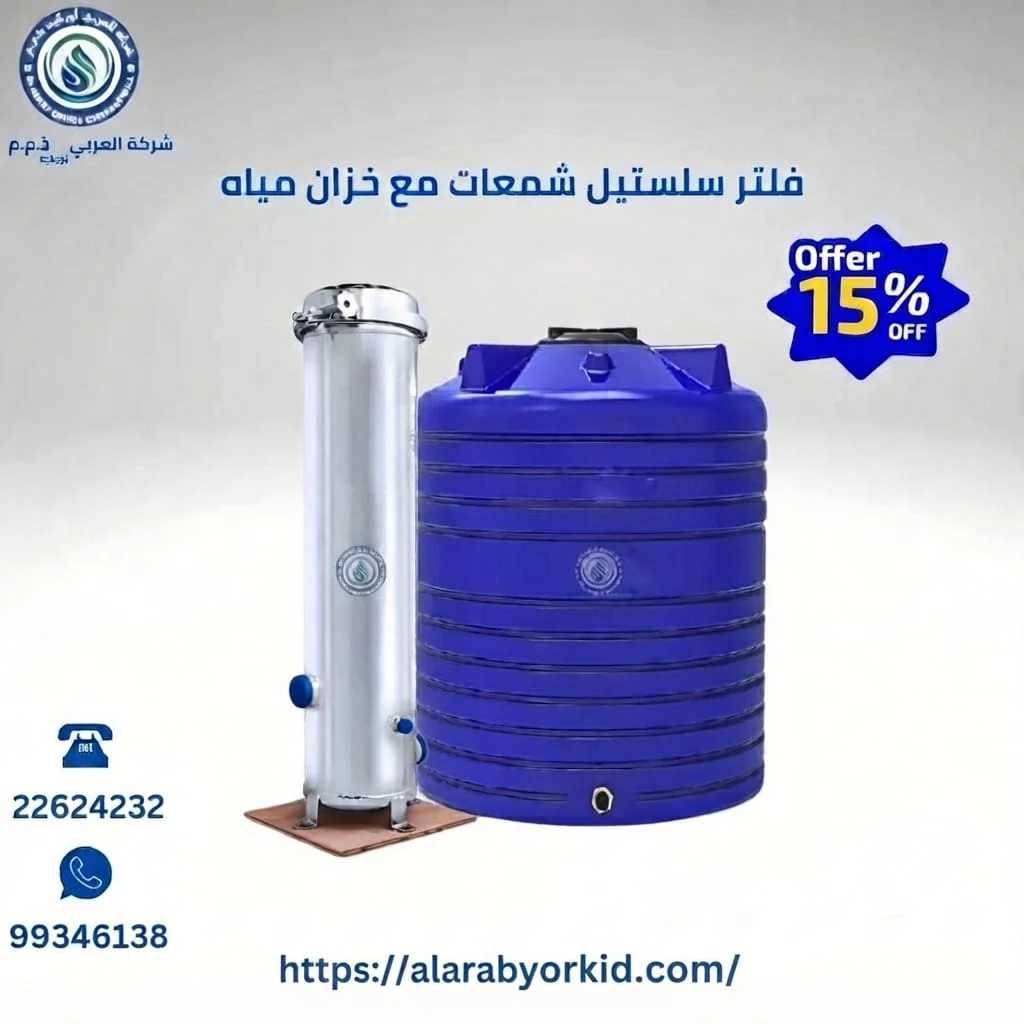
When you are choosing between a nano water filter and a traditional filter, do not let the word “nano” make the decision for you. There is an important difference between a filter sold commercially under the name Nano and true nanofiltration technology, which uses a fine membrane operating under pressure and has clearly defined technical characteristics. Al Arabi Orchid currently offers stainless Nano, Aqua, and Panther filtration systems with configurations ranging from 8 to 20 cartridges, but its current page does not publish specifications proving that every product carrying the Nano name uses a true nanofiltration membrane in the scientific sense. The correct comparison should therefore focus on filtration media, filtration rating, flow rate, operating pressure, the substances you want to reduce, and maintenance cost, not simply on the product name.
Nano Water Filter or Traditional Water Filter

When you ask whether to choose a nano water filter or traditional water filter, the first step is defining exactly what both options mean. A traditional domestic filter may use sediment cartridges, activated carbon, several filter cartridges, or a Jumbo housing, and its performance depends on the filtration media, pore size, and cartridge specifications. True nanofiltration, on the other hand, is a membrane process operating at a much finer separation level. Technical water-treatment references place nanofiltration between ultrafiltration and reverse osmosis, with the ability to address microorganisms and certain dissolved substances depending on the membrane.
This is where one of the most common market misunderstandings appears. A product called “Nano filter” does not automatically contain a nanofiltration membrane. Al Arabi Orchid currently describes one of its categories as a stainless Nano filter and offers Nano, Aqua, and Panther stainless systems containing between 8 and 20 cartridges. However, its current public product information does not state a nanofiltration membrane pore size, membrane rejection percentage, membrane operating pressure, or other specifications that would allow us to assume automatically that the commercial Nano name is identical to membrane nanofiltration technology.
That distinction completely changes the comparison. If the product described as Nano is actually a stainless multi-cartridge filter, then the real comparison is between larger filtration area, higher cartridge count, potentially higher flow capacity, and stainless-steel construction versus a smaller traditional filter. If the product genuinely uses a nanofiltration membrane, then the comparison moves into a different technical category involving membrane pressure, feed-water quality, pretreatment, membrane rejection characteristics, and long-term maintenance.
For this reason, the first question should not be “Is nano better?” It should be: What filtration technology is actually inside this system?
-
If Nano is mainly a commercial product name compare the actual components rather than the label
-
True nanofiltration is a membrane technology and is fundamentally different from ordinary sediment or carbon cartridges
-
A stainless multi-cartridge system may provide higher flow than a small kitchen filter but that alone does not prove the presence of a nanofiltration membrane
-
Ask for filtration rating membrane type cartridge specifications and flow rate instead of accepting a general advanced-technology description
-
The best decision begins with identifying the real water-quality problem and selecting a technology specifically designed to address it
Difference Between Nano and Traditional Water Filters
The difference between nano and traditional water filters appears most clearly in the way substances are separated from water. Traditional filtration generally relies on physically trapping particles inside a filtration medium or on adsorption when activated carbon is used. Carbon filters are commonly used for issues such as taste and odor, while the ability of any filter to address microorganisms or specific chemicals depends on the actual filtration rating, media, design, and documented performance of the product.
True nanofiltration uses a fine membrane and works through separation based on factors such as particle or molecule size, molecular characteristics, and charge effects. Technically, nanofiltration sits between ultrafiltration and reverse osmosis. It can provide greater separation than conventional mechanical filtration and may reduce certain microorganisms and dissolved compounds depending on the membrane design.
Some nanofiltration membranes also allow more monovalent ions to pass through than reverse osmosis while rejecting a greater proportion of some divalent ions such as calcium and magnesium and certain organic compounds. This is an important technical point because “finer” does not automatically mean “better for every objective.” Reverse osmosis may be more suitable when the goal involves particular dissolved substances, while a membrane system may be completely unnecessary if the household only needs sediment or taste and odor control.
A traditional filter can be simpler and less sensitive to operating conditions when the main purpose is sediment removal or taste and odor improvement. A Jumbo filter or a stainless multi-cartridge filter, for example, may provide the flow required by a larger water line without the complexity of a membrane treatment process.
Pressure requirements are another major difference. Fine membrane technologies require suitable operating conditions, and the smaller the effective separation level becomes, the more important pressure and feed-water quality can become. If a product is described as Nano but operates exactly like a cartridge filter and has no published membrane information, it should not automatically be assigned the technical characteristics of true nanofiltration.
-
Traditional systems generally rely on mechanical particle capture activated carbon or combinations of filtration media
-
True nanofiltration uses a much finer membrane and operates differently from conventional filter cartridges
-
Nano performance depends on the membrane characteristics and should never be presented as a universal promise to remove everything
-
A traditional filter may be the simpler and more appropriate choice when the main problem is sediment taste or odor
-
Always confirm whether the product contains an actual nanofiltration membrane or whether Nano is only the commercial name of a multi-cartridge system
Advantages of Nano Water Filters
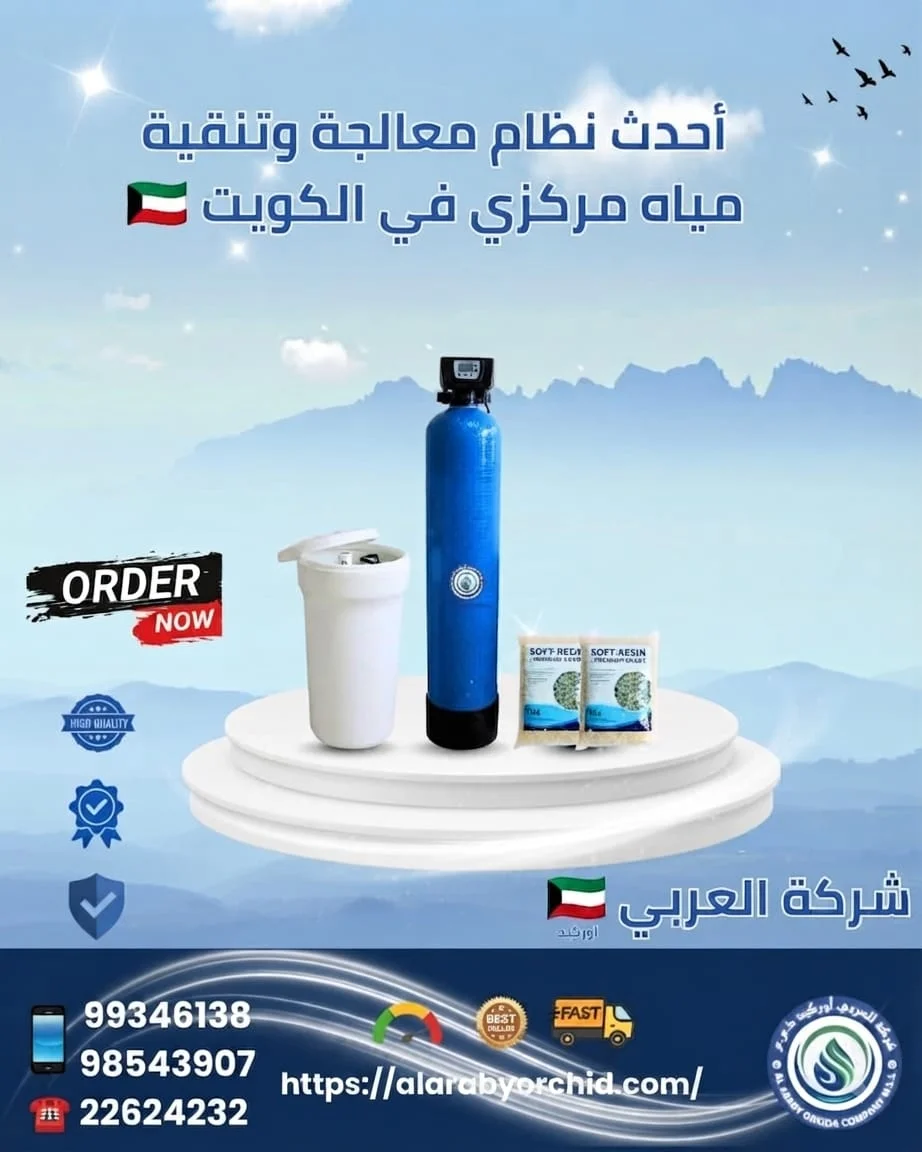
The advantages of nano water filters depend first on what the word Nano actually means in the product being considered. If we are discussing true membrane nanofiltration, one of the main advantages is a finer separation level than many conventional mechanical filtration systems.
Nanofiltration can provide more advanced separation than traditional sediment filtration and can be useful in applications that require a treatment level between ultrafiltration and reverse osmosis. Depending on the membrane, it may reduce microorganisms and certain dissolved compounds while allowing a different mineral profile to pass compared with reverse osmosis.
Another potential advantage is that nanofiltration can reduce substantial amounts of some hardness-related ions and certain organic substances while permitting more passage of some monovalent salts than reverse osmosis. For certain applications, that can create a useful balance between treatment intensity and mineral passage, although the actual result always depends on the membrane specification.
If we are instead discussing the stainless Nano filter category currently offered by Al Arabi Orchid, the advantages that can be confirmed from the available product description are different. The company emphasizes stainless-steel construction, durability, corrosion resistance, and multi-cartridge configurations from 8 to 20 cartridges. This suggests a design intended for larger flow rates and higher filtration capacity than a small under-sink kitchen filter, but it does not by itself prove that the system uses a true nanofiltration membrane.
A multi-cartridge stainless system can also offer a larger total filtration surface. When designed correctly, distributing water through a larger filter area can help support higher household flow and reduce the loading on individual cartridges compared with a small filter housing.
-
True nanofiltration provides a finer separation level than many conventional mechanical filtration systems
-
Some nanofiltration membranes offer a different balance between dissolved-substance reduction and mineral passage compared with reverse osmosis
-
Stainless-steel construction can offer durability and corrosion resistance when the material grade and installation are suitable
-
Multi-cartridge systems can be designed for higher flow than small point-of-use kitchen filters
-
The real value of a Nano system can only be judged after confirming the membrane or cartridge specifications and the actual substances the product is designed to reduce
Disadvantages of Nano Filters
The disadvantages of nano filters begin with one of the biggest problems in the market: the term itself can be unclear. If a product uses the word Nano without a proper technical specification sheet, the customer may pay more believing they are buying membrane nanofiltration when the system is actually a stainless cartridge filter or a conventional fine-filtration unit.
The second disadvantage of true nanofiltration is that membrane systems require suitable operating conditions. Fine membranes depend on pressure and can be affected by surface fouling, scale, and contamination. Proper pretreatment may therefore be necessary depending on incoming water quality.
The third disadvantage is that nanofiltration does not address every water-quality problem equally. It can be effective for certain microorganisms and dissolved compounds, but its reduction performance varies depending on the membrane and the substance involved. If the main goal is one specific chemical contaminant, the word Nano alone is not enough. The exact product claim should be reviewed.
The fourth disadvantage is maintenance. The more cartridges or membrane components a system contains, the more important proper replacement schedules and compatible spare parts become. A stainless system containing 8, 15, or 20 cartridges creates a very different maintenance budget from a small conventional three-stage filter.
The fifth disadvantage is the risk of installing a system that is larger or more complex than the household actually needs. A larger treatment system can increase purchase price, maintenance cost, and operating complexity without providing an equivalent practical benefit.
-
An undefined Nano label can cause customers to compare marketing language instead of real technology
-
A genuine nanofiltration membrane requires suitable feed-water quality pressure and pretreatment for the exact model
-
Nanofiltration is not a universal solution for every dissolved chemical or contaminant
-
Multi-cartridge and membrane systems increase the number of components that need inspection and replacement
-
Installing an advanced system for a simple filtration problem can increase cost without adding meaningful practical value
Nano Filter for Homes in Kuwait
A Nano filter for homes in Kuwait can make sense when the requirement goes beyond a single drinking-water faucet, but the first step is determining whether the product is a stainless multi-cartridge system for a larger water line or a true membrane nanofiltration unit.
Al Arabi Orchid currently lists stainless Nano, Aqua, and Panther filters with approximately 8 to 20 cartridges within its water-filtration services. The company also positions different home filtration options for purposes such as reducing sediment and helping protect heaters, pumps, and plumbing equipment.
If the filter is intended to serve a larger part of the home, flow rate becomes one of the most important specifications. A system supplying several bathrooms needs much more flow than a unit designed for one kitchen faucet. Point-of-entry systems operate at very different flow requirements from point-of-use drinking-water systems.
The condition of the household water tank is also important in Kuwait. If the tank contains a heavy sediment load, installing a very fine filter without suitable preliminary protection may cause rapid cartridge loading or pressure loss. If the property uses a booster pump, pressure before and after the filtration system should also be considered so that better filtration does not create an unacceptable reduction in water flow at bathrooms and fixtures.
Most importantly, if the supplier says “Nano,” ask for filtration rating, cartridge type, whether a membrane is present, required pressure, and rated flow rate. An answer such as “it is a 20-cartridge Nano filter” is not enough technical information to determine the actual filtration technology.
-
Determine whether the system is intended for one kitchen faucet or a larger household water line
-
Ask for the design flow rate because cartridge count alone does not prove that the system is suitable for the plumbing network
-
Heavy sediment in the storage tank may require a preliminary filtration stage before a finer system
-
Monitor pressure loss because an overly restrictive filtration system can weaken household water flow
-
Contact Al Arabi Orchid on 99346138 and request the actual cartridge and system specifications before deciding that Nano is the correct choice
Traditional Filter for Home Water
A traditional filter for home water should not automatically be considered weak, outdated, or inferior. In many situations, the simpler technology is actually the more accurate choice because it performs the required function without adding treatment complexity that the household does not need.
For example, if the main problem is larger particles and sediment, a suitable Jumbo filter or sediment cartridge may be more appropriate than an advanced membrane system. Al Arabi Orchid currently offers Jumbo filtration starting from KWD 50 and describes this category as a solution for larger impurities and protection of the plumbing network. In this case, the function is clear and specific, which makes it possible to evaluate the product properly instead of simply comparing it against the word Nano.
If the objective is improving drinking-water taste or odor, activated carbon is a well-established treatment approach. Carbon filters are commonly used for these aesthetic characteristics, although the exact performance still depends on the cartridge and its documented claims.
Another advantage of traditional systems is simpler troubleshooting and maintenance. You often have a known housing, a clearly identified cartridge, and a straightforward flow path. If flow falls, the cartridge and pressure drop can be checked directly. There is no need to deal with membrane pressure, rejection rate, or recovery unless the system was specifically designed around those technologies.
Traditional filtration does have limits. A sediment cartridge does not suddenly become a dissolved-solids treatment system, and carbon is not a replacement for every other water-treatment technology. Traditional filtration is excellent when its function matches the problem and poor when customers expect it to do something it was never designed to do.
-
A traditional filter may be the better option when sediment is the actual household problem
-
Activated carbon is widely used for certain taste and odor concerns depending on the product specification
-
Simpler systems are generally easier to maintain and have more straightforward cartridge replacement
-
Lower complexity does not mean lower quality when the technology matches the treatment goal
-
Do not expect a traditional cartridge to reduce a substance unless the product is specifically designed and documented for that claim
Comparing Water Purification Technologies
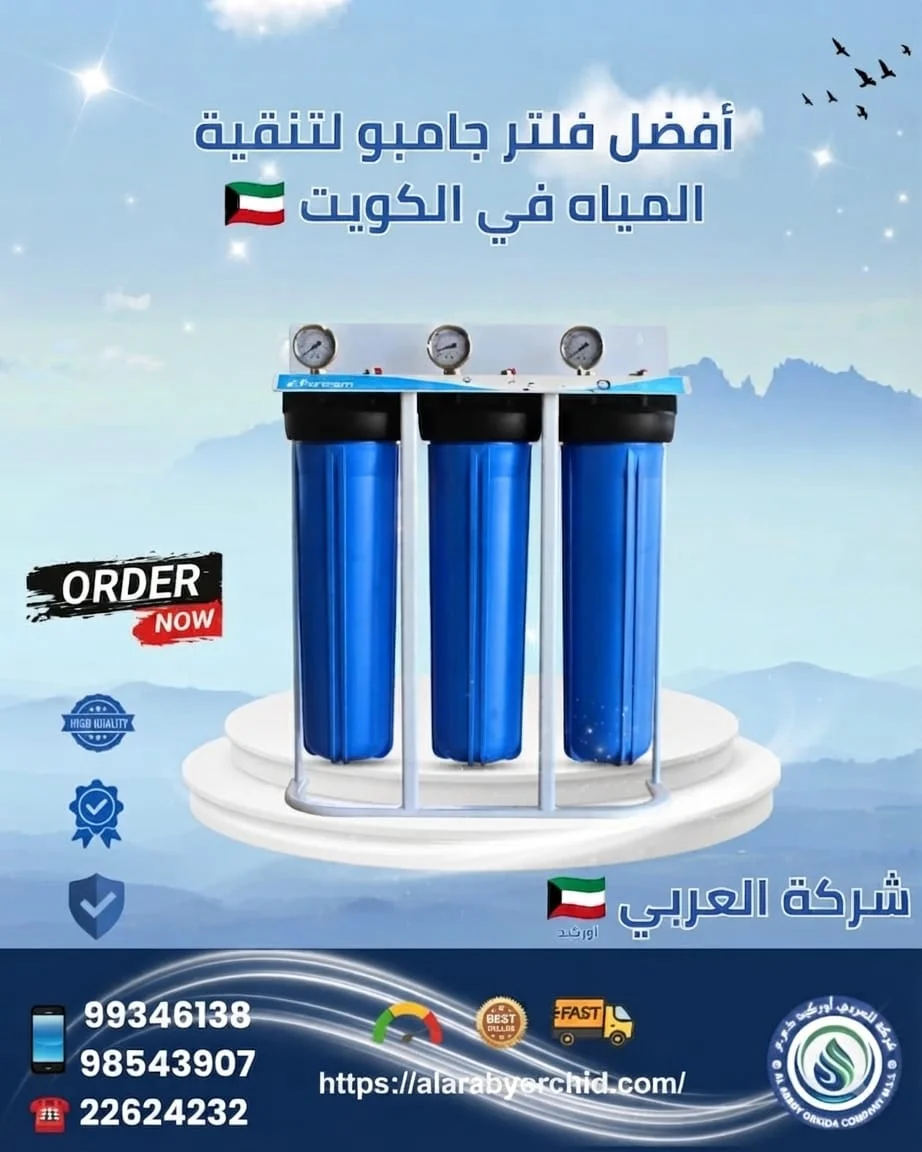
A proper comparison of water purification technologies should move beyond dividing the market into only “traditional” and “nano.” There are several different treatment levels, including microfiltration, ultrafiltration, nanofiltration, reverse osmosis, and carbon adsorption, and each works differently.
Microfiltration generally uses larger pores and is suited to larger particles and certain microorganisms but is not normally intended for viruses or dissolved chemicals. Ultrafiltration provides finer separation and is more effective against bacteria. Nanofiltration operates at an even finer level and may address viruses and certain dissolved substances depending on the membrane. Reverse osmosis uses another level of membrane separation and can reduce a wide range of dissolved salts and specific contaminants depending on the system design.
Activated carbon belongs to a different category because it is not defined mainly by membrane pore size. It works primarily through adsorption and is commonly used for taste, odor, chlorine, and other product-specific claims.
There is therefore no technology that ranks first in every category. If the goal is capturing large sediment, using a nanofiltration membrane may be unnecessary complexity. If the goal involves specific dissolved substances, a sediment cartridge alone will not be sufficient. If only one drinking-water faucet needs treatment, a point-of-use system may be more practical than treating the full household supply.
The system should be sized according to the amount of water that actually needs treatment. Oversizing equipment can increase cost without providing additional value.
-
Microfiltration ultrafiltration nanofiltration and reverse osmosis are different technical processes rather than marketing levels
-
Carbon performs through adsorption and should not be compared with membranes only by pore size
-
The best technology for sediment is not automatically the best technology for dissolved substances
-
Point-of-use treatment can be more logical when only drinking water needs treatment
-
Compare the product with the treatment result you need rather than placing technologies on a simple scale from ordinary to advanced
Nano Purification Versus Traditional Filtration
Nano purification versus traditional filtration also differs in terms of flow behavior and maintenance. Traditional cartridge filtration usually has a relatively easy-to-understand operating pattern: as sediment accumulates, pressure drop increases, water flow falls, and the cartridge eventually needs replacement.
Membrane nanofiltration adds other variables. The membrane itself can experience fouling or scaling, which means pretreatment and feed-water quality become more important. Fine membrane processes require suitable incoming water conditions if long-term performance is to remain stable.
Traditional systems can be more tolerant of heavy particulate loads when properly designed for main-line sediment filtration, and cartridge replacement is usually straightforward. However, even conventional filters can cause excessive pressure loss if an unnecessarily fine cartridge is selected for a high-flow application. Traditional filtration still requires correct engineering and should not simply be reduced to “the more cartridges, the better.”
From a treatment perspective, true nanofiltration can provide a wider separation range than basic mechanical filtration, but performance depends on the membrane. It is inaccurate to say “Nano removes everything.” Every system should be assessed according to documented performance and the substances of concern.
Reject-water behavior can also differ depending on the membrane process. Some membrane systems separate incoming water into a permeate stream and a concentrate stream, while ordinary cartridge filtration normally passes all treated water through the filter media. For this reason, the exact system design must be understood instead of assuming that every Nano system behaves like reverse osmosis or vice versa.
-
Traditional cartridge filters are usually easier to monitor through flow reduction and cartridge loading
-
Membrane nanofiltration depends more heavily on membrane condition and appropriate pretreatment
-
Higher nanofiltration capability does not remove the need to verify which substances the exact product is designed to reduce
-
An overly fine conventional cartridge can also cause serious pressure loss even without a nanofiltration membrane
-
Compare maintenance cost component count service intervals and water quality before making the final decision
Choosing a Nano or Standard Filter
Choosing a Nano or standard filter becomes easier if you answer five questions.
The first question is: what is the problem? If the issue is simply sediment, begin with a filtration solution designed for sediment. If the issue is taste or odor, consider a suitable carbon system. If you are concerned about a specific microorganism or chemical substance, move toward a product that has documented performance for that exact concern.
The second question is: what does Nano mean in the quotation? Ask for the technical specification sheet. Is there a membrane? What is the filtration rating? What pressure does it require? What flow does it provide? Or is it simply a stainless multi-cartridge system using Nano as the commercial category name?
The third question is: where do you want filtration? There is a major difference between point-of-use treatment and whole-house or point-of-entry filtration. If you only need drinking water, there may be no reason to process the entire household supply through a large system.
The fourth question is: what will maintenance cost? A traditional three-cartridge system is completely different from a stainless system using 20 cartridges, and both are different from a membrane system requiring pretreatment and specialized components. Calculate one or two years of ownership, not only the purchase price.
The fifth question is: is there a documented performance claim or certification? If you are concerned about one specific substance, choose a model evaluated for that claim rather than relying on the technology name alone. Certification of a general technology does not replace verification of the exact product.
-
Choose a standard filter when its clearly defined function solves the problem without unnecessary complexity
-
Choose true membrane nanofiltration when the household need genuinely benefits from its characteristics and the model has proper technical documentation
-
Do not pay a premium for the Nano label if the supplier cannot explain what technology is actually inside the system
-
Compare one full year of cartridge membrane and maintenance costs rather than only the first installation price
-
Contact Al Arabi Orchid on 99346138 and request the specifications of the proposed system then compare it with a traditional option at the same flow requirement and treatment goal
Best Water Filtration Technology for Home
The best water filtration technology for home is not one fixed product category that can be recommended to every customer. The best system is the one that solves the actual problem with the least unnecessary complexity, suitable flow, and a clear maintenance plan.
If sediment is entering the system before the heater or booster pump, a conventional main-line filter may be more logical. Al Arabi Orchid currently offers Jumbo filters, sand filters, and stainless multi-cartridge systems, with each category serving a different part of the household water-treatment spectrum.
If the requirement is only drinking and cooking water, a point-of-use filter can make more sense because there is no reason to process shower and laundry water through the same treatment technology.
If there is a specific microbiological or chemical concern, technology and documented performance become more important than the appearance or material of the filter body. Taste, smell, and appearance alone are not enough to determine water safety.
If you decide on true nanofiltration, ask for the membrane type, flow rate, operating pressure, pretreatment requirements, and specific tested reduction claims. If you choose a commercially named stainless Nano filter, ask for the exact cartridge count, cartridge media, filtration rating, and rated flow. Do not assume the commercial Nano label means the same thing as membrane nanofiltration.
This is the principle that separates informed purchasing from buying by name: the best technology is the one you can clearly explain why your home actually needs.
-
For sediment choose a system specifically designed for sediment instead of automatically selecting the finest technology available
-
For drinking water only consider point-of-use treatment before oversizing the system for the entire property
-
For a specific substance look for documented reduction performance on the exact model
-
For Nano systems request membrane or cartridge specifications so you know whether the term is technical or commercial
-
Contact Al Arabi Orchid on 99346138 and ask for two options compared at the same flow rate and treatment objective before purchasing
Conclusion
The answer to Nano water filter or traditional filter: which should you buy? begins by correcting the most important misunderstanding: not every product called Nano necessarily uses true membrane nanofiltration technology.
True nanofiltration is a recognized treatment process and is technically different from conventional filtration. It sits between ultrafiltration and reverse osmosis in separation performance and can address microorganisms and certain dissolved substances depending on the membrane and system design.
Al Arabi Orchid currently offers a stainless Nano filter category and lists Nano, Aqua, and Panther systems with approximately 8 to 20 cartridges, but its current public page does not publish membrane pore size, membrane rejection values, or similar data proving that every product carrying the Nano name uses the same membrane nanofiltration technology described in technical water-treatment references. The professional approach is therefore to treat Nano as a product name until the actual technical specification confirms otherwise.
A traditional filter should also not be treated as an automatically inferior choice. If the problem is sediment and larger impurities, a Jumbo or suitable sediment system may be more practical, less expensive, and easier to maintain. If the objective is taste and odor improvement, activated carbon is a well-established treatment technology for that purpose.
If the household genuinely needs finer membrane separation, true nanofiltration may make sense, but you should know the membrane type, operating pressure, flow rate, pretreatment requirements, and the exact substances the model has been evaluated to reduce.
Before purchasing from Al Arabi Orchid, contact 99346138 and ask for five pieces of information: cartridge or membrane type, filtration rating, flow rate, required operating pressure, and replacement cost. If the product is called Nano, ask directly: “Does this system use a real nanofiltration membrane, or is Nano the commercial name of a stainless multi-cartridge filter?”
That single question can prevent the biggest comparison mistake and help you choose by specification rather than by product name.
Frequently Asked Questions
Is a Nano filter better than a traditional filter?
Not always. If the product uses true membrane nanofiltration, it can provide finer separation than many conventional filters, but that level of treatment may be unnecessary for some homes. If Nano is only the commercial name of a multi-cartridge system, the actual components must be compared before making any judgment.
What is the real difference between Nano and a standard filter?
True nanofiltration uses a fine pressure-driven membrane, while a traditional filter usually relies on sediment cartridges, activated carbon, or other conventional media. Their ability to reduce different substances depends on the technology and the exact model.
Does the Al Arabi Orchid Nano filter use a real nanofiltration membrane?
The current Al Arabi Orchid website describes a stainless Nano filter and lists systems with approximately 8 to 20 cartridges, but it does not currently publish membrane pore-size or membrane-performance data sufficient to confirm that every model uses true membrane nanofiltration. The exact model specifications should be confirmed through 99346138.
Can nanofiltration reduce bacteria and viruses?
True nanofiltration can provide strong reduction of microorganisms depending on membrane design, but actual performance depends on the exact product. The model’s documented claims should always be checked rather than relying only on the technology name.
Does Nano filtration remove all salts and chemicals?
No. Nanofiltration performance varies by membrane and substance. It can reduce certain dissolved compounds and hardness-related ions, but it should not be presented as removing every salt or chemical automatically. If one specific substance is the concern, review the exact model performance.
Is a traditional filter enough for sediment?
In many cases, yes, if the system is correctly selected for the size and amount of sediment present. Al Arabi Orchid currently offers Jumbo filtration for larger impurities and plumbing protection, so a membrane technology is not always necessary for a basic sediment problem.
Can a Nano filter reduce water pressure?
Any filtration media creates some flow resistance. A very fine or poorly sized filtration system can cause noticeable pressure loss. The result depends on filtration area, cartridge or membrane rating, flow demand, and maintenance condition.
Is stainless steel better than plastic for water filters?
Stainless steel can offer durability and corrosion resistance depending on the material grade and operating environment, but the housing material alone does not determine filtration quality. Cartridge type, filtration rating, flow rate, seals, and installation remain equally important.
When should I choose a traditional filter instead of Nano?
Choose a traditional filter when the need is clear, such as sediment removal or improvement of certain taste and odor characteristics, and a simpler system can achieve that objective. There is no benefit in paying for a more advanced technology when the household does not need its additional capability.
How do I choose between Nano and traditional filters from Al Arabi Orchid?
Contact 99346138 and explain whether the filter is needed for the kitchen or the main household line, how many water outlets are involved, the sediment condition, and the available pressure. Ask for a comparison covering filtration media, filtration rating, cartridge count, flow rate, whether a true nanofiltration membrane is present, and maintenance cost. Then compare both options against the same filtration objective instead of choosing only from the words “Nano” or “traditional.”
