
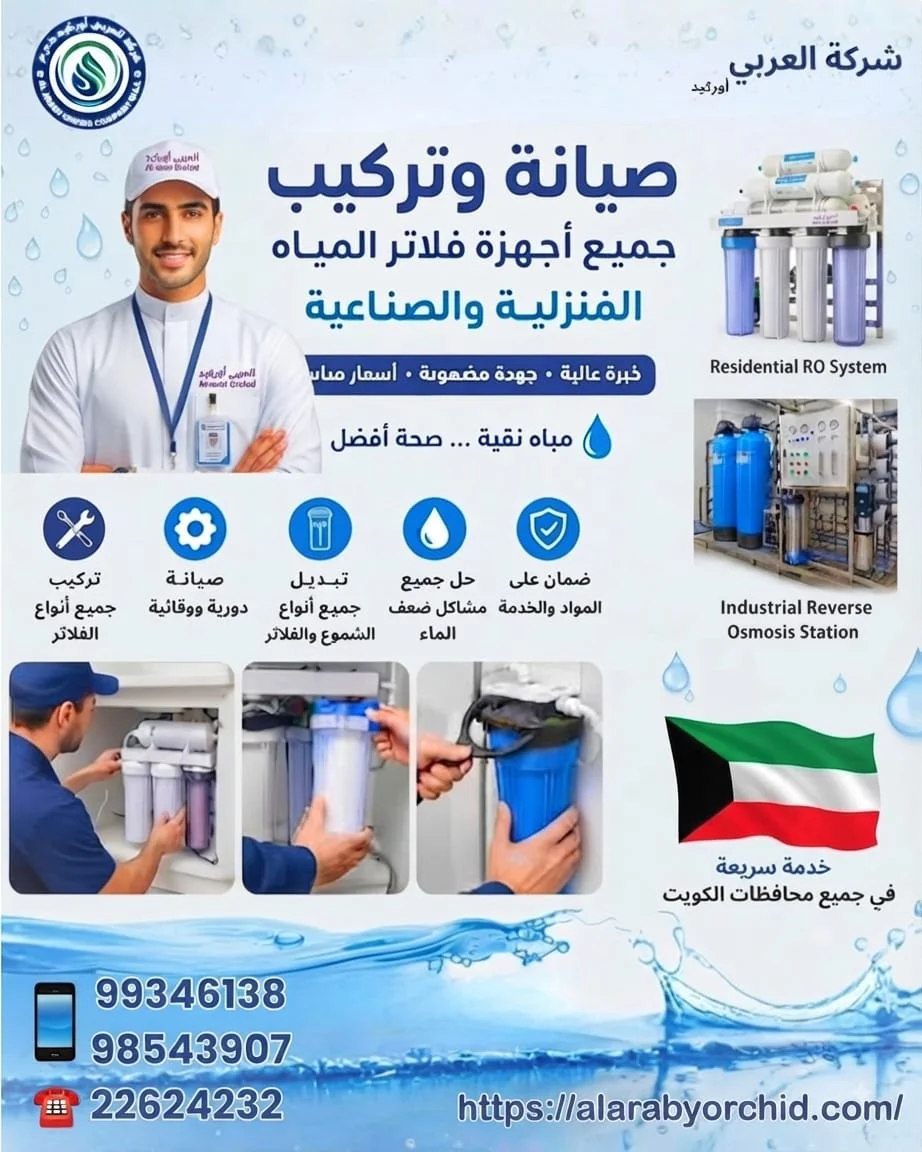
The question how often should water filter cartridges be replaced does not have one answer such as every 3 months or every 6 months that applies to every filtration system. Replacement timing depends on cartridge type, rated capacity, incoming water quality, household consumption, and manufacturer specifications. A sediment cartridge does not work like a carbon cartridge, and an RO membrane does not follow the same replacement schedule as a post-carbon filter. Water filters generally have a defined service cycle based on time or the volume of water treated, so it is better to follow the actual product capacity and manufacturer instructions instead of judging only by cartridge appearance. Al Arabi Orchid currently provides water-filter installation and maintenance services together with replacement of cotton, carbon, and charcoal cartridges in Kuwait, so accurate maintenance starts by identifying your exact system, filtration stages, and the date of the last replacement.
How Often Should Water Filter Cartridges Be Replaced?
When asking how often should water filter cartridges be replaced, the first step is separating three ways of deciding replacement time: time, water volume, and actual performance. Relying on only one of these factors can make you replace a cartridge too early and spend money unnecessarily, or leave it in service too long until filtration performance begins to decline.
The first method is the time interval published by the manufacturer. Some companies may state that a particular cartridge lasts 6 months or 12 months. That number is useful, but it is based on expected operating conditions rather than a promise that every household will achieve exactly the same lifespan. Some manufacturers provide general guidance suggesting that certain carbon filters may require replacement approximately every 6 to 12 months and some residential sediment filters around 6 to 9 months, while also emphasizing that actual filter life changes according to water quality, consumption, and filter type.
The second method is rated capacity in liters or gallons. This can sometimes be more important than months because a household using a large amount of water can consume cartridge capacity much faster than a smaller household, even when both installed exactly the same filter on the same date. Many filtration products have a service cycle expressed either as a time limit or a rated water volume, and maintaining certified performance requires replacing the cartridge when its stated service capacity has been reached.
The third method is actual performance symptoms. If flow drops noticeably, chlorine taste returns, odor appears, or pressure at the filtered-water faucet changes, those signs deserve inspection even when the calendar replacement date has not arrived. However, these symptoms do not automatically mean every cartridge is exhausted. A sediment stage may be blocked while the carbon stage still has usable capacity.
Consider a practical example. Two homes install the same sediment cartridge on the same date. The first receives relatively clean incoming water and has moderate consumption. The second receives more sediment and uses much more water every day. It is completely reasonable for the second home to require earlier cartridge replacement. This is why the better question is not only “every how many months?” but also what cartridge type do you have, what is its rated capacity, and how much water actually passes through it?
-
Do not use one replacement interval for every cartridge because each filtration stage has a different function and capacity
-
Monitor time water consumption and performance together because reaching any relevant service limit can affect the maintenance decision
-
A household with higher consumption or more sediment in incoming water may need some stages replaced earlier than another household using the same system
-
If flow decreases do not automatically assume the carbon cartridge is exhausted because the sediment cartridge before it may be blocked
-
Record the installation date and model of every cartridge instead of writing one date for the whole filter because the stages do not necessarily need replacement together
Water Filter Cartridge Replacement Schedule
The water filter cartridge replacement schedule should first come from the specifications of the exact model and then be adjusted according to real household conditions. Replacement cartridges are not automatically universal, and even cartridges that appear similar in size may have different capacities, materials, and performance characteristics.
A common problem is purchasing a 5-stage or 7-stage filter and then following one note that says “replace the cartridges every 6 months.” This may be easy to remember, but it is not always technically accurate. The sediment stage deals primarily with particles, the carbon stage depends on adsorption capacity, and an RO membrane has a completely different service life. Replacing every stage on the same date without evidence can mean throwing away filters that still have useful capacity remaining.
Some under-sink sediment and carbon cartridges may have estimated service intervals of 6 to 12 months depending on usage, while other products from the same manufacturer can have completely different replacement cycles. This proves that simply knowing the words “carbon cartridge” is not enough to determine a precise replacement date without the exact product number.
Some newer filtration systems also include a filter-life indicator instead of relying entirely on memory. In systems that include this feature, the indicator can provide useful information about remaining cartridge life. However, this is a product-specific feature and is not available on every filtration system.
In a home in Kuwait, maintenance may need to be moved earlier if the sediment cartridge collects a large amount of debris, household consumption rises significantly, or incoming water conditions change. In another home, a cartridge may still look visually clean while the carbon media has already reached its adsorption capacity, so visual appearance should not be used as the only indicator for every stage.
A practical maintenance record should include:
Installation date
Cartridge number
Rated capacity
Maximum manufacturer interval
Any change in flow taste or odor
Al Arabi Orchid currently advertises water-filter installation and maintenance together with cotton, carbon, and charcoal cartridge replacement, so when requesting service it is better to send a photo of the filtration system and installed stages instead of simply saying, “I need all the cartridges changed.”
-
The maintenance schedule should begin with the exact product instructions rather than a general table taken from another filter
-
Do not replace every stage on the same date if the system manual assigns different service cycles to individual cartridges
-
If the system includes a filter-life indicator it should be considered rather than ignored in favor of a memorized calendar date
-
Early blockage or a clear performance change before the scheduled date deserves inspection because water quality and usage affect actual lifespan
-
When contacting 99346138 prepare a photo of the filter cartridge names and the last replacement date so the maintenance decision can be more accurate
Water Filter Cartridge Replacement Table

If you want a useful water filter cartridge replacement table, it should be treated as an initial reference, not a universal rule. A good table gives you approximate ranges and then tells you to check the exact model because manufacturers themselves publish different service lives for apparently similar products.
As general examples only, not as a fixed table for every Al Arabi Orchid filter or every system in Kuwait, some manufacturer guidance may list approximate ranges such as:
Carbon cartridges around 6 to 12 months
Residential sediment cartridges around 6 to 9 months
Prefilters in some RO systems around 6 to 18 months
RO membranes in some general estimates around two years
However, actual intervals depend on the exact product and operating conditions.
The strongest proof that there is no universal table is that the same manufacturer may list one specific RO membrane with an estimated service life of 18 months, while another manufacturer may recommend 2 to 5 years for a particular membrane used in a different RO system. Therefore, writing “all RO membranes must be replaced every two years” would be technically inaccurate for many products.
Sediment stages also vary. In one whole-house filtration system, a manufacturer may recommend replacing a specific 5-micron prefilter every 6 to 9 months depending on actual sediment load and may also use signs such as dark discoloration or pressure loss to support the decision. That interval belongs to that particular system and should not be converted into a universal rule.
A better household maintenance table would look like this:
Sediment stage: replacement according to cartridge model plus monitoring of flow and sediment load
Carbon stage: manufacturer interval or rated capacity plus monitoring for returning taste and odor
Post-carbon stage: according to system model and stage capacity
RO membrane: according to system manual and measured performance rather than one fixed date
Any additional stage: according to its function and its own product instructions
The purpose of the table is not to automatically replace everything at once. It is to remind you when each stage should be reviewed.
-
Treat general replacement ranges only as starting points because real products from the same manufacturers can have different service lives
-
Record both the inspection date and the actual replacement date because those two dates do not always need to be the same
-
RO stages should not be replaced as one package because the prefilter membrane and post-filter can have different service cycles
-
Falling flow through a sediment cartridge can be a stronger reason for early inspection than waiting for a fixed calendar date when the cartridge is already blocked
-
Do not copy another household’s filter schedule even if both systems have the same number of stages because cartridge types and rated capacities may be different
Lifespan of Water Filter Cartridges
The lifespan of water filter cartridges requires separating two concepts: storage life while the cartridge is new and unused, and operating life after water begins passing through it. This article focuses on operating life because that determines maintenance timing in the home.
Operating life usually ends through one of two mechanisms. The first is that mechanical filter pores fill with sediment and water flow decreases. The second is that adsorption media such as activated carbon reaches its capacity and can no longer reduce targeted substances at the same level. Mechanical blockage can often be noticed through reduced flow, while exhausted adsorption capacity may not always be visible by looking at the cartridge.
This explains why visual inspection alone is not enough. A carbon cartridge may still look almost unchanged on the outside while its useful adsorption capacity is exhausted. On the other hand, a white sediment cartridge may become heavily brown very quickly when incoming water contains a large amount of particles and its flow capacity begins to decrease.
Operating life is also influenced by:
Daily water consumption
Feed-water quality
Sediment concentration
Cartridge function
Flow rate
Whether previous filtration stages are working properly
If the sediment stage is neglected and allows worse operating conditions to reach later stages, it can shorten the useful life of the rest of the filtration system. This is particularly important with RO systems because prefilter maintenance helps protect more expensive downstream stages.
Manufacturers generally specify a rated service cycle or capacity for each filter because product performance is evaluated under particular service conditions. Replacement cartridges should also be suitable for the exact system because a cartridge that looks almost identical can still allow water to bypass the intended filtration media if it does not fit or seal correctly.
-
Operating lifespan is not only a number printed on the box because cartridge capacity is gradually consumed as water passes through the system
-
The appearance of a carbon cartridge does not always show its remaining adsorption capacity because media exhaustion cannot necessarily be seen
-
Blocking the first filtration stage can affect the performance of the entire system so delaying its replacement is not genuine saving
-
Use cartridges specified for the exact system because a similar physical size does not prove that water will pass through the filtration media correctly
-
If the filter manual gives a capacity in liters or gallons treat it as an important service limit just like the time interval
How Many Months Between Filter Cartridge Replacements?
The question how many months between filter cartridge replacements needs one clear answer: check the recommendation for your exact cartridge model first and do not use one number for every system. If you need approximate ranges simply to understand the concept, some manufacturers place common carbon and sediment cartridges within ranges beginning at several months and extending to a year or longer depending on the specific product.
General manufacturer guidance may place some carbon filters around 6 to 12 months, residential sediment filters around 6 to 9 months, and prefilters in certain RO systems around 6 to 18 months. However, water quality, consumption, and filter design can significantly change actual lifespan.
Specific products within the same manufacturer may also differ. One carbon replacement cartridge may be listed for approximately 6 months, while another carbon cartridge may have a 6-to-12-month range. Sediment products can also vary. These differences inside the same product family clearly show why the statement “replace every cartridge every 6 months” is not technically reliable.
If household usage is very high, do not wait for the final month if the cartridge has already reached its rated capacity. If the system has a filter-life indicator, use it. If taste, odor, or flow changes abnormally, inspect the system before the planned date.
However, do not move to the opposite extreme and say, “replace a cartridge the moment its color changes.” Some cartridges cannot be judged accurately from appearance, and many filter housings are not transparent.
A practical approach in Kuwait is to create a reminder a few weeks before the manufacturer’s expected replacement date so you can inspect the system, then follow the maximum service cycle specified in the product documentation even if no obvious symptom has appeared.
-
Six months may be common for some products but it is not a mandatory replacement interval for every filter and every stage
-
If the manufacturer states 2000 gallons or 12 months follow whichever service limit applies according to the product instructions
-
A high-consumption household can use up the same cartridge faster than a low-consumption household even when both filters were installed on the same day
-
Do not wait for severe flow loss when a cartridge has already reached its rated service cycle because some filtration media do not provide a visible warning
-
Use calendar reminders as maintenance-review dates rather than automatic instructions to replace cartridges that have not reached their actual service limit
Lifespan of a Carbon Filter Cartridge
The lifespan of a carbon filter cartridge depends more on adsorption capacity than on the external appearance of the cartridge. Activated carbon captures certain substances on its surface, and with continued use the available adsorption area becomes increasingly occupied until the media reaches its capacity.
Adsorption media eventually becomes saturated and can no longer retain the same amount of targeted substances, which is why carbon cartridges should be replaced according to the rated service cycle of the specific product.
In practical use, several factors can shorten carbon life:
Concentration of chlorine or targeted substances
Daily water volume
Carbon type and media quantity
Flow rate
Performance of the sediment stage before it
Exact cartridge specifications
Some manufacturers currently list specific carbon replacement cartridges with an estimated life of 6 months, while other carbon products from the same brand may be rated for 6 to 12 months. This difference is not a contradiction. It reflects differences in cartridge size, design, application, and capacity.
One sign that should prompt a review of the carbon stage before the planned date is the return of a taste or odor that the filter previously reduced. However, if that happens, the carbon cartridge should not automatically be blamed because incoming water may have changed or there may be bypass, incorrect installation, or another system problem.
After carbon replacement, flushing should be carried out according to the instructions for that exact product. Some new carbon filters may release fine carbon particles during initial use, which is why manufacturers may specify a particular flushing procedure. A flushing time from one product should never be copied automatically to another filter.
-
Carbon lifespan depends on actual adsorption capacity so water volume and feed-water quality matter more than calendar months alone
-
Returning taste or odor previously reduced by the filter is a reason to review the carbon stage but the source and installation should still be checked
-
Carbon cartridges can have different service lives even within the same manufacturer so identify the exact product number
-
Do not use carbon color as the only test because exhausted adsorption capacity does not necessarily create a visible change
-
After replacement follow the flushing procedure for that exact model instead of using a flushing time copied from another filtration system
Lifespan of a Sediment Filter Cartridge
The lifespan of a sediment filter cartridge is often affected very strongly by the amount of particles in the incoming water because this stage acts as the first line of defense in many filtration systems.
Its function is more mechanical than carbon filtration. It captures sand, rust, sediment, and particles larger than its rated micron level. As those particles accumulate inside the pores, resistance to water flow increases and you may notice lower flow or pressure at the filtered-water faucet.
For one particular whole-house system, a manufacturer may recommend replacing a 5-micron prefilter approximately every 6 to 9 months depending on actual sediment load and may use dark brown discoloration and lower pressure as practical signs. Other sediment replacement cartridges from the same manufacturer may have an estimated 6-to-12-month range. Again, the replacement interval belongs to the specific product rather than to the word “sediment” alone.
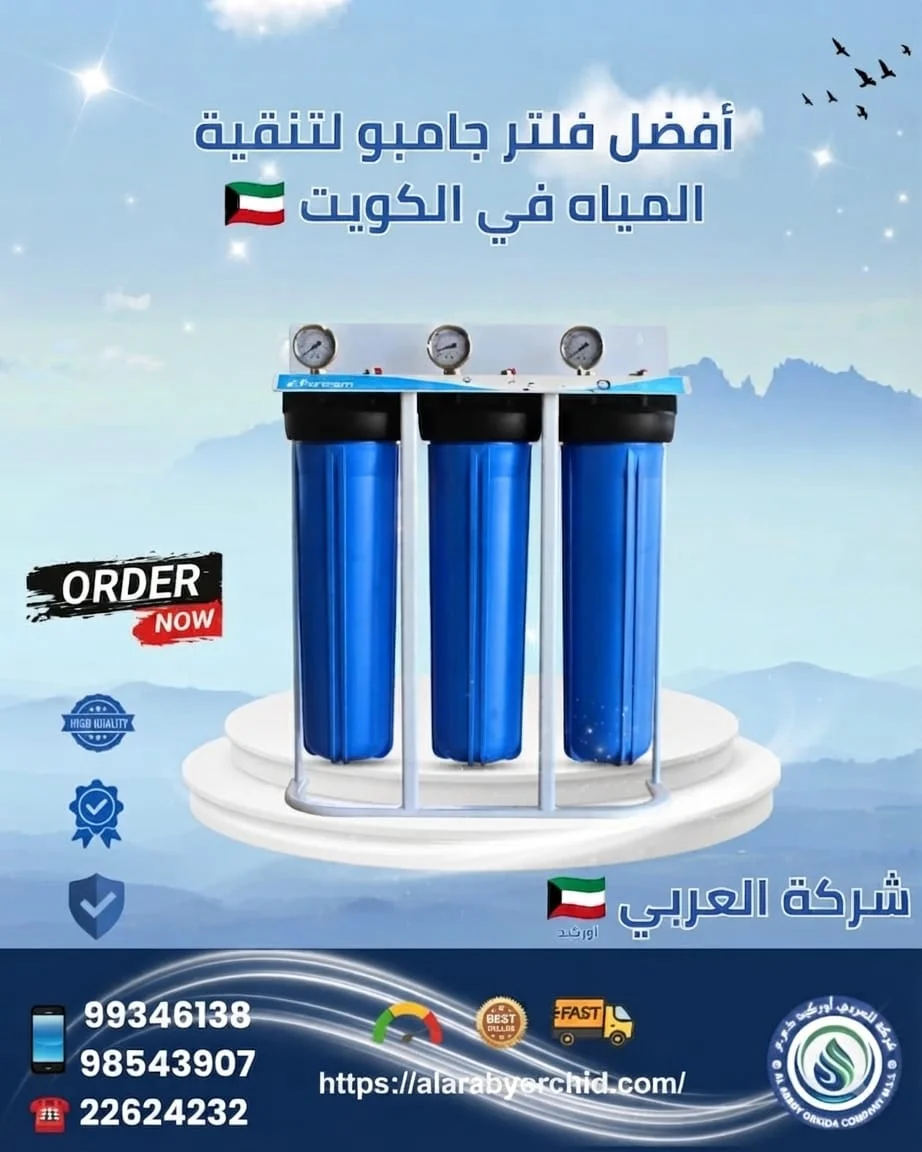
In Kuwait, an under-sink filter receiving relatively stable household water may behave very differently from a Jumbo or whole-house system handling the water consumption of an entire property. A small 10-inch under-sink cartridge should not automatically be compared with a larger main filtration stage.
Useful signs for reviewing the sediment cartridge include:
Reduced flow
Noticeable pressure difference before and after the filter when gauges are available
Heavy discoloration on a visible cartridge
Increased sediment in incoming water
Reaching the manufacturer’s time or capacity limit
However, it is not good maintenance to wait until water almost stops completely because forcing the rest of the system to operate with a heavily restricted first stage can create poor operating conditions downstream.
Al Arabi Orchid currently lists 3-stage filters, Jumbo filters, and replacement of cotton, carbon, and charcoal cartridges, so before replacement it is important to know whether the cartridge serves one drinking faucet or a larger household line because the water load is very different.
-
Sediment cartridges are directly affected by particle load so incoming water quality can move the replacement date much earlier
-
Reduced flow is one of the strongest practical signs of pore blockage but you should not wait until water almost stops completely
-
A cartridge serving the whole house should not automatically be compared with a small under-sink cartridge because the volume of treated water is completely different
-
Cartridge color can help when the filter is visible but it does not replace manufacturer instructions or rated capacity
-
Replacing the sediment stage at the proper time helps protect carbon and RO membrane stages from worse operating conditions
RO Cartridge Maintenance Schedule
The RO cartridge maintenance schedule should be written separately for every stage because a reverse-osmosis system is not “one filter cartridge.”
A typical system may include:
Sediment prefilter
Carbon prefilter
RO membrane
Post-carbon filter
Additional stages depending on system design
A common mistake is saying, “I replace the RO every year.” What exactly does that mean? Every stage? Only the membrane? The carbon? Those components need to be separated.
General guidance may suggest that some RO prefilters require replacement around 6 to 18 months, while some RO membranes may be around two years in certain systems. However, one specific membrane may have an estimated life of 18 months, while another manufacturer may list a particular RO membrane for 2 to 5 years. These examples prove that replacement timing depends on product design, water conditions, and operating environment rather than one universal rule.
The RO membrane in particular should not be replaced only because a calendar date arrives when the system manual allows performance-based evaluation. Useful checks may include:
Water production rate
Reduction or rejection performance specified for the system
Feed-water pressure
Condition of prefilters
Any persistent change in produced-water quality
At the same time, the membrane should not be kept in service indefinitely simply because the water still tastes acceptable.
Prefilters are important because they protect the membrane from loads they were designed to manage before water reaches the membrane. Neglecting a relatively inexpensive prefilter can shorten the life of a much more expensive RO component.
If your system model is unknown or it was assembled with generic cartridges without clear specifications, maintenance becomes much harder. At the next service visit, it is better to document the name and model of every stage and build a new maintenance schedule from accurate information instead of continuing to guess.
-
Give every RO stage its own maintenance interval because sediment carbon membrane and post-carbon do not share one service cycle
-
Real membrane lifespans ranging from around 18 months to 2 to5 years in different products show why the exact model is necessary before giving a replacement date
-
Replacing prefilters on time protects the RO membrane from sediment or substances that should be treated before reaching it
-
RO evaluation includes production performance and feed pressure rather than taste alone
-
If you do not know the membrane model photograph its label before requesting maintenance so an incorrect replacement is not installed
Frequency of Replacing Multi-Stage Filters
The frequency of replacing multi-stage filters should be based on the function of each stage rather than its stage number. The words “stage two” do not describe one fixed cartridge because one system may use GAC, another a carbon block, and another a completely different treatment media in the same position.
Replacement cartridges should not automatically be treated as universal simply because they fit inside the same housing. A small difference in size, sealing, or media can allow water to bypass the intended filtration path or deliver different performance from the original system design. Therefore, selecting the correct replacement is part of the replacement schedule itself.
If you have a 7-stage system, this does not mean you should automatically purchase a “7-cartridge set” at the same interval every time. The first two or three stages may need earlier review, while the RO membrane can remain in service much longer and mineral or alkaline stages may have their own separate instructions.
Replacing filters too often is not automatically an advantage when they have not reached the end of their service life because it increases maintenance cost without evidence. At the same time, delaying replacement beyond the rated service capacity just to save the cost of one cartridge can reduce the performance you purchased the system to provide.
A practical household system is:
Place a sticker on each housing or keep a record on your phone
Write the cartridge name
Installation date
Expected inspection date
Rated capacity if available
Reason for the previous replacement
After several maintenance cycles, you will have a schedule specific to your home. You may discover, for example, that your sediment stage genuinely needs earlier replacement because of local particle load while the carbon stage normally completes its expected service cycle.
This is one of the strongest ways to avoid random maintenance expenses because the technician does not need to start from zero at every visit.
-
Stage number does not determine lifespan because the function and filtration media are more important than the position inside the system
-
Do not automatically buy a complete replacement set simply because the housings look similar when individual stages may have different schedules
-
Recording the history of each cartridge creates a realistic maintenance schedule based on your own household water and consumption
-
Using an incorrect replacement cartridge can reduce performance even when it physically fits inside the filter housing
-
Replacing too early and delaying too long both increase cost in different ways so rated capacity performance and manufacturer instructions should guide the decision
Best Time to Replace Water Filter Cartridges
The best time to replace water filter cartridges is before certified or intended performance is lost, not after the filter is almost completely blocked. However, “before” does not mean replacing cartridges every month as a precaution.
Use four signals in this order:
First: Manufacturer instructions
If the product states 6 months, 2000 gallons, or another rated capacity, that is the starting point.
Second: Actual household consumption
If you reach the rated water capacity before reaching the stated number of months, you should not wait for the calendar date.
Third: Performance
Reduced flow, returning targeted taste or odor, or another abnormal performance change should trigger inspection.
Fourth: Incoming water conditions
If sediment levels rise or feed-water quality changes noticeably, the service cycle may become shorter.
Regular replacement is important because a filter should be maintained according to its rated service cycle if it is expected to continue delivering the performance claimed for the product.
I would not advise a customer to wait until “month six” if flow has already collapsed in month four, and I would not advise changing a carbon cartridge in month three only because someone online says all filters need replacement every three months. The decision should be based on evidence.
The replacement procedure itself is also part of maintenance. Proper service may include:
Cleaning the housing according to system instructions
Checking the O-ring
Installing the correct cartridge
Confirming direction on inline filters
Performing the required flushing procedure
Checking for leaks
Some under-sink carbon systems specifically require flushing after replacement to remove fine carbon particles. This shows that choosing the right replacement date alone is not enough if the new cartridge is not installed and commissioned correctly afterward.
Al Arabi Orchid currently provides water-filter maintenance and replacement of cotton, carbon, and charcoal cartridges in Kuwait. For evaluation, contact 99346138 and preferably have a photo of the system, last maintenance date, and cartridge information instead of requesting a “complete replacement” without inspection.
-
The best time is when the cartridge reaches its rated service cycle or capacity or when performance provides a justified reason for earlier replacement according to product instructions
-
Do not wait for complete blockage just to save the price of one cartridge because delayed maintenance can affect later filtration stages
-
Do not replace healthy stages simply because one cartridge has reached the end of its life unless the system instructions require grouped replacement
-
Perform the required flushing and leak checks after installation because a new cartridge cannot deliver correct performance if maintenance is incomplete
-
Contact 99346138 and ask for identification of the stages that have actually reached their service limit instead of purchasing a complete set by guesswork
Conclusion
The answer to how often water filter cartridges need to be replaced comes down to one simple principle: the exact model, rated capacity, incoming water quality, and household consumption matter more than a fixed number of months.
Water filters have different service cycles from one product to another. Some systems specify life by months, others by water volume, and proper performance requires following the actual product instructions and rated capacity.
If you only want approximate ranges to understand the idea, general manufacturer guidance may mention 6 to 12 months for certain carbon filters, 6 to 9 months for some residential sediment filters, and 6 to 18 months for certain RO prefilters. However, water quality and consumption can change those intervals significantly.
More importantly, even RO membranes do not have one universal replacement date. One specific product may be rated around 18 months, while another membrane from a different system may have an estimated life of 2 to 5 years. Therefore, any statement that “every RO membrane must be replaced exactly every two years” ignores real product differences.
Sediment filters should be evaluated through flow, particle load, rated service life, and the product instructions. Carbon should be evaluated through its rated capacity and may also show signs such as returning taste or odor. RO stages should each have their own maintenance record.
Al Arabi Orchid currently advertises water-filter installation and maintenance together with cotton, carbon, and charcoal cartridge replacement throughout Kuwait. If you do not know the correct schedule for your filter, contact 99346138 and provide:
A photo of the system
Number of stages
Names or photos of the cartridges
Date of the last replacement
Whether flow has decreased
Whether taste or odor has changed
A maintenance schedule can then be created specifically for your filtration system instead of using a general rule that makes you replace cartridges that still have useful life or leave exhausted stages in service too long.
Frequently Asked Questions
How often should water filter cartridges be replaced?
There is no single replacement date for every cartridge. Each filtration stage has a different service cycle and rated capacity, so the correct decision depends on the cartridge model, manufacturer instructions, household consumption, and incoming water quality.
Do I have to replace filter cartridges every 3 months?
Not as a general rule. Some products may require shorter intervals depending on their application, but many residential products have longer service ranges such as 6 to 12 months. Follow the specifications of the cartridge actually installed in your system instead of one general number.
How often should a carbon filter cartridge be replaced?
It depends on the product. Some carbon cartridges may be specified around 6 months while others may have a 6-to-12-month range. Product number and rated capacity are more important than simply knowing that it is “carbon.”
How do I know when a sediment cartridge needs replacement?
Important signs include reduced flow, heavy sediment accumulation, and reaching the rated service cycle. In some systems, a specific sediment prefilter may be recommended around every 6 to 9 months depending on actual particle load.
Should all cartridges in a 7-stage filter be changed together?
Not necessarily. Each stage can have a different service life, especially when the system includes sediment, carbon, an RO membrane, post-carbon, and additional mineral or alkaline stages.
How long does an RO membrane last?
It depends on the exact model, feed-water quality, and operation. Some specific products may have an estimated membrane life around 18 months, while other membranes may be listed for 2 to 5 years. There is no single replacement interval for every RO membrane.
Does weak water flow mean I should replace every cartridge?
No. One blocked sediment stage may be the cause, or there may be another flow-related problem. The stage creating the restriction should be identified before replacing the complete set.
Does a change in water taste mean the carbon cartridge needs replacement?
It can be an indicator, especially when a taste or odor previously reduced by the carbon stage returns, but incoming water, installation, and other filtration stages should still be checked before making the final decision.
Can I use any replacement cartridge with the same size?
It is better not to. A replacement cartridge may appear to have the same dimensions but still differ in sealing, filtration media, capacity, or certified performance. Use the cartridge specified or approved for the exact filtration system.
How do I request a cartridge replacement schedule from Al Arabi Orchid?
Contact 99346138 and send a photo of the filter, number of stages, cartridge models, and date of the last replacement. Ask for an inspection of sediment, carbon, and RO stages separately according to each stage’s own service life and rated capacity instead of assigning one replacement date to the entire system.