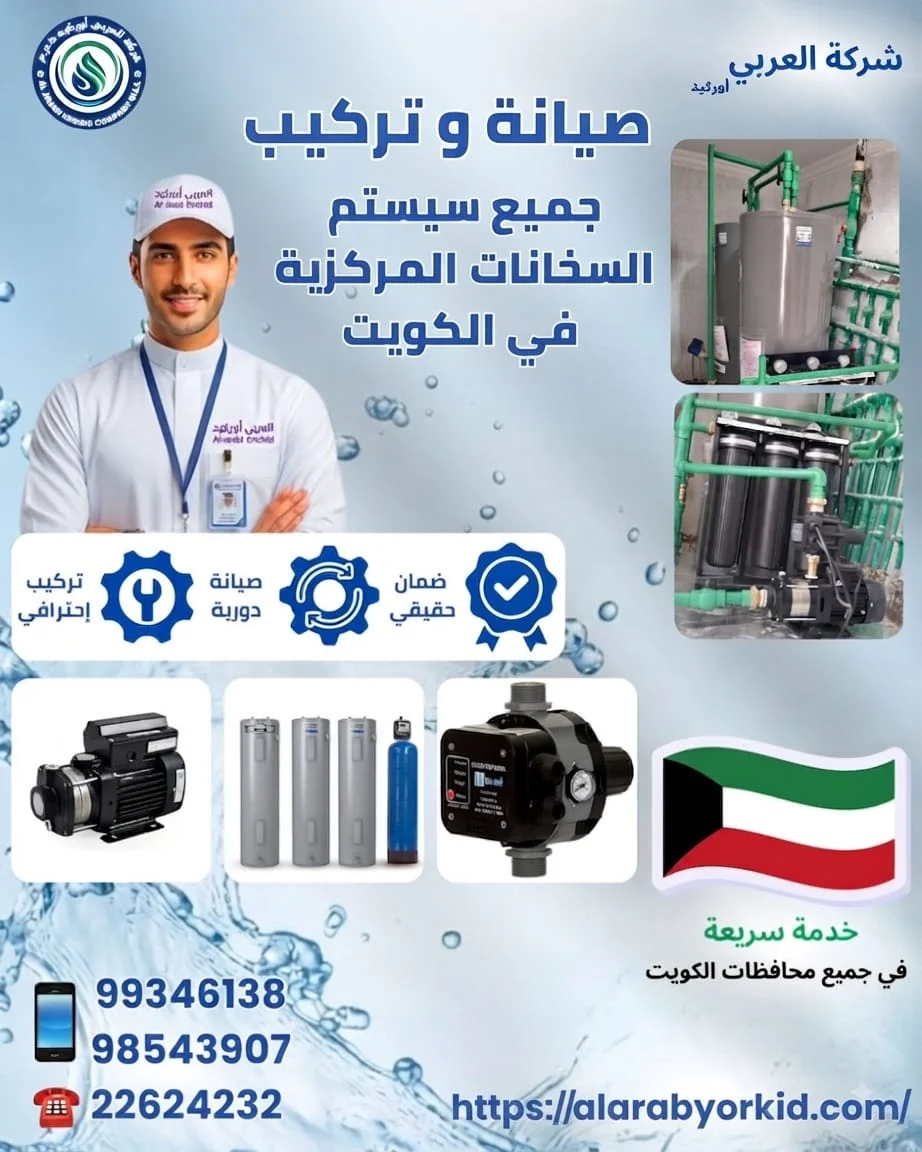
When a central water heater fails, the question is not simply, “How much will the repair cost and how much will a new heater cost?” The better comparison asks: How much will I pay today, and how much am I likely to spend over the next two or three years for reliable hot-water service? Sometimes replacing one heating element or thermostat in a structurally sound tank is far more economical than buying a new unit. In other cases, a cheap repair today can be followed by a second and third repair because the tank itself has already entered an advanced stage of deterioration. Even the price of a “new installation” needs to be broken down carefully. Does the quotation include only the heater, or removal of the old unit and installation of the new one, or a complete central system with a pump, filter, and piping network? Al Arabi Orchid currently advertises a complete central system starting from around KWD 650, which is completely different from replacing the heater tank alone.
Install a New Heater or Repair the Old One

The decision to install a new heater or repair the old one should begin with what can practically be called the “cost of restoring reliable service,” rather than simply choosing the lowest bill today. If the technician finds that only one heating element has failed while the tank itself has no structural leakage or serious corrosion and the heater was providing normal hot-water performance before the failure, then you have a limited component problem. Replacing an entire appliance because one serviceable part failed would not usually make financial sense.
The situation changes when the same heater has needed a heating element, then a thermostat, then a valve within a relatively short period, and later develops a leak or noticeable deterioration in the tank. Each repair may look affordable when viewed separately, but the combined amount can begin approaching the cost of a new heater that comes with a new warranty and a fresh service life.
Rheem’s guidance published in March 2026 identifies heater age, type of failure, repeated repair history, and the ratio between repair cost and replacement cost as important decision factors. As a general rule of thumb, Rheem suggests that when a repair approaches or exceeds roughly 50% of the cost of a new unit, replacement can often become the stronger investment. This should be treated as a general guideline rather than a strict rule, because Kuwait labor costs, installation requirements, and the condition of each individual heater can vary considerably.
Age alone should not decide the issue either. Conventional storage heaters are often associated with an approximate service-life range of 8 to 12 years, but an eight-year-old unit with a sound tank and one limited fault is not equivalent to another eight-year-old heater with corrosion, leakage, and repeated service visits.
A practical way to make the decision is to write down the current repair cost, then add the condition of the tank, likelihood of near-term failures, remaining warranty status, and whether the heater still suits current household demand. If the repair restores a suitable and dependable appliance, repairing can be the better option. If the repair only “keeps it going for a while,” replacement deserves serious consideration.
-
Repair usually makes more financial sense when the fault is limited to a replaceable component while the tank body main connections and overall heater condition remain healthy
-
Replacement becomes financially stronger when small repairs start repeating because the comparison is no longer between one repair bill and one new heater but between a sequence of future expenses and a complete replacement
-
Do not rely on heater age alone because operating history tank condition and the type of failure are usually more meaningful than the number of years by itself
-
Use the ratio between repair cost and replacement cost as one decision tool rather than an automatic rule because actual installation costs in Kuwait can differ significantly between properties
-
Before approving either option ask whether the repair addresses one isolated fault or whether the heater already has several deteriorating areas that are likely to create another expense soon
Cost of Installing a New Water Heater
The cost of installing a new water heater does not simply mean the price of the tank shown in an advertisement. You need to know exactly what is included in the quotation because a replacement project can involve purchasing the heater, disconnecting and removing the old unit, transporting it away, preparing or modifying the support base, reconnecting cold and hot water lines, installing safety components, making electrical changes, commissioning the new heater, and sometimes adjusting the recirculation loop or booster system.
The first cost is the heater itself, which varies according to brand, capacity, heating-element power, electrical configuration, and overall specifications. The second cost is removal of the existing unit. When the replacement heater is very similar in size, connection position, and electrical requirement, the work can be relatively straightforward. Moving to a substantially different capacity or physical design may require more plumbing and structural changes.
The third cost is electrical work. If the new heater requires a different heating input, voltage, or phase arrangement, the total project cost can increase because the breaker, cable size, panel connection, or supply may need modification. This is why choosing the “most powerful heater available” without checking the property’s electrical infrastructure can turn a heater purchase into an additional electrical project.
The fourth cost involves the safety and operating components around the heater. The T&P relief valve, discharge line, shutoff valves, check valves, fittings, and connections should be reviewed according to the requirements of the new heater and the plumbing system rather than simply copied from the old installation.
It is also important to distinguish between a new heater and a complete central hot-water system. Al Arabi Orchid currently advertises a complete central system starting from approximately KWD 650, including an American heater, Grundfos pump, filter, pipe network, galvanized base, and check valves, while a smart central system is advertised from around KWD 800. These are complete-system prices and should not be treated as the price of replacing one heater tank.
-
Ask for an itemized quotation that separates the heater price removal installation fittings and any modifications so you understand exactly why one offer costs more than another
-
If the new heater requires different electrical power calculate the cost of upgrading the circuit before purchasing because the appliance price alone does not represent the complete project
-
Moving to a larger capacity can require more floor space a stronger base and plumbing changes so the larger heater should not be compared with the old unit without including the installation work
-
Do not compare the price of a complete central system with the cost of repairing one heater because the complete package may include a pump filter piping and other work unrelated to the current fault
-
The best quotation is not automatically the cheapest one but the one that clearly identifies the model capacity installation scope warranty and any additional work before the project begins
Cost of Repairing an Old Water Heater

The cost of repairing an old water heater should be divided into three parts: the replacement component, labor, and the underlying condition that caused the failure. This distinction matters because replacing one part without correcting the reason it failed can lead to another repair bill shortly afterward.
As examples from Al Arabi Orchid’s currently advertised services, an original American heater element is listed at approximately KWD 13 including installation, an American heater thermostat is also listed at around KWD 13 including installation, and a safety valve is listed at around KWD 12 including installation. These are examples of very specific repair services, not fixed prices for every central water heater repair. They do not automatically include descaling, leakage repair, wiring work, or several simultaneous faults.
This is where accurate diagnosis becomes valuable. If one heating element has failed while the tank itself is healthy, a small component repair may be extremely inexpensive compared with replacement. However, if the element failed in a heater with heavy mineral buildup, a weak drain valve, and an old thermostat, comparing the decision only against the KWD 13 component price would be misleading. All required work should be added together.
Leakage also needs to be categorized correctly. A leak from an external fitting or replaceable valve may be a limited repair, while water escaping from the tank body or bottom due to internal corrosion is a much more serious condition. When the actual storage vessel has deteriorated, replacing external parts does not solve the structural problem.
Older heaters can also reveal additional issues once work begins. Connections can be seized, valves may be deteriorated, and fittings may be weaker than they look from the outside. For that reason, the most reliable repair price is normally established after inspection, not from a phone description such as “the heater is not heating.”
-
The price of one heating element or thermostat does not represent the complete repair cost when sediment leakage wiring or another related fault is also present
-
A low-cost repair can be an excellent financial decision when the fault is isolated and the tank remains healthy because service can be restored without replacing an otherwise usable appliance
-
Leakage from an external fitting should not be priced or treated the same as corrosion through the storage tank because the technical seriousness of the two conditions is completely different
-
Ask the technician to separate replacement-part costs from additional service work so you can see whether the total price comes from one fault or several accumulated problems
-
After diagnosis calculate the full amount required today instead of approving the first component replacement and later discovering that two additional repairs are also necessary
Comparing Water Heater Repair and Replacement
Comparing water heater repair and replacement becomes much clearer when both options are evaluated over the same time period. One option is to repair the heater today and continue operating the existing unit. The second option is to replace it today and begin again with a new appliance and a new warranty. The meaningful comparison should then cover the next 24 or 36 months rather than only the amount paid on the first day.
Consider the first situation: a moderately aged heater has a healthy tank, suits the household, and only has a failed thermostat. Repair will usually win financially because the problem is limited and the component and labor cost are small compared with buying a complete new appliance.
The second situation is very different: an older heater has already been repaired several times and now leaks from the actual tank body. Even if one symptom could temporarily be managed, the storage vessel itself has become the weak point. In this case, continuing to spend money on surrounding components becomes increasingly difficult to justify.
The third situation is more complicated. The tank is not leaking, but performance has declined, the heater is old, and the current repair is moderately expensive. Here it helps to calculate the cost of the coming period. If the repair today costs X and there is a realistic likelihood of paying Y and Z for additional faults during the next two years, add those amounts together and compare them with the complete replacement cost, while also considering the value of a new warranty and reduced likelihood of recurring service visits.
Capacity should also be included. If the old heater was already undersized for the family, repairing it returns a functioning appliance but does not correct the original comfort problem. Replacement may solve both the mechanical failure and the sizing problem at the same time.
-
Compare repair and replacement over the same future period because the long-term decision depends on expected repairs warranty and reliability rather than only the first payment
-
A small replaceable component failure in a healthy tank is financially very different from a leaking tank body even though both problems may interrupt hot water on the same day
-
If the heater remains undersized or unsuitable after repair part of the money spent restores equipment that still does not meet the household requirement
-
Include service downtime and repeated technician visits in the comparison especially in a property that depends on one central heater for all bathrooms
-
The strongest financial choice is the option that provides the lowest reasonable cost for a reliable period of service rather than simply the lowest number on today’s invoice
When Is Buying a New Water Heater More Economical?

When is buying a new water heater more economical? The first situation is when the current repair becomes a large percentage of the cost of a suitable replacement. Rheem uses a general guideline suggesting that when repair cost exceeds roughly 50% of the price of a new unit, replacement often becomes the stronger option, particularly when the existing heater is already older. Again, this is a broad decision guideline rather than a fixed rule for the Kuwait market.
The second situation is repeated repairs. If you have paid for three separate repairs within one year, the next question should not be only, “Is the fourth repair inexpensive?” The better question is, “How much money has this heater required, and am I buying only a few more months of operation each time?” Previous costs are already spent, but they still reveal the equipment’s reliability pattern.
The third situation is when the warranty has expired and several signs of deterioration appear together, such as visible corrosion, discolored water, loud operating noises, leakage, and a clear decline in hot-water performance. A combination of several symptoms has more significance than one minor fault by itself.
The fourth situation is when the new heater solves another existing problem. For example, if the household has grown and the existing heater is now too small, replacement with a correctly sized model provides additional value because it not only eliminates the fault but also corrects the capacity problem.
The fifth situation is the value of a new warranty. Al Arabi Orchid currently advertises six years of tank coverage and two years on heating elements for selected American heater offerings. When comparing an old out-of-warranty heater with a new replacement, that warranty has financial value because some future repair risk is transferred away from the customer during the coverage period, provided the exact terms are confirmed in writing for the purchased model.
-
A new heater becomes more economical when current repair cost approaches a significant portion of replacement cost and the existing unit also has high age or a repeated-failure history
-
Do not evaluate only the latest repair because the sequence of faults during the previous year or two provides a much stronger picture of the old heater’s future value
-
If replacement also corrects a capacity efficiency or electrical-compatibility problem those improvements should be included when comparing it with repair
-
A new warranty has real financial value because it reduces some of the customer’s exposure to early repair costs during the coverage period
-
Buying new is not automatically cheaper simply because the heater is new but it becomes more logical when keeping the old unit operating is expected to cost more or provide substantially less reliability
Repairing the Heater Versus Replacing It
In the comparison of repairing the heater versus replacing it, there is one cost many people forget: the cost of downtime. If one central heater supplies every bathroom in the property, each failure can mean waiting for a technician, inconvenience for the household, and sometimes temporary arrangements. These costs may not appear on the parts invoice, but they are part of the real ownership decision.
Repair has an important advantage: it usually creates less disturbance to the existing system. When the heater capacity is still appropriate and the surrounding plumbing and electrical work are in good condition, replacing one element or control can restore service without modifying piping, support bases, or electrical infrastructure. This can reduce both labor time and the risk of introducing new problems through unnecessary changes.
Replacement, by contrast, gives the owner a fresh starting point but requires a larger installation process. The old heater has to be isolated, drained, disconnected, and physically removed. The new unit must be positioned, connected, filled completely, air must be purged before electrical elements are energized, and all plumbing, temperature, leakage, and safety functions need to be tested. The replacement cost therefore includes a full installation process, not merely the price of a larger piece of equipment.
The availability of replacement parts also changes the calculation. An old or uncommon model may be theoretically repairable but practically expensive if the correct component is difficult to source. A widely supported model with readily available parts can remain economical to service for much longer.
Sometimes the best first step is neither “repair everything” nor “replace immediately.” A proper diagnostic inspection can produce two clear numbers—a complete repair price and a complete replacement price—before any major work begins. This avoids starting a repair and discovering halfway through that replacement would have been the stronger financial decision.
-
Include the inconvenience and duration of hot-water outages in the comparison because repeated failures cost the household time and disruption even when each repair bill is relatively small
-
Limited repair preserves an already stable plumbing system and can be ideal when the tank is suitable and no capacity or electrical changes are needed
-
Replacement requires a complete process from removal through commissioning so the appliance price should never be compared directly with the price of one spare part
-
Spare-part availability affects financial viability because a theoretically simple repair can become expensive if the correct component is rare or delayed
-
When the diagnosis is uncertain request a complete repair quotation and a complete replacement quotation before major work begins instead of making the decision gradually during the job
Cost of Replacing a Central Water Heater

The cost of replacing a central water heater is different from the cost of simply “buying a heater” because replacement is a project with a defined starting point and completion point. It begins with isolating electricity and water, draining and disconnecting the existing appliance, and safely removing a large heavy tank. It ends only when the new heater is installed correctly, filled, commissioned, checked for leakage, and confirmed to deliver hot water normally to the property.
If the new heater is a similar replacement in capacity, dimensions, and electrical configuration, the work will generally be simpler than upgrading from 50 gallons to 80 or 120 gallons. Increasing capacity can affect the support base, installation space, pipe alignment, access path, and sometimes electrical supply.
This is also where the advertised KWD 650 complete-system starting price from Al Arabi Orchid needs to be interpreted correctly. The advertised package includes an American heater, Grundfos pump, filter, pipe network, galvanized base, and check valves. Therefore, if the customer only wants to replace one existing heater, KWD 650 should not be treated as the mandatory replacement price. A separate quotation should be requested for the heater and the exact work required at the property.
A replacement project can also be an opportunity to correct old installation weaknesses. An unsuitable support base, incorrect safety-valve arrangement, poor discharge line, or disorganized piping should not simply be transferred to the new heater. Correcting those issues can increase today’s installation cost but prevent the same problems from affecting the new appliance.
Warranty also belongs in the replacement calculation. Al Arabi Orchid currently advertises six years on the American heater tank and two years on heating elements for selected offers. The written warranty supplied with the exact brand and model should be used when calculating the value of replacement.
-
Replacing a heater with another unit of similar capacity and electrical demand is usually simpler than making a major capacity upgrade so identify whether the project is a like-for-like replacement or a full upgrade
-
The advertised price of a complete central system does not represent the price of one heater because the package includes additional components with their own cost and value
-
Any existing weakness in the support base valves discharge arrangement or piping should be included in the replacement quotation so a new heater is not installed on top of the same old problem
-
Removal and disposal of the old heater are part of the project cost particularly with large tanks that require safe handling and a suitable exit route
-
Request a final site-specific quotation before purchasing because real replacement cost depends on both the selected model and the preparation work required at the property
Should I Repair My Old Water Heater?
The question should I repair my old water heater becomes easier to answer if the appliance is given a practical “repairability score” rather than judging it by age alone. The first factor is the tank itself. If there is no structural leakage or serious corrosion, you still have a sound foundation that may justify component repair. If the actual storage vessel is leaking, the value of replacing surrounding components falls sharply because the main vessel can no longer be considered dependable.
The second factor is the type of failure. Heating elements, thermostats, safety valves, and other replaceable components are different from structural tank deterioration. Component repair can be very sensible in a unit with a healthy tank, while leakage through the tank body usually points much more strongly toward replacement.
The third factor is whether the heater is still suitable today. A heater installed years ago for a three-person household may now be serving six people. Even if every mechanical fault is corrected, the unit may still provide less hot water than the household requires. Repairing it restores mechanical operation but does not correct an outdated sizing decision.
The fourth factor is recent spending history. Write down the last two years of service visits. How much was spent? What was replaced? Were the failures related? A first serious repair after many years is much more reassuring than a heater that requires attention every few months.
The fifth factor is parts and technical support. A well-known model with correct parts and service information available gives greater confidence in repair than an unknown unit that has repeatedly received non-matching replacement parts.
-
Repair the old heater when the tank is healthy the fault is limited and the unit still suits household demand because this is the strongest financial case in favor of repair
-
Do not make age the only reason for disposal because an older heater in good condition can still be a better financial choice than unnecessary replacement
-
If the tank body itself is leaking consider replacement seriously because changing a thermostat or element cannot repair deterioration of the main storage vessel
-
Review expenses over the previous two years so you can distinguish normal maintenance from a heater that has entered a repeating failure cycle
-
Confirm that the correct replacement part is available because a cheap repair using an incorrect component can reduce performance and create another expense soon afterward
Decision to Buy a New Central Water Heater
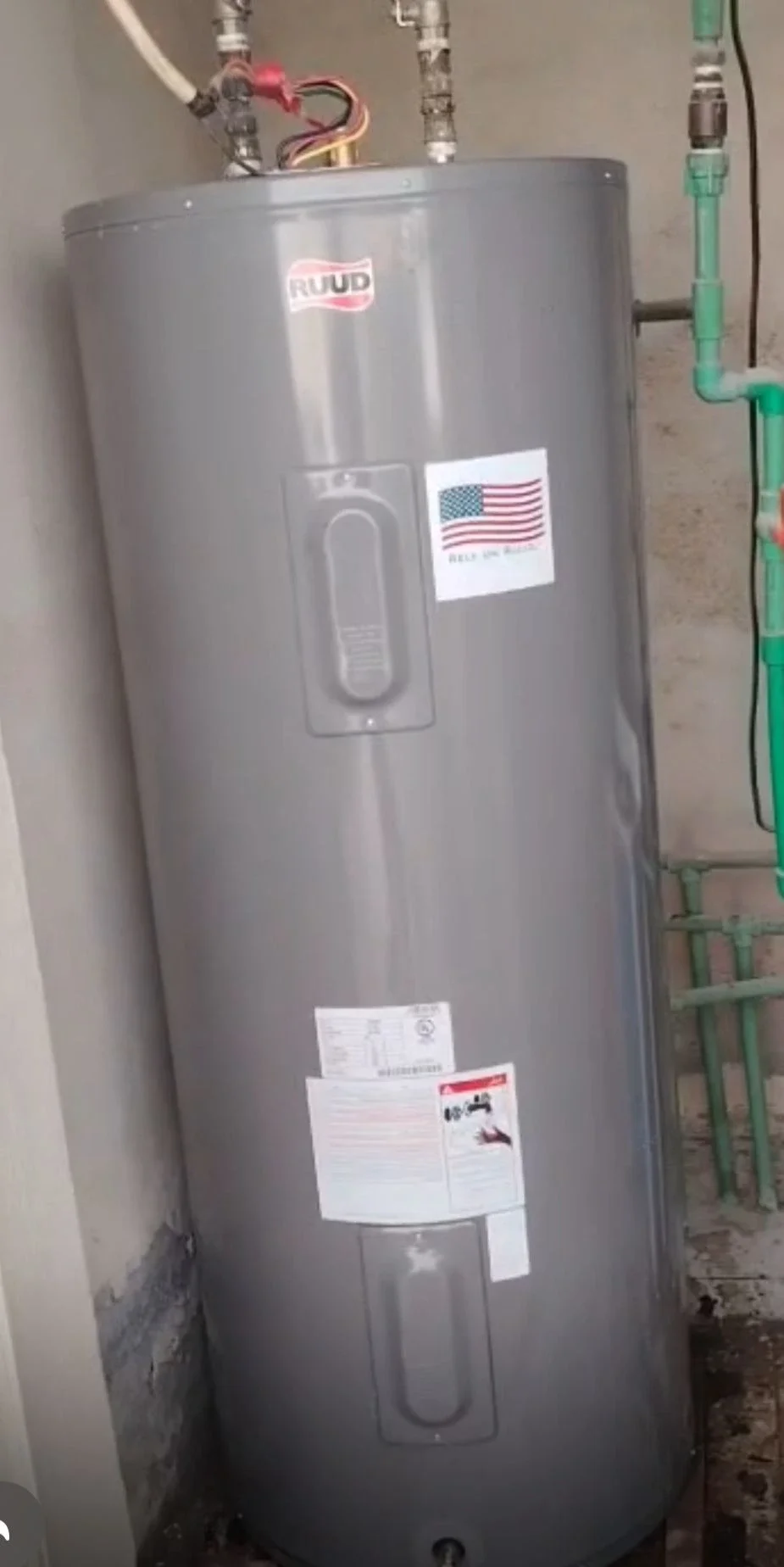
The decision to buy a new central water heater should not simply be an attempt to escape the current failure. If you are already investing in a new appliance, use the opportunity to correct everything that was unsuitable about the previous system.
Begin with capacity. Did the old heater provide enough hot water during peak demand, or did the household regularly run out? If it was undersized, do not automatically purchase the same gallon capacity simply out of habit.
Next, review electrical requirements. A new heater with the same nominal gallon capacity can have a different heating input or electrical configuration. Ask for the rated voltage, phase, and heating-element power, then confirm that these specifications match the property before payment.
Third, review the installation area. Was the old heater tightly packed into a location where maintenance was difficult? Choose dimensions that allow access to the elements, thermostats, valves, and service points instead of repeating the same installation problem.
Fourth, confirm warranty coverage. Ask for tank, element, and labor coverage in writing where applicable. Al Arabi Orchid currently advertises American central heaters from Ruud, Bradford White, A. O. Smith, American, Rheem, and Richmond in capacities including 50, 65, 80, and 120 gallons, with selected offers listing six years on the tank and two years on heating elements.
Fifth, calculate total ownership cost, not just purchase price. A slightly cheaper heater that is undersized, difficult to maintain, or poorly matched to the property can become more expensive over time.
Finally, if the home also has pressure, filtration, or recirculation problems, ask for separate prices for “heater replacement only” and “complete system improvement.” The house may not need a full upgrade, but if additional work is already necessary, completing it at the same time may sometimes be more economical than doing it in several separate projects.
-
Do not automatically repeat the capacity of the old heater before confirming that it actually met current household demand comfortably
-
Review the electrical system before approving the new model because a successful purchase begins with compatibility rather than brand popularity
-
Use replacement as an opportunity to improve maintenance access instead of installing the new heater in the same inconvenient arrangement as the old one
-
Obtain the warranty in writing for the exact model being delivered because warranty value is an important part of the reason for paying for a new appliance
-
Compare heater-only replacement with a broader system upgrade when other problems exist but do not buy a pump filter or piping package simply because it is available
Comparing Maintenance Cost and Purchase Cost
The most useful comparison between maintenance cost and purchase cost uses two columns and one future period, such as 24 or 36 months. Under the repair column, write down the current repair cost, all additional work required now, the likelihood of further repairs based on the condition of the heater, and any meaningful cost caused by repeated downtime. Under the new-heater column, include the appliance price, removal, installation, modifications, warranty, and any improvement in capacity or performance.
Consider a purely hypothetical example. A KWD 30 repair on a healthy heater with no recent failure history usually does not require a long financial debate against replacement costing several hundred dinars. However, a KWD 150 repair on an older unit that is likely to need another KWD 100 repair and has a deteriorating tank produces a very different calculation. These figures are only examples of the decision method, not current Kuwait market quotations.
Real published prices also show why the comparison scope matters. Al Arabi Orchid currently advertises some specific component services such as heating elements and thermostats at approximately KWD 13 installed and a safety valve at approximately KWD 12 installed, while a complete central-system package starts from around KWD 650. The large difference proves why you must compare the same scope of work: component against component, heater against heater, or complete system against complete system.
Warranty should also be assigned value. A new appliance with clear coverage can reduce some future repair exposure during the first years. At the same time, a very inexpensive repair can remain the smartest decision when the existing tank is structurally healthy and suitable for the household.
There is no single magic percentage. Even the 50% guideline used by Rheem should remain only one decision aid. The strongest conclusion comes from actual equipment condition, age, repair history, and the real site-specific replacement price.
-
Compare both options over one future period so you do not place a one-day repair expense against an appliance expected to serve for years and treat the two figures as financially equivalent
-
Use prices for the same scope of work because comparing the cost of one heating element with a complete central system creates a misleading conclusion even when both prices are accurate
-
Include warranty and reliability in the financial calculation because the value of a new heater is not only the tank itself but also reduced exposure to some near-term repair risks
-
When repair cost is low and the tank is healthy do not turn a percentage guideline into an excuse for unnecessary replacement while repeated failures should trigger a serious financial review
-
Contact Al Arabi Orchid on 99346138 and request a complete repair quotation and a clearly defined replacement quotation for the same property so the decision is based on two genuinely comparable figures
Conclusion
Should you install a new central water heater or repair the old one? The financial answer does not come from heater age alone or from the price of the first replacement part. If the tank is healthy and the fault is limited to a heating element, thermostat, or safety valve, repair can be dramatically more economical. Al Arabi Orchid currently advertises some specific repair components with installation starting around KWD 12–13, which shows why it makes little financial sense to discard a sound tank because of one serviceable component.
However, when the tank body leaks, repairs repeatedly return, current repair cost becomes a large percentage of replacement cost, or the old capacity no longer meets household demand, a new heater can become a much more logical investment. The type of failure, age, repair history, and the ratio between repair and replacement cost all belong in the decision, with percentage rules used only as general guidance.
The advertised KWD 650 Al Arabi Orchid price should also not be interpreted as the cost of replacing every central heater. It is a starting price for a complete central-system package that includes a heater, pump, filter, pipe network, and additional components. If you only need the heater replaced, request a separate quotation for that specific scope.
Before deciding, contact Al Arabi Orchid on 99346138 and request a diagnosis that identifies the fault and evaluates tank condition, followed by a complete repair price and a complete replacement price. Then compare the two options over the next two or three years. This turns the decision into both a financial and technical comparison rather than simply choosing between “cheap today” and “expensive today.”
Frequently Asked Questions
Is repairing an old water heater always cheaper than buying a new one?
No. Repair is usually cheaper when the fault is limited, the tank is structurally healthy, and the heater does not have a repeated failure history. If repairs keep returning, the tank is leaking, or the current repair is expensive, replacement may cost less over the coming years.
What is the 50% rule for water heater repair?
Rheem uses a general rule of thumb suggesting that when a repair approaches or exceeds roughly half the price of a new unit, replacement often deserves stronger consideration, particularly with an older or frequently repaired heater. It is not a mandatory rule and should be applied to the actual replacement cost for your property.
Does a leaking heater always need replacement?
It depends on the source of the leak. A fitting or external valve can sometimes be repaired, but leakage through the tank body or bottom caused by internal corrosion usually points much more strongly toward replacement because the storage vessel itself has deteriorated.
How much does an American heater element repair cost?
Al Arabi Orchid currently advertises an original American heater element at approximately KWD 13 including installation, a thermostat at approximately KWD 13, and a safety valve at approximately KWD 12 including installation. These are prices for specific services and do not mean every heater repair will cost the same amount.
Is KWD 650 the cost of replacing a central water heater?
No. Al Arabi Orchid advertises a complete central system starting from approximately KWD 650, including an American heater, Grundfos pump, filter, pipe network, support base, and check valves. Replacing only the heater requires a separate quotation based on the model, capacity, and site conditions.
Is heater age alone enough to decide on replacement?
No. Conventional storage heaters are often associated with an approximate 8–12 year service-life range, but actual condition, type of failure, maintenance history, and tank integrity matter more than age alone. An older heater with a healthy tank can still justify a simple repair.
When is repairing the heater an excellent decision?
Repair is particularly attractive when the tank is healthy, the current capacity still suits household demand, the failure is limited to a replaceable component, the repair cost remains far below replacement cost, and there has not been a recent pattern of repeated failures.
What costs are included when installing a new water heater?
The total can include the heater itself, removal and disposal of the old unit, installation of the new heater, plumbing connections, safety valves, support-base modifications, electrical changes, and commissioning. A complete system package may also include a pump, filter, network piping, and additional components.
Is a new heater a better choice if the old one is undersized?
Replacement deserves much stronger consideration because a new properly sized heater can solve both the current mechanical fault and the original capacity problem. Repairing an undersized heater may restore operation while the complaint of insufficient hot water continues.
How do I compare repair and replacement with Al Arabi Orchid?
Contact 99346138 and provide the heater brand, capacity, approximate age, current fault, and previous repair history. Request a complete repair price after diagnosis and a separate heater-only replacement price, apart from any complete-system package. Then compare the expected cost, warranty, reliability, and likely expenses over the next 24–36 months before making the final decision.